The Von Restorff Effect: Making Your Meta Ad Stand Out in the Feed
Apply the Von Restorff effect to make your Meta Ad stand out in crowded feeds. Learn isolation strategies that boost recall by 70% and increase CTR significantly.
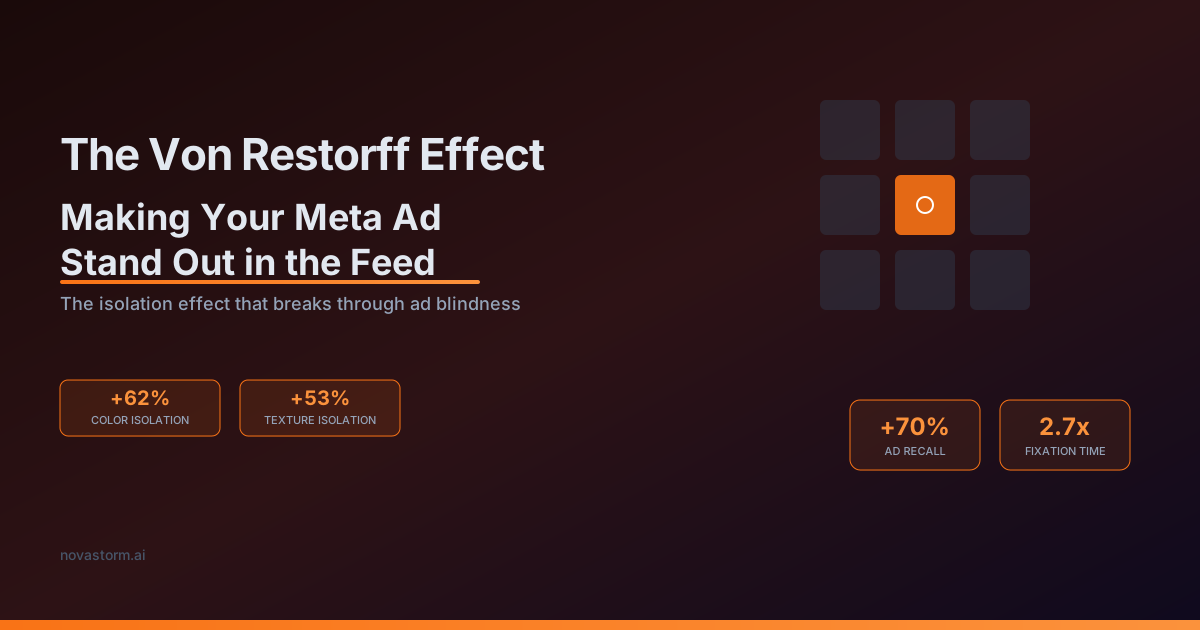
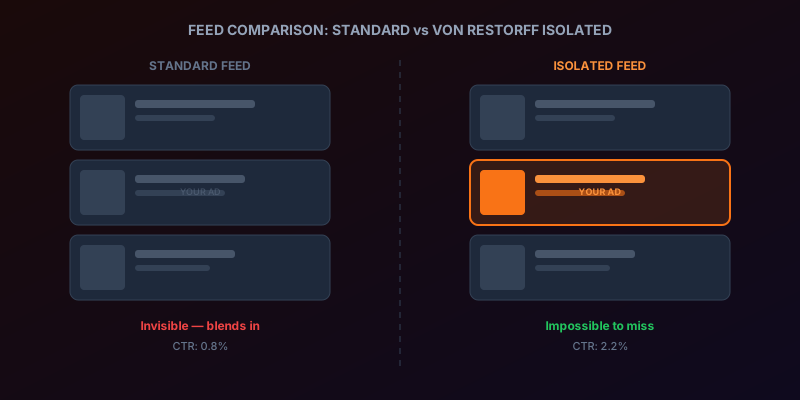
In a sea of polished product photos, lifestyle imagery, and branded carousels, the ads that get remembered are the ones that look nothing like anything else. This principle has a name: the Von Restorff effect. Also known as the isolation effect, it states that when multiple similar items are presented together, the one that differs most from the rest is most likely to be remembered. Applying the Von Restorff effect to your Meta Ad strategy can be the difference between being scrolled past and being clicked.
German psychiatrist Hedwig von Restorff documented this phenomenon in 1933. Her research showed that isolated items in a list — those that stood out by color, size, or type — were recalled at significantly higher rates than uniform items. Nearly a century later, this principle is more relevant than ever in the crowded Meta Ads feed.
Why Most Meta Ads Blend Into the Feed
The average Meta user sees between 6,000 and 10,000 ads per day across platforms. Most of these ads follow predictable patterns: product-on-white-background, smiling person using product, bold text overlay with a discount. When every advertiser follows the same creative best practices, those practices stop being best practices. They become camouflage.
The Von Restorff effect Meta Ad strategy works precisely because it breaks these patterns. Your ad does not need to be louder. It needs to be different. Difference is what triggers the brain's novelty detection system, which operates faster than conscious thought.
Eye-tracking studies show that visually distinct ads receive 2.7x more fixation time in the feed compared to ads that match the surrounding content style. This additional attention is the prerequisite for every other metric — clicks, conversions, and recall.
The Science Behind Visual Isolation in Advertising
The brain processes visual information in two stages. The first stage is pre-attentive processing, which happens automatically and without conscious effort. During this stage, the brain scans for anomalies — items that break the expected pattern. The Von Restorff effect operates at this pre-attentive level.
When your Meta Ad breaks the visual pattern of surrounding content, it triggers an orienting response. This is an involuntary shift of attention toward the novel stimulus. The viewer has not chosen to look at your ad — their brain has directed attention there automatically. This is the most powerful form of attention in advertising because it bypasses ad blindness.
| Isolation Dimension | Feed Pattern to Break | Standout Strategy | Recall Lift |
|---|---|---|---|
| Color | Blue/white dominant feed | High-contrast warm tones (orange, yellow) | +62% |
| Format | Static image majority | Stop-motion, cinemagraph, or text-only | +48% |
| Composition | Centered product shots | Extreme close-ups or vast negative space | +44% |
| Texture | Smooth, polished imagery | Hand-drawn, rough, or tactile elements | +53% |
| Motion | Smooth video transitions | Abrupt cuts, jump edits, or freeze frames | +70% |
Practical Strategies to Apply the Von Restorff Effect in Meta Ads
Implementing the Von Restorff effect Meta Ad approach requires systematic analysis of your competitive landscape. Before creating distinctive creative, you need to know what the default looks like. Audit 50-100 ads in your niche using Meta's Ad Library. Catalog the dominant colors, formats, compositions, and messaging styles.
Once you have mapped the patterns, deliberately break them. If competitors use polished photography, try illustrated or hand-drawn creative. If the feed is dominated by video, test a bold static image with arresting typography. If everyone uses cool blue tones, deploy warm oranges and reds.
- Audit 50+ competitor ads in Meta Ad Library for visual patterns
- Identify the 3 most common creative elements in your niche
- Design ads that deliberately contradict each pattern
- Test pattern-breaking creative against conventional creative
- Rotate isolation strategies every 2-3 weeks to maintain novelty
- Monitor frequency to ensure distinctiveness does not fade with repetition
Format-Level Isolation: Beyond Visual Design
The Von Restorff effect applies to more than just visual aesthetics. Ad format itself can be an isolation lever. When every competitor runs single-image ads, a carousel stands out. When carousels become the norm, a text-only post with a compelling hook breaks the pattern.
Stop wasting ad budget
NovaStorm AI cuts Meta Ads CPA by 40% on average. Start free.
Meta offers multiple ad formats, and each one creates a different visual footprint in the feed. The key is choosing the format that contrasts most with what surrounds it. This changes by platform, time of day, and audience — which is why continuous testing matters more than any single tactic.
| Ad Format | Best When Feed Is Dominated By | Isolation Strength |
|---|---|---|
| Text-only post (boosted) | Visual-heavy product ads | Very High |
| Single bold image | Video and carousel content | High |
| Carousel with consistent design system | Disconnected mixed content | Medium-High |
| Instant Experience | Standard link ads | High |
| UGC-style video | Polished brand content | Very High |
| Poll or interactive ad | Passive consumption content | High |
Copy Isolation: Making Your Message the Anomaly
Visual isolation gets the eye. Copy isolation gets the mind. When every ad in a category uses benefit-driven headlines, a question or a provocative statement stands out. When competitors lead with urgency, a calm and confident statement creates contrast.
The Von Restorff effect Meta Ad principle applies to tone, structure, and length. If every ad uses short, punchy copy, try a long-form narrative. If everyone screams with capitals and exclamation points, use lowercase and periods. The contrast creates cognitive interruption — and interruption is the first step to engagement.
Test a "whisper ad" against your current creative. Use minimal text, muted colors, and a quiet confidence in the copy. In a feed full of visual shouting, whispering can be the loudest thing in the room.
Measuring the Von Restorff Effect on Ad Performance
The primary metrics for isolation-driven creative are thumbstop rate (the percentage of impressions that result in at least a 1-second pause), ad recall lift, and click-through rate. These metrics directly measure whether your creative successfully broke through the feed noise.
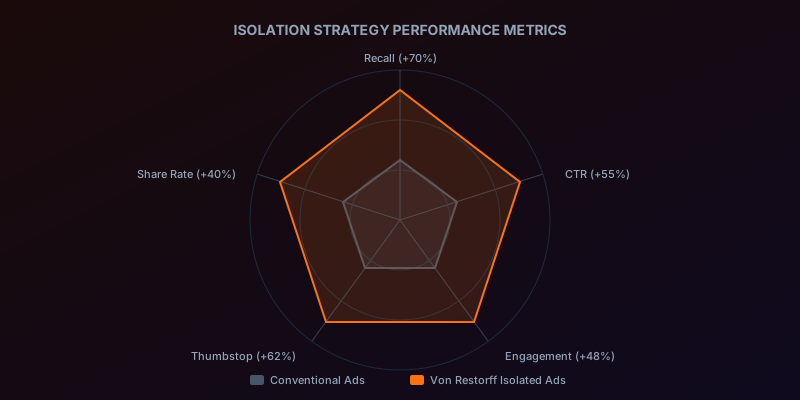
Set up A/B tests with strict creative isolation. Keep targeting, budget, and scheduling identical. Change only the creative approach — conventional versus isolation-optimized. Run each test for at least 7 days and 10,000 impressions per variant to achieve statistical significance.
The Novelty Decay Problem and How to Solve It
The Von Restorff effect has a built-in expiration date. Once your distinctive creative becomes familiar, it loses its isolation advantage. This is why creative fatigue hits pattern-breaking ads faster than conventional ones. What was novel yesterday becomes expected today.
The solution is systematic creative rotation with escalating differentiation. Start with one isolation dimension — color, for example. When performance declines, shift to a different dimension — format. Then composition. Then copy tone. By cycling through multiple isolation strategies, you maintain the Von Restorff effect Meta Ad advantage without repeating yourself.
- Monitor creative frequency — isolation loses power above 3.5 frequency
- Rotate isolation dimensions every 2-3 weeks
- Maintain a creative pipeline with 4-6 distinct isolation approaches
- Re-audit the competitive landscape monthly — the pattern you are breaking may shift
- Use DCO to test multiple isolation variants simultaneously
The Von Restorff effect is not about being weird for the sake of it. It is about understanding that attention is a competition, and the feed is the arena. Map the patterns, break them deliberately, measure the results, and rotate before novelty fades. In the Meta Ads ecosystem, the most dangerous creative is the one that looks like everything else.
Novastorm AI automates Meta Ads routine — from monitoring to optimization. Learn more at novastorm.ai
Disclaimer: This article was generated with the assistance of AI and reviewed by the NovaStorm AI team. While we strive for accuracy, we recommend verifying specific data points and consulting official sources (linked where available) for critical business decisions.
Ready to automate your Meta Ads?
NovaStorm AI takes full responsibility for your campaigns — from monitoring to optimization.
Get Started FreeRelated Articles
The Elaboration Likelihood Model in Meta Ad Persuasion
Learn how the Elaboration Likelihood Model shapes Meta ad persuasion through central and peripheral routes. Build ads that persuade at every engagement level.
Storytelling Arcs in Sequential Meta Ads: Three-Act Structure
Master the three-act structure for sequential Meta ads. Build storytelling arcs that guide prospects from awareness to conversion with narrative ad sequences.
The Contrast Effect in Meta Ad Creative: Standing Out in the Feed
Learn how the contrast effect in Meta ad creative helps your ads stand out in crowded feeds. Proven psychology-backed strategies for higher CTR and engagement.