The Contrast Effect in Meta Ad Creative: Standing Out in the Feed
Learn how the contrast effect in Meta ad creative helps your ads stand out in crowded feeds. Proven psychology-backed strategies for higher CTR and engagement.
Every second, thousands of posts compete for attention in your audience's Meta feed. Organic photos, friend updates, Reels, sponsored content — it all blurs together into a single stream of sameness. The brands that win are not necessarily the ones with the biggest budgets. They are the ones that understand a fundamental principle of human perception: the contrast effect in Meta ad creative.
The contrast effect is a cognitive bias where our perception of something changes based on what surrounds it. A gray square looks darker on a white background and lighter on a black background. The same principle applies to advertising. Your ad does not exist in isolation — it exists in the context of everything else in the feed. And that context is your greatest weapon.
Why the Contrast Effect Matters for Meta Advertisers
Meta's feed algorithm is designed to keep users scrolling. Content blends together by design — uniform card sizes, consistent spacing, predictable layouts. This creates what psychologists call perceptual habituation: the brain stops registering stimuli that match the expected pattern.
When you deploy the contrast effect in Meta ad creative, you deliberately break that pattern. You introduce a visual or conceptual element that the brain cannot ignore because it violates expectations. Research from the Journal of Consumer Psychology shows that ads leveraging contrast principles see 23-41% higher recall rates compared to ads that blend with surrounding content.
Key Insight: The contrast effect does not require louder or flashier creative. It requires creative that is strategically different from the surrounding feed context.
The Five Dimensions of Feed Contrast
Understanding the contrast effect in Meta ad creative requires analyzing the feed across multiple dimensions. Each dimension offers an opportunity to differentiate your ads from both organic content and competing advertisers.
| Contrast Dimension | Feed Default | High-Contrast Strategy | Expected Lift |
|---|---|---|---|
| Color | Warm, saturated tones | Cool monochromes or bold neons | +18-27% CTR |
| Composition | Centered subjects | Asymmetric or edge-weighted layouts | +12-20% engagement |
| Motion | Fast cuts, quick transitions | Slow motion or static frames | +15-22% view duration |
| Typography | Small, overlay text | Large, dominant type as focal point | +20-35% readability |
| Emotion | Positive, aspirational | Honest, vulnerable, or surprising | +25-40% comment rate |
Color Contrast: Breaking the Feed Palette
The average Meta feed skews toward warm colors — skin tones, sunsets, food photography, earth-toned interiors. This is not accidental. Instagram's filters trained an entire generation of content creators to favor warmth and saturation.
The contrast effect in Meta ad creative suggests going the opposite direction. Brands like Calm and Headspace dominate feed attention with cool blues and muted greens precisely because those colors are rare in organic content. Similarly, stark black-and-white photography creates an immediate pattern interrupt.
- Audit the top 20 posts in your target audience's feed to identify the dominant color palette
- Design your ad creative using colors from the opposite side of the color wheel
- Test monochromatic schemes against the feed's typical variety
- Use a single accent color to draw the eye to your CTA
- Avoid trending filter aesthetics — they guarantee you blend in
Structural Contrast: Layout as a Differentiator
Most Meta ad creatives follow a predictable structure: product image or lifestyle shot, headline overlay, logo in the corner. This layout is so common that users have developed banner blindness specifically for it. Their eyes skip right past anything that matches this template.
Structural contrast means rethinking the fundamental layout of your ad. Consider text-only ads in a feed full of imagery. Consider extreme close-ups when competitors use wide shots. Consider negative space when everyone else fills every pixel.
Stop wasting ad budget
NovaStorm AI cuts Meta Ads CPA by 40% on average. Start free.
The Whitespace Paradox
One of the most counterintuitive applications of the contrast effect in Meta ad creative is generous whitespace. In a feed crammed with visual information, an ad that is 70% empty space feels almost shocking. Apple has used this technique for decades, and it works just as well in social media advertising. A single product on a clean background with minimal text can outperform a visually complex creative by 2-3x on click-through rate.
Temporal Contrast: Pacing Against the Feed
Video ads introduce a time-based dimension to the contrast effect. The average Reel or Story moves quickly — fast cuts, rapid transitions, energetic music. This pace has become the norm, and norms are exactly what contrast exploits.
Slow-paced video ads create a jarring interruption in the scroll. A single, lingering shot. A long pause before the text appears. Silence instead of music. These techniques leverage temporal contrast to force attention. Data from Meta's own Creative Shop shows that ads with an unexpected pacing change in the first three seconds see 34% higher completion rates.
| Pacing Strategy | Best For | Hook Window |
|---|---|---|
| Slow open, fast close | Product launches, reveals | 0-2 seconds |
| Fast open, slow close | Emotional narratives, testimonials | 0-1 second |
| Consistent slow pace | Premium/luxury positioning | 0-3 seconds |
| Rhythm breaks | Retention and rewatch | Every 3-5 seconds |
Measuring Contrast Effectiveness
Applying the contrast effect in Meta ad creative is not a guessing game. You need a systematic approach to measure whether your creative actually stands out or simply feels different to you as the designer.
- Run a feed simulation test: place your ad between 10 organic posts and ask five people which they notice first
- Track thumb-stop rate (3-second video views / impressions) as your primary contrast metric
- Compare CTR against category benchmarks, not just your own historical performance
- A/B test high-contrast vs. standard creative with identical copy and offers
- Monitor frequency decay — high-contrast ads maintain performance longer before fatigue
Common Mistakes When Applying Contrast
The contrast effect is powerful, but it has limits. Contrast for its own sake — neon colors, bizarre imagery, shock tactics — can generate attention without generating results. The goal is not to be noticed. The goal is to be noticed by the right people and remembered for the right reasons.
Warning: Contrast that contradicts your brand identity creates cognitive dissonance. A luxury brand using meme-style creative may get clicks, but it erodes positioning. Always contrast against the feed, never against your own brand.
Another common mistake is applying contrast uniformly. If every ad in your account uses the same high-contrast style, you create a new pattern — and patterns are exactly what the brain learns to ignore. Rotate your contrast strategies just as you rotate your messaging.
The most effective Meta advertisers treat contrast as a dynamic, data-driven practice. They monitor what competitors and organic content look like this month, this week, even today — and they design creative that deliberately diverges. That level of real-time creative intelligence is where automation becomes essential.
When you understand the contrast effect in Meta ad creative, you stop competing on budget alone. You start competing on perception — and perception is where small brands can outmaneuver the giants.
Novastorm AI automates Meta Ads routine — from monitoring to optimization. Learn more at novastorm.ai
Disclaimer: This article was generated with the assistance of AI and reviewed by the NovaStorm AI team. While we strive for accuracy, we recommend verifying specific data points and consulting official sources (linked where available) for critical business decisions.
Ready to automate your Meta Ads?
NovaStorm AI takes full responsibility for your campaigns — from monitoring to optimization.
Get Started FreeRelated Articles
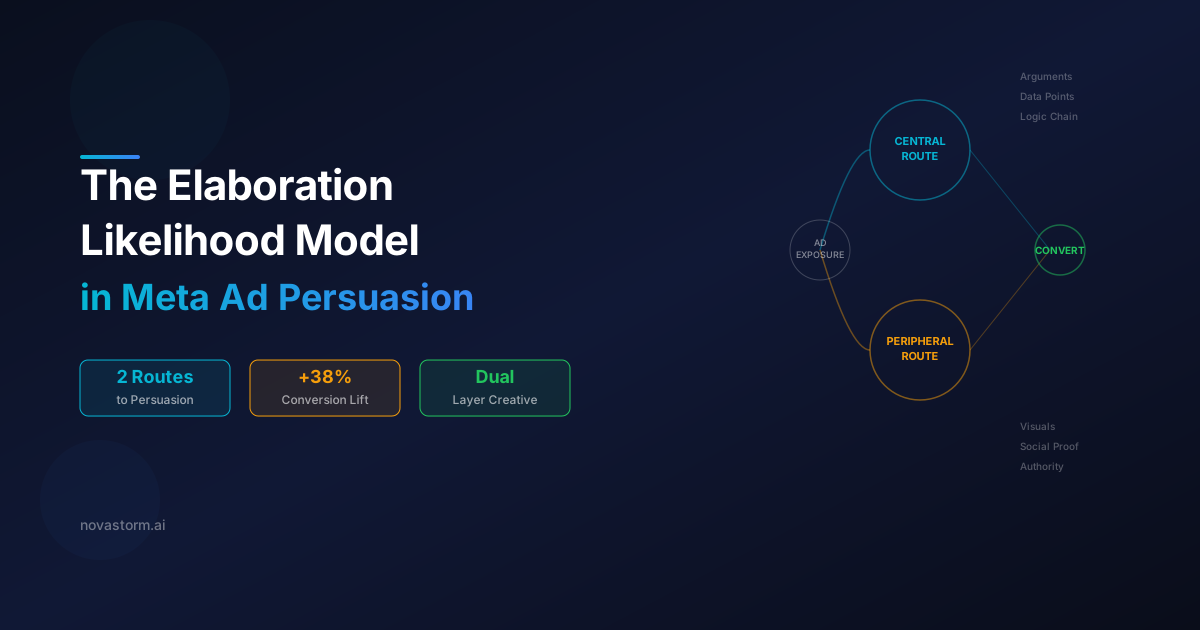
The Elaboration Likelihood Model in Meta Ad Persuasion
Learn how the Elaboration Likelihood Model shapes Meta ad persuasion through central and peripheral routes. Build ads that persuade at every engagement level.
The Pratfall Effect: How Showing Flaws Builds Trust in Meta Ads
Discover the pratfall effect in Meta ads — how strategically showing flaws builds trust and boosts conversions. Psychology-driven advertising that works.
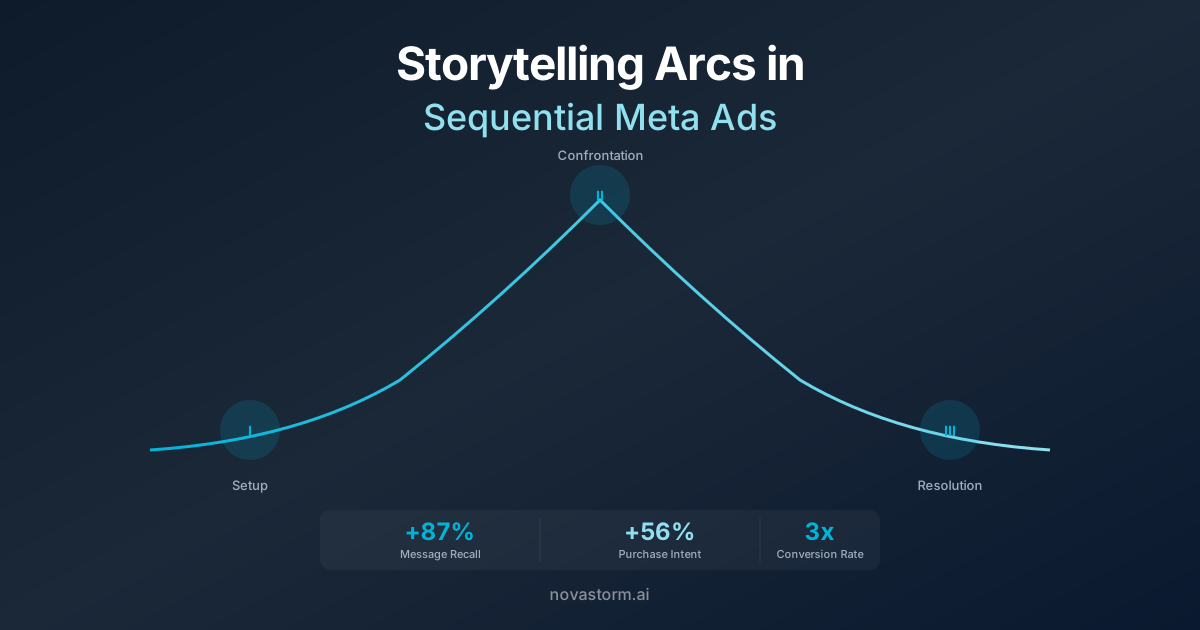
Storytelling Arcs in Sequential Meta Ads: Three-Act Structure
Master the three-act structure for sequential Meta ads. Build storytelling arcs that guide prospects from awareness to conversion with narrative ad sequences.