Social Proof in Ads: How Reviews and Testimonials Boost Meta Ad Performance
Learn how social proof in ads like reviews, testimonials, and trust signals can dramatically improve your Meta ad click-through rates and conversions.
Social proof in ads is one of the most powerful psychological levers available to advertisers. When potential customers see that others have already purchased, reviewed, or endorsed a product, their resistance drops significantly. In Meta advertising specifically, social proof elements like star ratings, testimonial quotes, and user-generated content can transform mediocre campaigns into high-performing ones. This article explores exactly how to leverage every form of social proof to improve your Meta ad results.
What types of social proof work best in Meta ads?
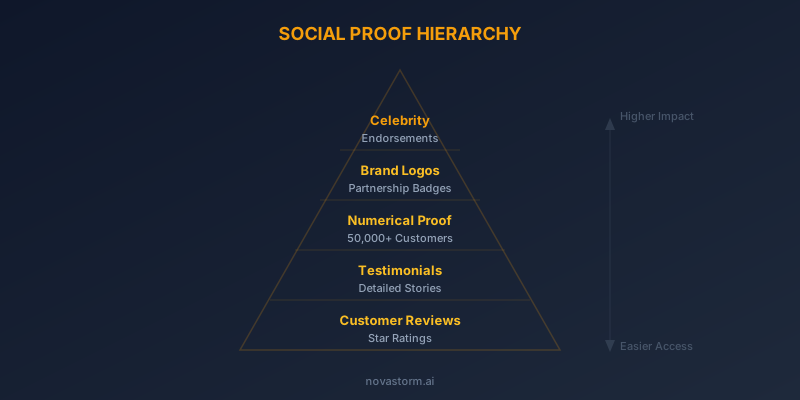
Not all social proof is created equal. The effectiveness of each type depends on your audience, product, and where the prospect sits in their buying journey. Understanding the hierarchy helps you prioritize which elements to test first.
Customer reviews are the most accessible form of social proof. A simple star rating overlay on your ad image immediately communicates quality. Testimonials go deeper, offering specific stories that prospects can relate to. Numerical proof, such as "50,000+ customers served" or "4.8 out of 5 stars," provides quick credibility without requiring the viewer to read a full review.
Brand logos and partnership badges work exceptionally well in B2B contexts. When a prospect sees that recognizable companies already use your product, the implied endorsement reduces perceived risk. Celebrity or influencer endorsements occupy the top tier but carry higher costs and potential authenticity concerns.
How to place social proof elements in ad creative
Placement matters as much as the proof itself. The most effective position for a star rating is the top-left corner of your ad image, where eyes naturally land first. Testimonial quotes work best as the primary text above the image, formatted with quotation marks and attribution.
For carousel ads, dedicate one card entirely to social proof. This card often performs best in the second or third position, after the initial hook has captured attention. In video ads, place a brief testimonial clip within the first five seconds or use a lower-third overlay showing ratings throughout.
Avoid cluttering a single ad with multiple types of social proof. One strong signal is more effective than three weak ones competing for attention. Choose the most relevant proof type for each specific ad and let it breathe.
How do star ratings in ad images affect click-through rates?
Star ratings are visual shorthand that the brain processes almost instantly. Research consistently shows that displaying star ratings in ad imagery can increase click-through rates by 15 to 30 percent compared to identical ads without them. The effect is strongest when the rating is between 4.2 and 4.8 stars.
Interestingly, a perfect 5.0 rating can actually reduce trust. Consumers have learned to be skeptical of perfection, and a slightly imperfect score feels more authentic. When designing your star rating overlay, keep the design clean and legible even at small sizes. Yellow or gold stars on a dark background create maximum contrast and recognition.
| Star Rating Range | Trust Level | Recommended Use |
|---|---|---|
| 4.7 - 4.9 | Highest trust | Primary hero images, headlines |
| 4.3 - 4.6 | High trust | Supporting creative, carousel cards |
| 4.0 - 4.2 | Moderate trust | Use with additional context |
| Below 4.0 | Low trust | Do not display in ads |
Why video testimonials outperform text reviews in Meta ads
Video testimonials combine multiple trust signals simultaneously. The viewer sees a real person, hears their genuine tone of voice, reads their body language, and absorbs their specific experience. This multi-sensory proof is far more convincing than a text quote attributed to a name and location.
The most effective testimonial videos are 15 to 30 seconds long. They open with the customer stating their initial problem, transition to how the product solved it, and close with a specific result. Avoid overproduction. Videos shot on a phone in natural settings outperform studio-quality testimonials because they feel authentic.
Caption every testimonial video. The majority of Meta users watch video with sound off, and captions ensure the social proof message is delivered regardless of audio settings. Use large, high-contrast text that remains readable on mobile screens.
Stop wasting ad budget
NovaStorm AI cuts Meta Ads CPA by 40% on average. Start free.
How to leverage the comment section as social proof
The comment section beneath your Meta ads is an often-overlooked goldmine of social proof. When prospective customers scroll down and see genuine positive comments from other users, it reinforces the ad message in a way that feels organic rather than manufactured.
Actively manage your comment sections. Pin the most compelling positive comments to the top. Respond to questions quickly and helpfully, which demonstrates active customer care. Address negative comments professionally rather than deleting them, as transparent handling of criticism actually builds trust.
Some advertisers seed their comment sections by asking existing customers to share their experiences. This strategy works best when the comments are genuine and varied. Identical or formulaic comments will be spotted immediately and damage credibility.
Which social proof works at each funnel stage?
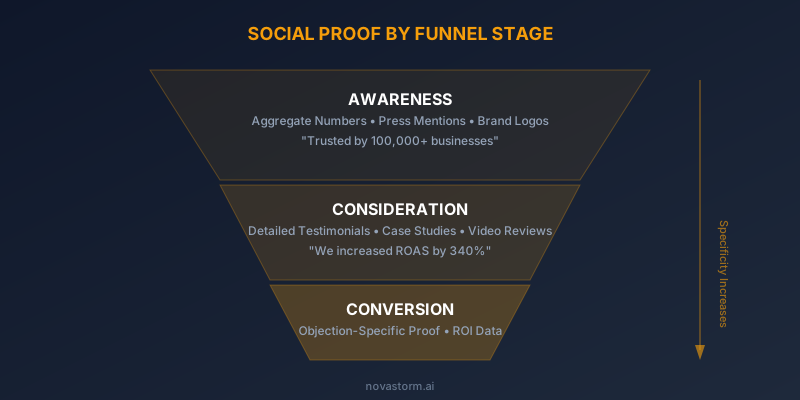
At the top of the funnel, numerical social proof works best. Statements like "Trusted by 100,000+ businesses" or "Rated #1 in the category" communicate credibility quickly to cold audiences who have no prior relationship with your brand. The goal here is to establish legitimacy.
In the middle of the funnel, detailed testimonials and case studies become more effective. Warm audiences already know your brand exists. They need proof that people like them achieved specific results. Format these as short stories with concrete numbers whenever possible.
At the bottom of the funnel, the most persuasive social proof addresses specific objections. If prospects commonly worry about ease of setup, feature a testimonial that specifically mentions simple onboarding. If price sensitivity is the barrier, show proof from customers who discuss return on investment.
- Top of funnel: aggregate numbers, press mentions, brand logos
- Middle of funnel: detailed testimonials, case study summaries, video reviews
- Bottom of funnel: objection-specific testimonials, ROI proof, comparison reviews
How to A/B test social proof elements in Meta ad campaigns
Testing social proof requires isolating the proof element as your single variable. Create two identical ads where only the social proof component differs. For example, test a star rating overlay against a testimonial quote overlay, keeping the product image, copy, and call to action identical.
Run each test for at least seven days with a minimum of 1,000 impressions per variant before drawing conclusions. Social proof tests often show statistically significant results faster than other creative tests because the psychological impact is immediate. Monitor both click-through rate and downstream conversion rate, as some proof types attract more clicks but convert at lower rates.
Build a testing calendar that systematically works through proof types, placements, and formats. Document every test with screenshots and results. Over time, you will develop a clear picture of which social proof combinations work best for each audience segment.
When testing social proof, always check that your proof elements are current. Testimonials from two years ago or outdated user counts undermine the very credibility you are trying to build.
Social proof is not a set-it-and-forget-it element. As your customer base grows and your product evolves, your social proof should evolve with it. Refresh testimonials quarterly, update numerical claims monthly, and continuously test new formats. The brands that treat social proof as a living, breathing component of their ad strategy consistently outperform those that treat it as a checkbox.
Novastorm AI automates Meta Ads routine — from monitoring to optimization. Learn more at novastorm.ai
Disclaimer: This article was generated with the assistance of AI and reviewed by the NovaStorm AI team. While we strive for accuracy, we recommend verifying specific data points and consulting official sources (linked where available) for critical business decisions.
Ready to automate your Meta Ads?
NovaStorm AI takes full responsibility for your campaigns — from monitoring to optimization.
Get Started FreeRelated Articles
The Psychology of Color in Meta Ad Creative
Explore the psychology of color in Meta Ad creative. Learn how color associations, contrast, CTA button colors, and cultural meanings impact ad performance.
Creative Velocity: Why Producing More Ads Wins on Meta
Learn why creative velocity is the top growth lever in Meta Ads. Discover frameworks for producing 10-20 ads per month, testing pipelines, and creative operations workflows.

Discount Strategy in Meta Ads: When Discounts Help and When They Hurt
Learn when discounts boost Meta Ads performance and when they erode margins. Percentage vs dollar off, conditional offers, urgency tactics, and premium positioning.