Discount Strategy in Meta Ads: When Discounts Help and When They Hurt
Learn when discounts boost Meta Ads performance and when they erode margins. Percentage vs dollar off, conditional offers, urgency tactics, and premium positioning.
The Double-Edged Sword of Discount Strategy in Meta Ads
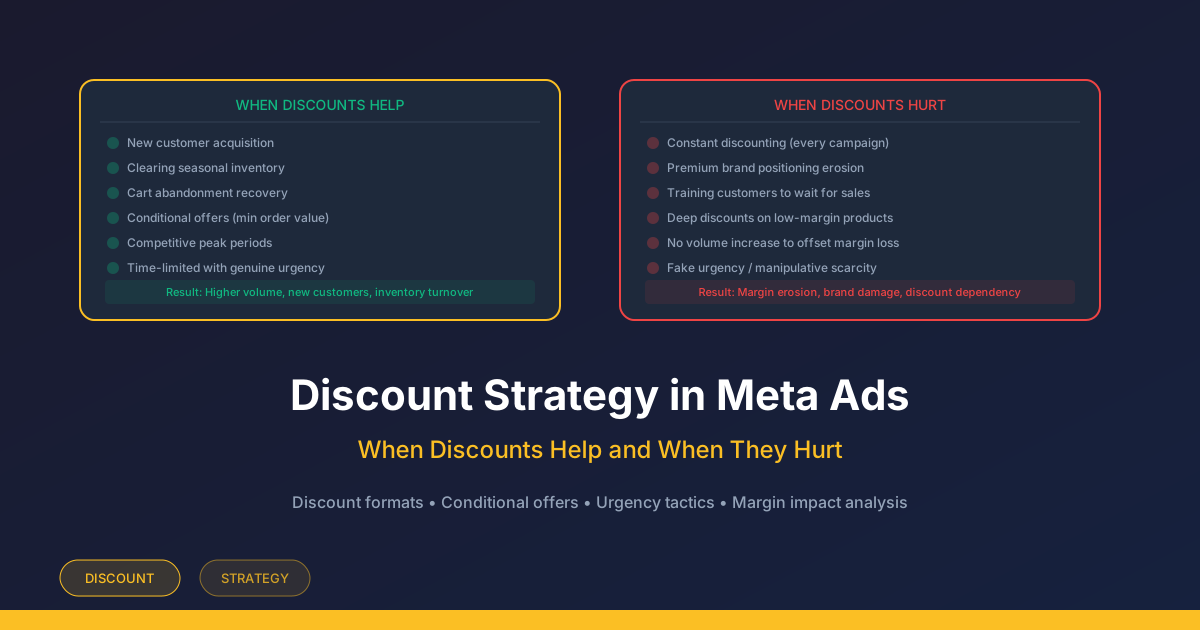
Discount strategy in Meta Ads is one of the most misunderstood levers in digital advertising. Discounts can dramatically increase conversion rates, lower cost per acquisition, and drive immediate revenue. But they can also erode margins, train customers to wait for sales, and undermine brand perception. The difference between a discount that grows your business and one that damages it comes down to strategy, timing, and execution.
The core tension is simple. Discounts reduce the friction between interest and purchase, making it easier for someone who is on the fence to convert. But that friction reduction comes at a cost, both financially through reduced margins and strategically through changed customer expectations. The key is using discounts intentionally as part of a broader pricing strategy rather than defaulting to them as a crutch when performance dips.
Understanding Discount Fatigue
Discount fatigue occurs when your audience becomes so accustomed to seeing discount offers that they stop purchasing at full price. This is one of the most damaging long-term consequences of aggressive discounting. Once customers are trained to expect discounts, they simply wait for the next sale rather than buying when they need the product.
The signs of discount fatigue are measurable. If your full-price conversion rate has declined over time while your discount campaign performance remains stable, you likely have a fatigue problem. Other indicators include a growing gap between traffic and conversions during non-sale periods, increasing customer emails asking about upcoming sales, and a higher percentage of total revenue coming from discounted purchases quarter over quarter.
If more than 40% of your total revenue comes from discounted sales, you are likely in a discount dependency cycle. Breaking this cycle requires a gradual reduction in discount frequency paired with stronger full-price value messaging.
Percentage Off vs Dollar Off: Which Performs Better
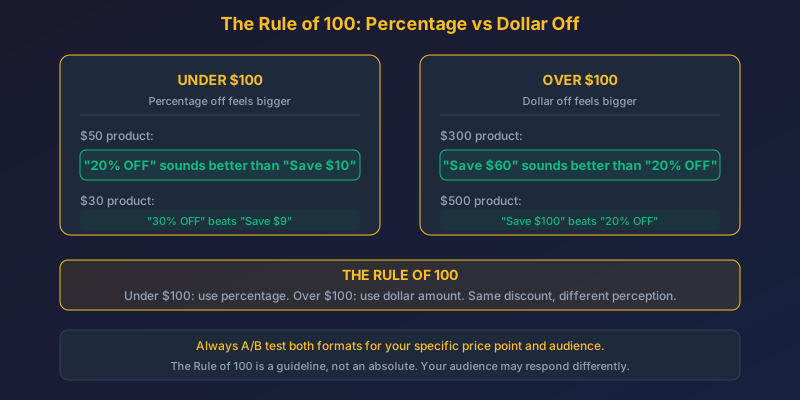
The format of your discount affects perception and conversion rates. Research consistently shows that percentage-off discounts perform better for products under $100, while dollar-off discounts perform better for products over $100. This is known as the Rule of 100.
For a $50 product, '20% off' (which is $10) sounds more impressive than 'Save $10.' For a $500 product, 'Save $100' sounds more impressive than '20% off.' The dollar amount is the same in each example, but the perceived value differs based on the framing. Apply this principle to your Meta Ads creative by testing both formats for your price points.
| Product Price | Better Format | Example | Why |
|---|---|---|---|
| Under $20 | Percentage off | 30% off your order | Percentage sounds large relative to price |
| $20-$100 | Test both | 25% off or Save $20 | Depends on specific price and audience |
| $100-$500 | Dollar off | Save $75 today | Dollar amount sounds substantial |
| Over $500 | Dollar off | Save $200 on your purchase | Large dollar savings create urgency |
| Subscription | First month free | Your first month is on us | Removes trial risk entirely |
Conditional Discounts: Adding Requirements to Protect Margins
Conditional discounts require the customer to take a specific action to unlock the savings, which protects your margins while still providing the conversion incentive. These conditions can include minimum order values, specific product combinations, first-purchase-only restrictions, or time-limited availability.
- Minimum order threshold: 'Get 15% off orders over $100.' Increases AOV while offering a discount.
- Bundle discount: 'Buy 2, get 1 free.' Moves more inventory and increases transaction value.
- First purchase only: '10% off your first order.' Acquires new customers without discounting to existing ones.
- Free shipping threshold: 'Free shipping on orders over $75.' Costs less than percentage discounts and raises AOV.
- Loyalty discount: 'Exclusive 20% off for returning customers.' Rewards loyalty without training new customers to expect discounts.
Conditional discounts outperform blanket discounts in nearly every scenario because they allow you to control the economics. A '15% off orders over $100' offer often generates more profit than a flat '15% off everything' despite having the same discount rate.
Stop wasting ad budget
NovaStorm AI cuts Meta Ads CPA by 40% on average. Start free.
Urgency and Scarcity: Making Offers Time-Sensitive
Urgency and scarcity amplify the effectiveness of any discount by creating a reason to act now rather than later. Without a deadline, discounts lose their persuasive power because the customer can always come back later. A time limit converts browsers into buyers.
Effective urgency tactics in Meta Ads include countdown language in ad copy ('Ends Sunday'), limited-quantity messaging ('Only 50 left at this price'), and seasonal context ('End-of-season clearance, last chance'). The urgency must be genuine. False scarcity erodes trust faster than any discount builds it, and platforms like Meta are increasingly scrutinizing misleading urgency claims.
Premium Positioning Without Discounts
Not every brand should discount. Premium and luxury brands often perform better by never discounting and instead emphasizing exclusivity, quality, and aspiration. If your brand positioning depends on perceived value, discounting can be more damaging than beneficial.
Alternatives to discounts for premium brands include value-add offers (free gift with purchase), exclusive access (early access to new collections), enhanced experience (complimentary gift wrapping or personalization), and content-driven selling (highlighting craftsmanship, materials, and brand story). These approaches create perceived value without reducing price.
Split Testing Discount Offers on Meta
Never assume which discount format will perform best. Test systematically. Meta's A/B testing tools let you compare different offer structures while controlling for audience and placement variables.
- Test discount vs no discount: Run the same product with and without a discount offer to measure the incremental conversion lift.
- Test discount formats: Compare percentage off, dollar off, free shipping, and buy-one-get-one for the same product.
- Test discount amounts: Compare 10% vs 15% vs 20% to find the minimum effective discount that drives conversions.
- Test conditional vs unconditional: Compare a flat 15% off against 15% off orders over a minimum threshold.
- Test urgency variations: Compare 24-hour flash sale, weekend sale, and week-long sale to find the optimal duration.
- Measure margin-adjusted ROAS: The discount that generates the most revenue is not always the most profitable.
Margin Impact Calculation: The Math Behind Discounts
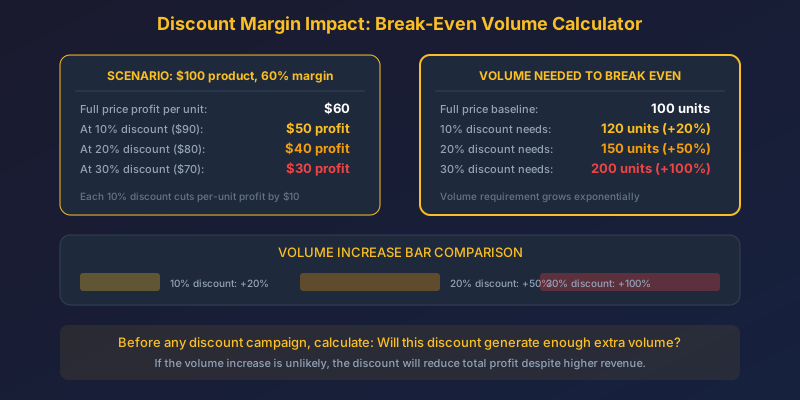
Before running any discount campaign, calculate the break-even point. You need to sell enough additional units at the discounted price to generate more total profit than you would at full price. The math is straightforward but often overlooked.
If your product sells for $100 with a 60% margin ($60 profit per unit), and you offer a 20% discount, the new price is $80 with a $40 profit per unit. You now need to sell 50% more units just to generate the same total profit. That means your 20% discount requires a 50% increase in volume to break even. If the discount drives less than 50% more sales, you have actually reduced total profit despite higher revenue.
Always calculate the volume increase needed to offset a discount before launching. A 10% discount on a 50% margin product requires 25% more volume to break even. A 20% discount requires 67% more volume. A 30% discount requires 150% more volume. The math gets aggressive fast.
Discounts are a tool, not a strategy. Used correctly with clear objectives, time boundaries, and margin awareness, they accelerate growth and acquire valuable customers. Used reflexively every time performance dips, they create a dependency that degrades margins and brand perception over time. The best advertisers treat discounts as one instrument in a full orchestra, deployed precisely when the composition calls for it.
Novastorm AI automates Meta Ads routine — from monitoring to optimization. Learn more at novastorm.ai
Disclaimer: This article was generated with the assistance of AI and reviewed by the NovaStorm AI team. While we strive for accuracy, we recommend verifying specific data points and consulting official sources (linked where available) for critical business decisions.
Ready to automate your Meta Ads?
NovaStorm AI takes full responsibility for your campaigns — from monitoring to optimization.
Get Started FreeRelated Articles
Cart Abandonment Retargeting: How to Recover Lost Revenue on Meta
Master cart abandonment retargeting on Meta. Learn optimal retargeting windows, creative strategies, frequency limits, and multi-touch sequences to recover lost revenue.
Instagram Shopping Ads: Product Tagging Best Practices
Learn product tagging best practices for Instagram Shopping Ads. Discover catalog requirements, creative optimization, and strategies to boost conversion rates from tagged products.
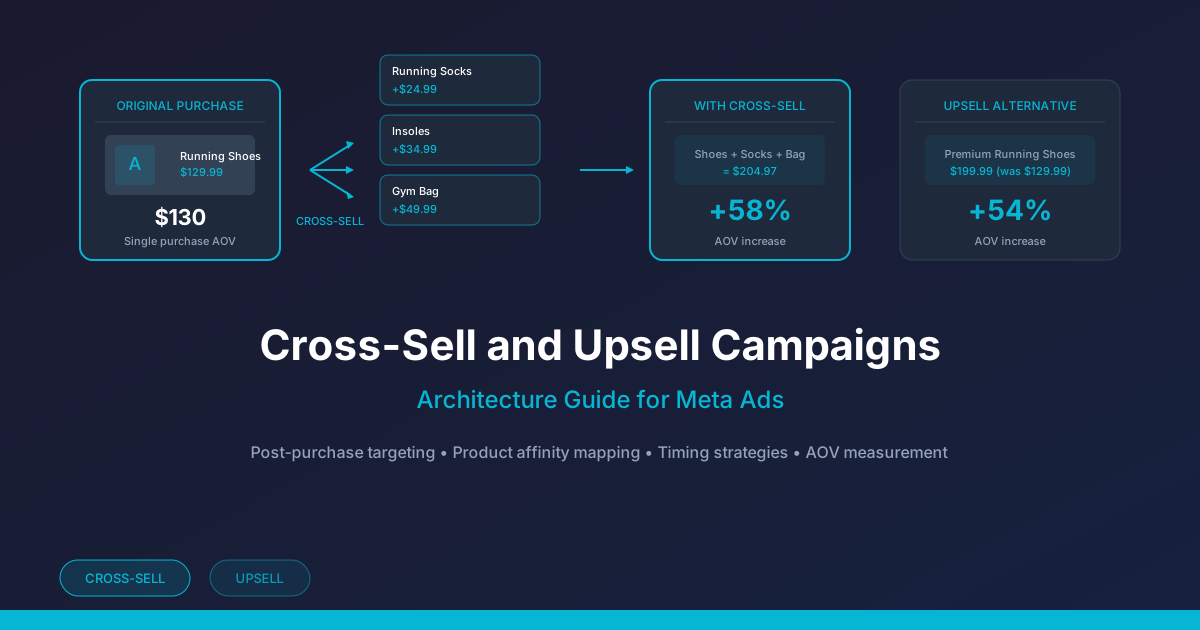
Cross-Sell and Upsell Campaigns on Meta: Architecture Guide
Build effective cross-sell and upsell campaigns on Meta. Learn post-purchase audience setup, product affinity mapping, timing strategies, and AOV impact measurement.