Scaling Meta Ads Without Killing Performance: The Step-by-Step Guide
Learn the proven methods for scaling Meta Ads without destroying performance. Master horizontal scaling, vertical scaling, creative scaling, and the 20% budget rule.
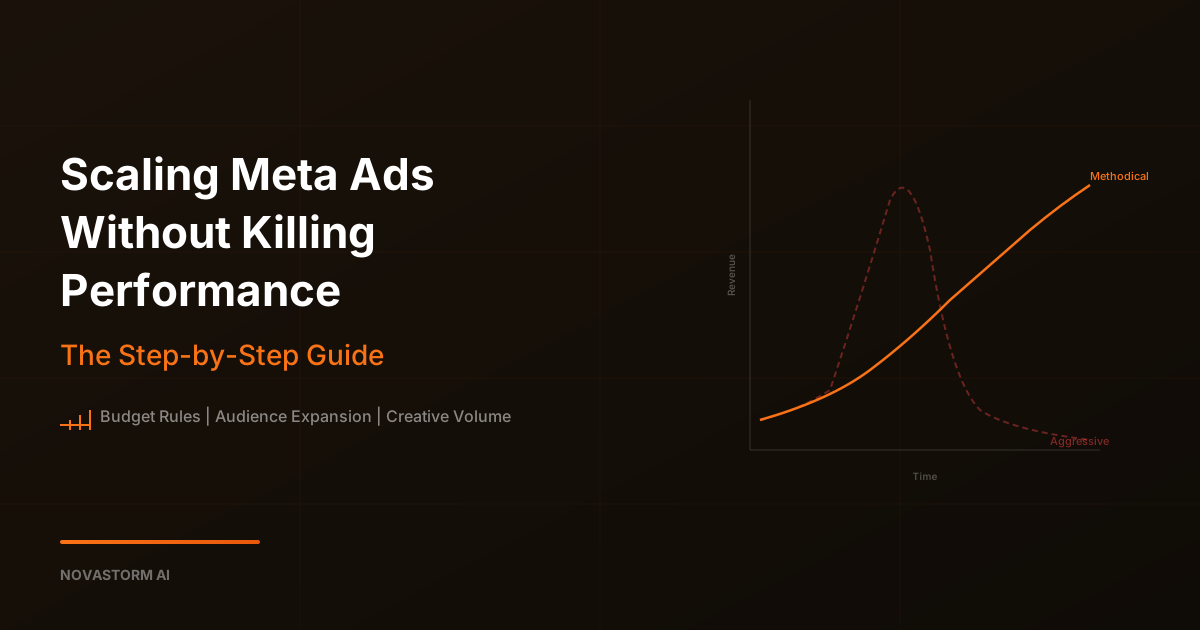
Scaling Meta Ads is the moment of truth for every advertiser. You have found winning creative, dialed in your targeting, and achieved a cost per acquisition that makes the math work. Now you want to spend more and get more results. But every media buyer has experienced the same frustration: you double the budget and performance falls off a cliff. Understanding why scaling breaks things and how to scale methodically is what separates profitable growth from expensive failure.
Why Scaling Meta Ads Breaks Performance
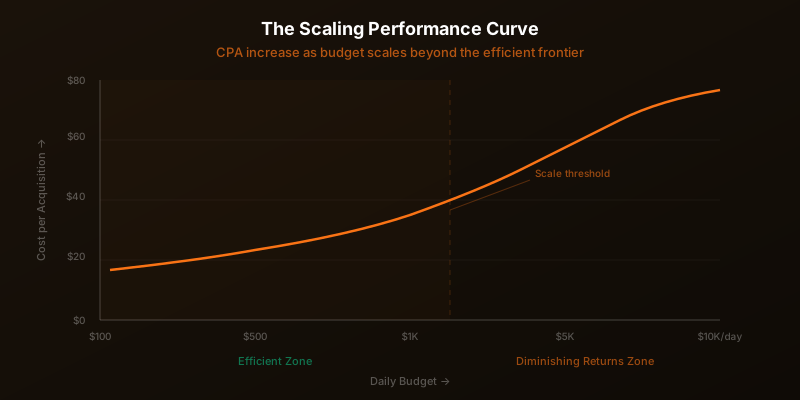
When you increase budget significantly, several things happen simultaneously. The algorithm needs to find new people to show your ads to, which means expanding beyond your proven audience into less responsive segments. The increased spend triggers a re-entry into the learning phase, where delivery is unstable and costs fluctuate. Your frequency increases among your existing audience, causing ad fatigue. And competition for the incremental impressions is often higher, driving up CPMs.
The core problem is that your initial results came from the most responsive portion of your audience. The first 100 conversions are easy because they come from people who are most likely to buy. The next 100 are harder, and the 100 after that are harder still. Each incremental cohort of customers costs more to acquire because they are progressively less inclined to convert.
The 20 Percent Budget Rule
The most reliable method for vertical budget scaling is the 20 percent rule. Instead of making dramatic budget increases, raise your daily budget by no more than 20 percent every 48 to 72 hours. This gives the algorithm time to adjust delivery without being forced into a full learning phase reset.
At 20 percent increases every three days, a 100 dollar daily budget becomes roughly 250 dollars in two weeks and 600 dollars in a month. This feels slow when you are eager to scale, but it consistently outperforms aggressive jumps because it maintains optimization stability.
If you need to scale faster than the 20 percent rule allows, duplicate the winning ad set into a new campaign with a higher budget rather than increasing the original. This preserves the optimization of your existing campaign while testing a higher spend level in parallel.
Horizontal Scaling: New Audiences
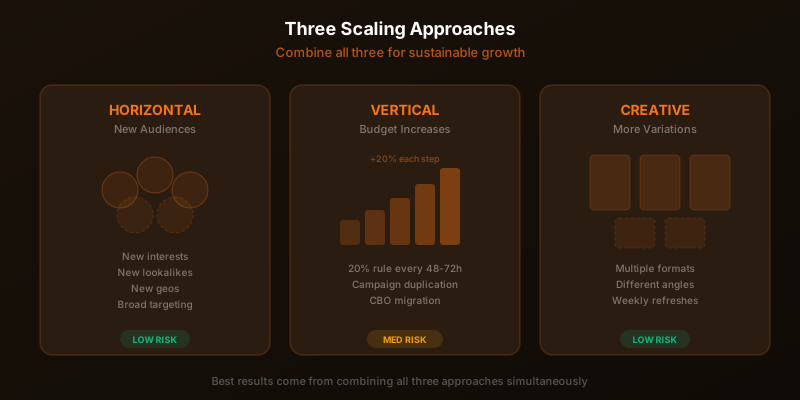
Horizontal scaling means expanding your reach by launching new ad sets targeting different audiences. Instead of pushing more budget through a single audience, you find additional audiences that respond to your offer. This is often more effective than vertical scaling because each new audience represents fresh, untapped potential.
Horizontal Scaling Strategies
- Test new interest-based audiences adjacent to your winning targets. If fitness enthusiasts convert well, test yoga, running, or CrossFit audiences.
- Create lookalike audiences at different percentage ranges. If your 1 percent lookalike works, test 2 percent, 3 percent, and 5 percent.
- Build lookalikes from different seed audiences. Use purchasers, high-value customers, email subscribers, and video viewers as separate seeds.
- Expand geographically if your product allows. Test new countries, regions, or cities that match your ideal customer profile.
- Test broad targeting with strong creative and let the algorithm find your audience without constraints.
Vertical Scaling: Budget Increases
Vertical scaling increases budget on existing winning audiences. Beyond the 20 percent rule, there are structural approaches that make vertical scaling more reliable.
| Method | How It Works | When to Use | Risk Level |
|---|---|---|---|
| Gradual increase | 20% every 48-72 hours on existing ad sets | Steady, predictable scaling | Low |
| Campaign duplication | Copy winning campaign with higher budget | Need faster scale without disturbing existing | Medium |
| CBO migration | Move winning ad sets into Advantage Campaign Budget | Multiple proven ad sets ready to scale | Medium |
| Advantage+ Shopping | Launch ASC with broader budget allocation | E-commerce with strong catalog and pixel data | Medium-High |
| Budget reset | Pause, increase budget significantly, relaunch | Current optimization stuck at local maximum | High |
Stop wasting ad budget
NovaStorm AI cuts Meta Ads CPA by 40% on average. Start free.
Creative Scaling: More Variations
Creative fatigue is the silent killer of scaling efforts. Your audience sees the same ad too many times, engagement drops, and costs rise. Creative scaling means continuously producing new ad variations to feed into your campaigns, preventing fatigue and giving the algorithm fresh material to test.
The volume of creative you need scales with your budget. A rough benchmark is that for every 1000 dollars in daily spend, you need at least three to five active creative variations, with new ones being introduced weekly. At 5000 dollars per day, you might need 10 to 15 active variations with multiple new pieces added each week.
- Vary formats: static images, carousels, short-form video, long-form video, and user-generated content
- Test different angles: benefit-focused, pain point-focused, social proof, aspirational, and educational
- Iterate on winners: take your best-performing creative and create variations with different hooks, colors, or copy
- Refresh regularly: even the best creative has a lifespan of two to four weeks before fatigue sets in
- Use dynamic creative testing to let Meta combine headlines, images, and descriptions automatically
Account Structure for Scaling Meta Ads
Your account structure needs to support scaling. A common mistake is having too many ad sets competing against each other, which fragments the data and prevents any single ad set from gathering enough conversion data to optimize effectively. The trend is toward simplified structures with fewer, broader ad sets that give the algorithm more room to work.
The ideal scaling structure typically has three to five campaigns: one for prospecting with broad targeting, one for retargeting, one for testing new audiences and creative, and optionally one Advantage+ Shopping campaign. Each campaign should have no more than three to five ad sets to avoid audience overlap and data fragmentation.
Warning Signs During Scaling
Knowing when to pull back is just as important as knowing when to push forward. Watch for these signals that indicate your scaling is outpacing your audience or creative.
- Cost per acquisition increasing by more than 30 percent over three consecutive days
- Frequency rising above 2.5 for prospecting campaigns or above 5 for retargeting
- Click-through rate dropping by 20 percent or more compared to your baseline
- Return on ad spend declining steadily for five or more consecutive days
- Learning phase lasting longer than seven days without stabilization
- Spend not delivering despite budget increases, indicating audience saturation
When you see warning signs, resist the urge to make multiple changes at once. Reduce budget back to the last stable level, introduce new creative, or expand to a new audience. Change one variable at a time so you can identify what caused the performance dip.
The Scaling Sequence
For the most reliable scaling, follow this sequence. First, ensure your creative library is deep enough to support higher spend. Second, expand horizontally by testing new audiences until you have multiple proven segments. Third, scale vertically using the 20 percent rule on each proven audience. Fourth, continuously refresh creative to combat fatigue. Fifth, consolidate into simplified structures as you scale past initial budgets.
Sources & Further Reading: Meta Business Help Center — About the Learning Phase — official guide to algorithm stabilization. AdEspresso — How to Scale Facebook Ads — data-driven scaling strategies. Social Media Examiner — How to Scale Facebook Ads — horizontal and vertical scaling expert guidance.
This sequence works because it builds a foundation of diversified audiences and creative before increasing financial exposure. Scaling a single audience with a single creative is fragile. Scaling multiple proven audiences with a deep creative library is resilient. The goal is not just to spend more but to spend more while maintaining or improving your unit economics.
Patience is the hardest part of scaling. The advertisers who scale successfully are those who accept that sustainable growth takes weeks, not days. They build systems for continuous creative production, methodical audience testing, and gradual budget increases. The result is a growth curve that steadily rises rather than a spike followed by a crash.
Novastorm AI automates Meta Ads routine — from monitoring to optimization. Learn more at novastorm.ai
Disclaimer: This article was generated with the assistance of AI and reviewed by the NovaStorm AI team. While we strive for accuracy, we recommend verifying specific data points and consulting official sources (linked where available) for critical business decisions.
Ready to automate your Meta Ads?
NovaStorm AI takes full responsibility for your campaigns — from monitoring to optimization.
Get Started FreeRelated Articles
Horizontal vs Vertical Scaling: Two Paths to Ad Growth
Understand horizontal vs vertical scaling in Meta Ads. Learn the 20% budget rule, when to duplicate ad sets, and how to scale without resetting the Learning Phase.

The Psychology of Color in Meta Ad Creative
Explore the psychology of color in Meta Ad creative. Learn how color associations, contrast, CTA button colors, and cultural meanings impact ad performance.
Managing Multiple Ad Accounts: Agency Best Practices
Agency best practices for managing multiple Meta Ad accounts including Business Manager setup, naming conventions, team permissions, cross-account reporting, and client onboarding.