Horizontal vs Vertical Scaling: Two Paths to Ad Growth
Understand horizontal vs vertical scaling in Meta Ads. Learn the 20% budget rule, when to duplicate ad sets, and how to scale without resetting the Learning Phase.
When a Meta Ads campaign starts performing well, the natural next question is how to spend more while keeping results profitable. This is where the debate around horizontal vs vertical scaling begins. Both approaches can grow your ad spend and revenue, but they work in fundamentally different ways, carry different risks, and suit different situations. Understanding when to use each one is the difference between scaling successfully and burning through budget.
What Is Vertical Scaling?
Vertical scaling means increasing the budget on an existing winning ad set or campaign. It is the most straightforward approach to growth. You have something that works, so you give it more money.
The concept is simple, but the execution requires care. Meta's algorithm is sensitive to budget changes. A sudden large increase can reset the Learning Phase, causing performance to drop temporarily or permanently. This is why the 20% rule exists.
The 20% Budget Rule
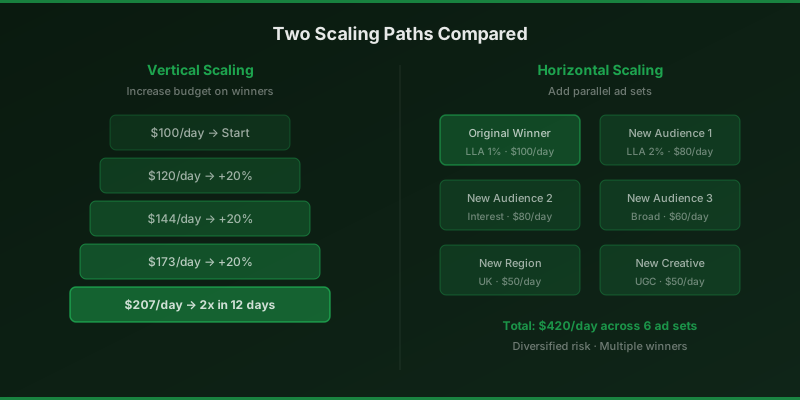
The widely accepted guideline is to increase your budget by no more than 20% every 48 to 72 hours. This gives the algorithm time to adjust without triggering a Learning Phase reset. For example, if your ad set is spending $100 per day, you would increase to $120, wait two to three days, then increase to $144, and so on.
| Day | Budget | Increase | Cumulative Growth |
|---|---|---|---|
| Day 1 | $100 | Starting point | 0% |
| Day 3 | $120 | +20% | +20% |
| Day 6 | $144 | +20% | +44% |
| Day 9 | $173 | +20% | +73% |
| Day 12 | $207 | +20% | +107% |
| Day 15 | $249 | +20% | +149% |
In just two weeks, you have more than doubled your budget while maintaining stable performance. The compounding effect of 20% increases is powerful when applied consistently.
What Is Horizontal Scaling?
Horizontal scaling means expanding your reach by creating new ad sets targeting different audiences, testing new creatives, or launching in new markets. Instead of pushing more budget through one funnel, you build parallel funnels.
Common horizontal scaling tactics include duplicating a winning ad set with a new audience, launching the same creative against lookalike audiences of different percentages, testing new geographic regions, and creating new campaign structures for different products or offers.
- Duplicate winning ad sets with new lookalike audiences (1%, 2%, 3%)
- Test new interest-based audiences adjacent to your proven ones
- Expand to new countries or regions with translated creative
- Launch new creative angles in separate ad sets to isolate variables
- Create separate campaigns for different product lines or offers
Horizontal vs Vertical Scaling: When Each Works Best
Neither approach is universally better. The right choice depends on your current situation, budget level, and campaign maturity.
Vertical scaling works best when you have a proven ad set with stable performance and consistent results over at least 7 to 14 days. It also works when your audience is large enough to absorb more spend without frequency issues. If you want to scale quickly with minimal setup work, vertical scaling is the faster path.
Horizontal scaling works best when your current ad sets are showing signs of audience saturation, frequency is climbing above 2.5 to 3 for cold audiences, or you have hit a budget ceiling where further increases cause performance to degrade. It is also the right approach when you want to diversify risk across multiple audiences rather than relying on a single winning ad set.
The best scaling strategy combines both approaches. Use vertical scaling to maximize proven winners while simultaneously launching horizontal tests to find new winning audiences. This creates a pipeline of scalable ad sets.
The Scaling Timeline
Stop wasting ad budget
NovaStorm AI cuts Meta Ads CPA by 40% on average. Start free.
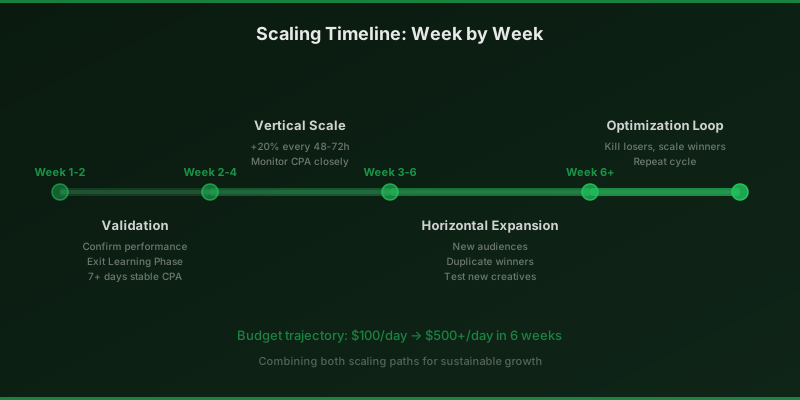
Scaling is not a one-time event. It is a process that unfolds over weeks and months. Here is a realistic timeline for scaling a winning campaign:
Week 1 to 2: Validation
Confirm the ad set has exited Learning Phase and delivered consistent results for at least 7 days. Do not scale anything that has not proven itself.
Week 2 to 4: Vertical Scaling
Begin 20% budget increases every 48 to 72 hours on the winning ad set. Monitor CPA and ROAS closely. If performance dips more than 20% from baseline, pause increases for a few days.
Week 3 to 6: Horizontal Expansion
While vertically scaling the winner, launch 2 to 3 new ad sets targeting adjacent audiences. Use the same creative that is working. Give each new ad set enough budget to exit Learning Phase.
Week 6 and Beyond: Optimization Loop
Review all ad sets. Kill underperformers, vertically scale new winners, and continue horizontal expansion with fresh audiences and creative. This cycle repeats indefinitely.
Avoiding Learning Phase Resets
The biggest risk when scaling is triggering a Learning Phase reset. This happens when Meta detects a significant change to your ad set and needs to recalibrate. Actions that trigger resets include large budget changes of more than 30% in a single day, changes to targeting or audience, changes to creative, bid strategy changes, and conversion event changes.
When an ad set re-enters Learning Phase, expect 2 to 5 days of volatile performance and potentially higher costs. During this period, do not make additional changes. Let the algorithm stabilize before evaluating.
To minimize reset risk during vertical scaling, follow the 20% rule strictly. For horizontal scaling, always create new ad sets rather than modifying existing winners. Your proven ad sets should remain untouched while you test new variations in parallel.
Choosing Your Scaling Path
Sources & Further Reading: Meta Business Help Center — About the Learning Phase — what triggers Learning Phase resets. AdEspresso — Scaling Facebook Ads Without Losing ROI — 20% rule analysis and scaling best practices. WordStream — How to Scale Facebook Ads — horizontal vs vertical scaling case studies.
Start with vertical scaling because it is simpler and preserves what is already working. When you hit diminishing returns, whether from rising frequency, increasing CPA, or audience saturation, shift toward horizontal scaling to find new pockets of opportunity. The advertisers who scale most successfully treat it as a continuous process of testing, validating, and expanding rather than a single dramatic budget increase.
Both horizontal and vertical scaling have their place in a mature ad account. Master both, know when to use each, and you will have a reliable framework for growing ad spend profitably over time.
Novastorm AI automates Meta Ads routine — from monitoring to optimization. Learn more at novastorm.ai
Disclaimer: This article was generated with the assistance of AI and reviewed by the NovaStorm AI team. While we strive for accuracy, we recommend verifying specific data points and consulting official sources (linked where available) for critical business decisions.
Ready to automate your Meta Ads?
NovaStorm AI takes full responsibility for your campaigns — from monitoring to optimization.
Get Started FreeRelated Articles
Dayparting in Meta Ads: Does Time-of-Day Targeting Still Work
Explore whether dayparting in Meta Ads still works in the age of algorithmic optimization. Learn when time-of-day targeting helps, when to avoid it, and how to analyze time performance.
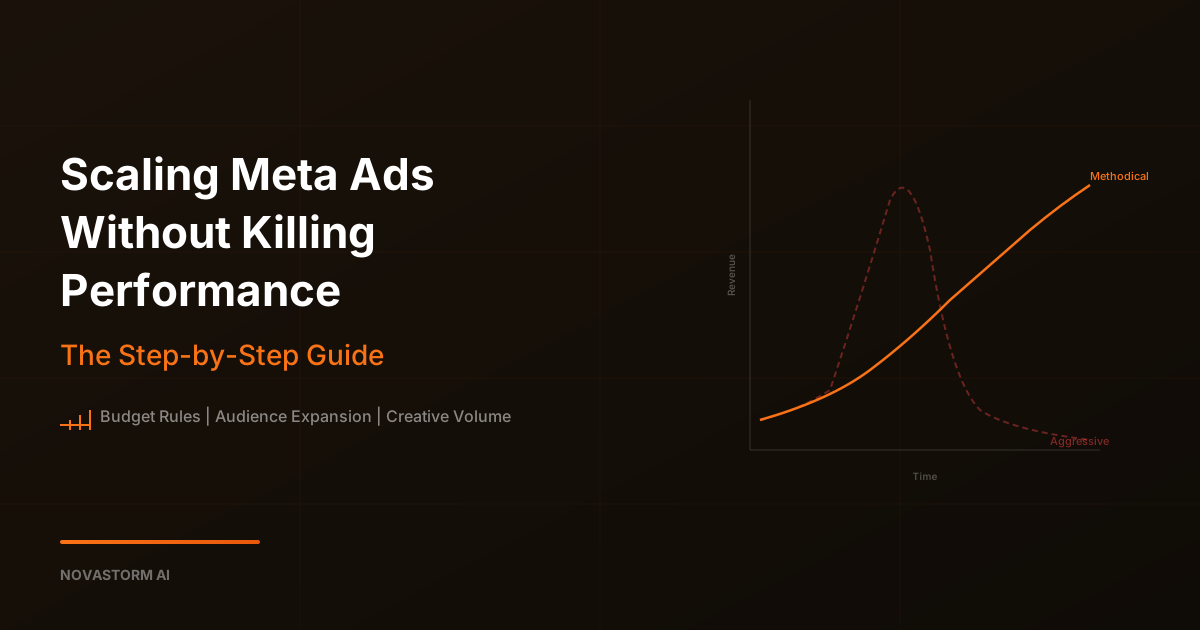
Scaling Meta Ads Without Killing Performance: The Step-by-Step Guide
Learn the proven methods for scaling Meta Ads without destroying performance. Master horizontal scaling, vertical scaling, creative scaling, and the 20% budget rule.
Meta Ads for Startups: Budget-Friendly Scaling Strategies
Learn proven Meta Ads for startups strategies that maximize growth on limited budgets. Scale from $500 to $5K/mo with data-driven ad campaigns.