Marketing Mix Modeling for Meta Ads: Beyond Last-Click Attribution
Discover how marketing mix modeling for Meta Ads reveals true channel impact beyond last-click attribution. Learn MMM methodology, implementation steps, and optimization strategies.

Marketing mix modeling for Meta Ads is rapidly becoming the gold standard for advertisers who refuse to settle for misleading last-click data. As privacy regulations tighten and cookie deprecation accelerates, traditional attribution falls apart at the seams. MMM offers a statistical framework that quantifies the true incremental contribution of every marketing channel, including Meta campaigns that often dominate the upper funnel but receive little credit from click-based models. In this guide, we break down how to implement MMM for your Meta advertising strategy, interpret the results, and reallocate budgets for maximum return.
Why Last-Click Attribution Fails Meta Advertisers
Last-click attribution assigns 100% of conversion credit to the final touchpoint before a sale. For Meta Ads, this creates a structural disadvantage. Meta campaigns typically operate at the top and middle of the funnel, building awareness and consideration long before a user clicks a branded search ad or types a URL directly. When last-click gets the final word, Meta consistently receives 40-60% less credit than it deserves. This distortion leads to chronic underinvestment in the very channels driving demand generation.
Consider a typical customer journey: a user sees a Meta video ad on Monday, engages with a carousel ad on Wednesday, then converts via a Google search on Friday. Last-click gives Google 100% of the credit. The Meta touchpoints that initiated and nurtured the journey are invisible in the report. MMM solves this by analyzing aggregate data patterns rather than individual user paths.
How Marketing Mix Modeling Works for Meta Ads
Marketing mix modeling uses regression analysis on historical data to isolate the impact of each marketing channel on business outcomes. The model ingests weeks or months of spend data across all channels, along with external variables like seasonality, promotions, economic indicators, and competitive activity. By controlling for these factors, MMM identifies how much each dollar spent on Meta Ads actually contributes to revenue.
The core equation typically follows a multiplicative or log-linear specification. Meta spend enters the model alongside search, display, email, TV, and offline channels. The model estimates coefficients that represent each channel's marginal contribution, accounting for diminishing returns through adstock transformations and saturation curves.

Key Data Inputs for Your Meta Ads MMM
Building a reliable marketing mix model requires clean, granular data. The quality of your inputs directly determines the quality of your outputs. Here is what you need to collect before starting your modeling effort.
| Data Category | Specific Variables | Source | Granularity |
|---|---|---|---|
| Meta Ads Spend | Daily spend by campaign objective, placement, audience | Meta Ads Manager API | Daily |
| Meta Impressions | Reach, frequency, CPM by format | Meta Ads Manager API | Daily |
| Other Media Spend | Search, display, email, TV, OOH | Platform APIs / finance | Weekly |
| Business Outcomes | Revenue, conversions, new customers | CRM / analytics platform | Daily |
| External Factors | Seasonality, holidays, weather, competitor promos | Public data / manual | Weekly |
| Pricing & Promotions | Discount events, pricing changes | Internal systems | Daily |
A minimum of two years of weekly data is recommended to capture seasonal patterns. If you only have 12 months, you can still build a model, but expect wider confidence intervals. Daily data improves precision for digital channels like Meta where spend and response fluctuate rapidly.
Implementation Steps for Marketing Mix Modeling
Stop wasting ad budget
NovaStorm AI cuts Meta Ads CPA by 40% on average. Start free.
- Audit and consolidate all marketing spend data into a single time-series dataset with consistent date alignment.
- Define your dependent variable clearly: total revenue, online conversions, or new customer acquisitions.
- Apply adstock transformations to model the carryover effects of Meta Ads beyond the day of exposure.
- Include saturation curves to capture diminishing returns at higher spend levels for each channel.
- Run initial regression models and validate against known business events like Black Friday spikes.
- Calculate marginal ROI for each channel by evaluating the derivative of the response curve at current spend levels.
- Build budget optimization scenarios by shifting spend from low-ROI to high-ROI channels.
- Validate results using holdout periods or geographic experiments to confirm model predictions.
Interpreting MMM Results for Meta Ad Budget Allocation
Once your model is calibrated, the most actionable output is the marginal ROI curve for each channel. This curve shows how much additional revenue you can expect from one more dollar of spend. For Meta Ads, you will typically find a steep positive slope at lower spend levels that gradually flattens as you hit saturation. The optimal budget sits at the point where Meta's marginal ROI equals your target return threshold.

In our experience, brands that switch from last-click to MMM-informed budgeting typically increase their Meta Ads allocation by 20-40%. The reason is clear: MMM captures the awareness and consideration impact that click-based models systematically ignore. This reallocation alone often drives a 15-25% improvement in overall marketing efficiency.
Common Pitfalls and How to Avoid Them
When Meta spend and search spend move in tandem (both increase during promotions), the model struggles to separate their individual effects. Break this correlation by running periods where you vary Meta spend independently. Even two weeks of deliberate spend variation provides the model with crucial identification data.
Other common mistakes include ignoring adstock decay rates, which causes the model to underestimate Meta's impact since its effects often persist for 7-14 days. Using overly aggregated data, like monthly instead of weekly, can also wash out the signal. Finally, failing to include competitive activity as a control variable will bias your results if a competitor's campaign surge coincides with your Meta spend changes.
Open-Source Tools for Meta Ads MMM
You do not need a six-figure consulting engagement to run marketing mix modeling. Meta itself has open-sourced Robyn, an automated MMM package built in R that uses ridge regression and evolutionary algorithms to find optimal model specifications. Google's Meridian is another strong option for Bayesian MMM. Both tools can ingest your Meta Ads data and produce channel-level ROI estimates with confidence intervals.
For teams that prefer Python, lightweight MMM is achievable with statsmodels or PyMC. The key is understanding the statistical assumptions rather than relying on any single tool. Whatever platform you choose, ensure you validate results against real business outcomes before making large budget shifts.
Marketing mix modeling represents a fundamental shift in how sophisticated advertisers evaluate Meta Ads. By moving beyond the limitations of last-click attribution, you gain a holistic view of channel contributions that drives smarter budget allocation and stronger returns. Start with clean data, choose the right modeling approach, and iterate as you accumulate more observations. The brands that master MMM will hold a decisive edge in an increasingly privacy-constrained advertising landscape.
Published by novastorm.ai
Disclaimer: This article was generated with the assistance of AI and reviewed by the NovaStorm AI team. While we strive for accuracy, we recommend verifying specific data points and consulting official sources (linked where available) for critical business decisions.
Ready to automate your Meta Ads?
NovaStorm AI takes full responsibility for your campaigns — from monitoring to optimization.
Get Started FreeRelated Articles
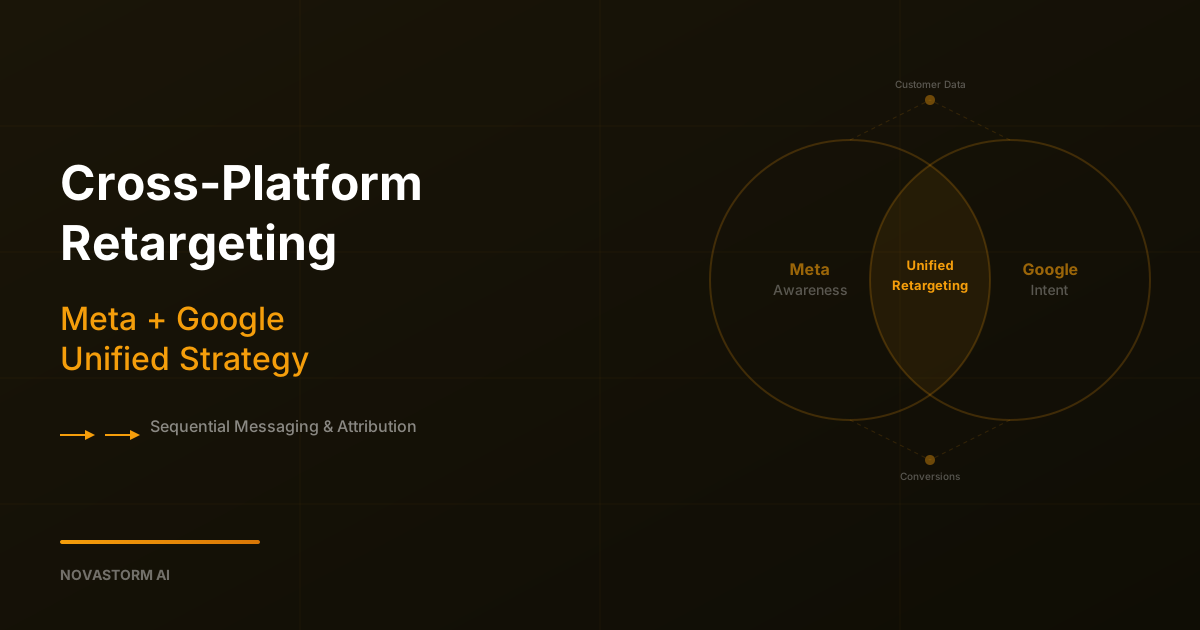
Cross-Platform Retargeting: Meta + Google Unified Strategy
Build a unified cross-platform retargeting strategy combining Meta and Google Ads. Learn audience sync, sequential messaging, attribution, and budget allocation across platforms.
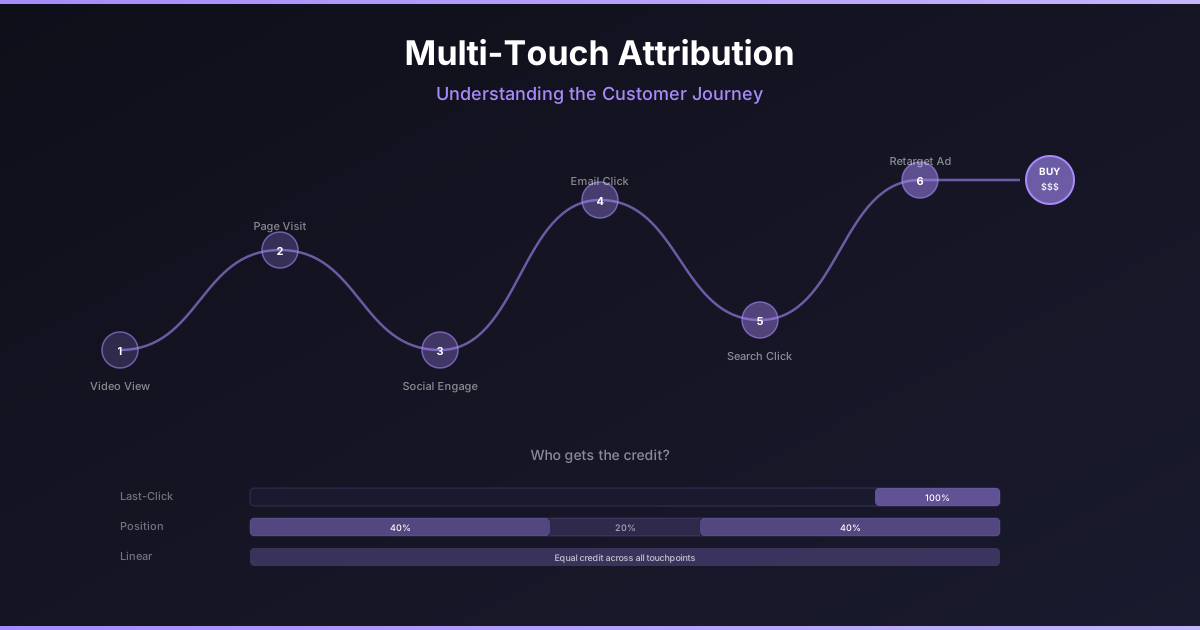
Multi-Touch Attribution: Understanding the Customer Journey in Meta Ads
Move beyond last-click attribution. Learn how multi-touch attribution models reveal the true impact of your Meta Ads across the entire customer journey.

Attribution Windows Explained: 1-Day Click vs 7-Day Click
Understand attribution windows in Meta Ads. Compare 1-day click vs 7-day click, learn how iOS 14.5 changed attribution, and choose the right window for your campaigns.