Multi-Touch Attribution: Understanding the Customer Journey in Meta Ads
Move beyond last-click attribution. Learn how multi-touch attribution models reveal the true impact of your Meta Ads across the entire customer journey.
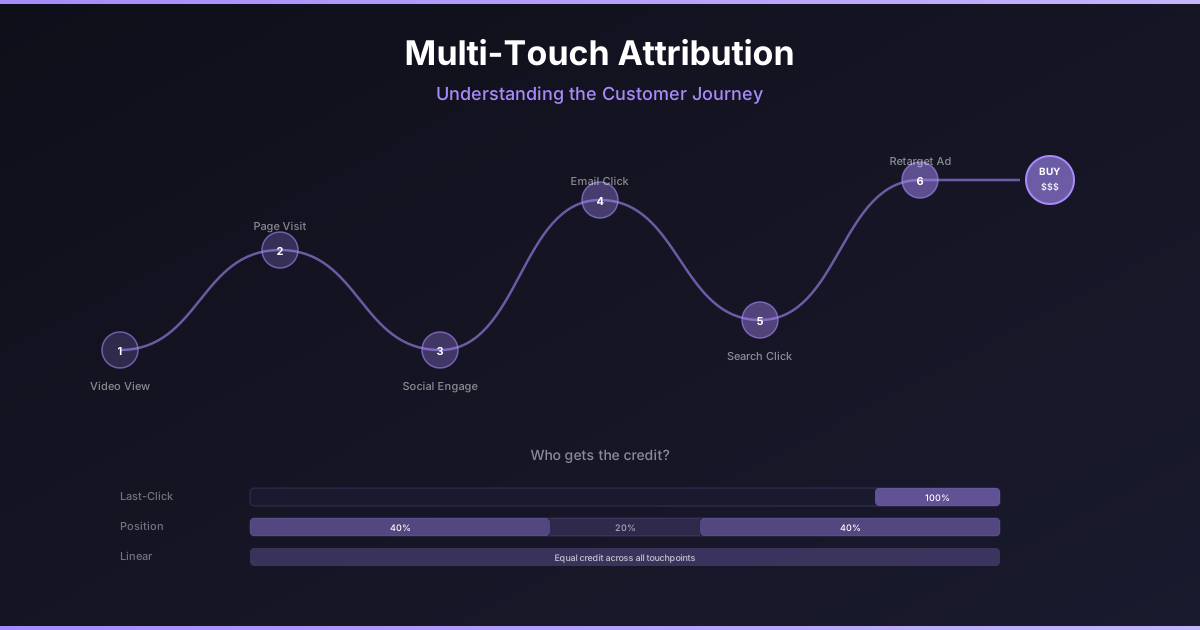
Multi-touch attribution is the framework that reveals what actually drives conversions in your Meta Ads campaigns. In a world where customers interact with your brand seven to twelve times before purchasing, giving all credit to the last click is not just inaccurate, it is actively misleading. Understanding the full customer journey enables smarter budget decisions, better creative strategies, and ultimately higher returns on your advertising investment.
Last-Click vs Multi-Touch Attribution
Last-click attribution assigns 100% of the conversion credit to the final touchpoint before a purchase. It is simple, easy to understand, and dangerously incomplete. Under last-click, a brand awareness video that introduced a customer to your product gets zero credit, while the retargeting ad they clicked before buying gets everything.
This creates a systematic bias toward bottom-funnel activities. Advertisers using last-click attribution consistently over-invest in retargeting and under-invest in prospecting, because the model is structurally incapable of showing the value of upper-funnel touchpoints. Over time, this leads to audience exhaustion, rising costs, and declining returns.
Multi-touch attribution distributes conversion credit across all touchpoints in the customer journey. It acknowledges that the awareness video, the engagement post, the product demo, and the retargeting ad all contributed to the final conversion. The question is how to distribute that credit fairly.
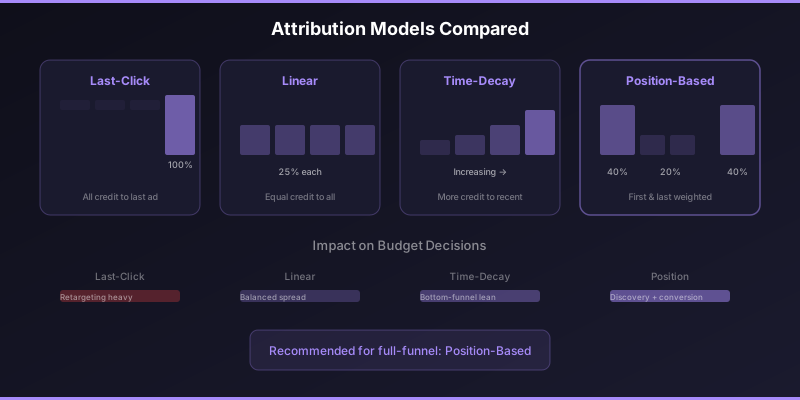
Attribution Models Explained
Linear Attribution
Linear attribution divides credit equally among all touchpoints. If a customer saw four ads before converting, each ad gets 25% of the credit. This model is straightforward and ensures no touchpoint is overlooked, but it fails to account for the varying influence of different interactions. A casual video view and an intent-driven product click are treated identically.
Time-Decay Attribution
Time-decay attribution gives more credit to touchpoints closer to the conversion. The logic is that recent interactions had more influence on the purchase decision. A retargeting ad clicked one day before purchase gets more credit than a brand video viewed two weeks ago. This model better reflects purchasing psychology but still undervalues initial discovery touchpoints.
Position-Based (U-Shaped) Attribution
Position-based attribution assigns 40% of credit to the first touchpoint, 40% to the last touchpoint, and distributes the remaining 20% among middle interactions. This model acknowledges that both discovery (first touch) and conversion (last touch) are critically important, while giving some recognition to nurturing activities in between. For many Meta Ads advertisers, this offers the most balanced view.
| Model | First Touch | Middle Touches | Last Touch | Best For |
|---|---|---|---|---|
| Last-Click | 0% | 0% | 100% | Simple DR campaigns |
| Linear | Equal | Equal | Equal | Understanding full journey |
| Time-Decay | Low | Increasing | Highest | Short purchase cycles |
| Position-Based | 40% | 20% shared | 40% | Full-funnel strategies |
Meta's Multi-Touch Attribution Tools
Meta provides several tools for understanding attribution within its ecosystem. The attribution settings in Ads Manager let you choose between 1-day click, 7-day click, 1-day view, and combinations thereof. These windows determine how long after an ad interaction Meta will credit a conversion to that ad.
Stop wasting ad budget
NovaStorm AI cuts Meta Ads CPA by 40% on average. Start free.
Meta also offers attribution comparison reporting, allowing you to view your campaign results under different attribution windows side by side. This reveals how sensitive your performance data is to the chosen window. If results look dramatically different between 1-day click and 7-day click, it signals that your campaigns are doing significant work beyond the immediate click.
Compare your campaign results using 1-day click versus 7-day click attribution. If the 7-day window shows significantly more conversions, your ads are influencing purchase decisions even when users do not buy immediately. This is a signal that your upper-funnel strategy is working.
Cross-Channel Attribution Challenges
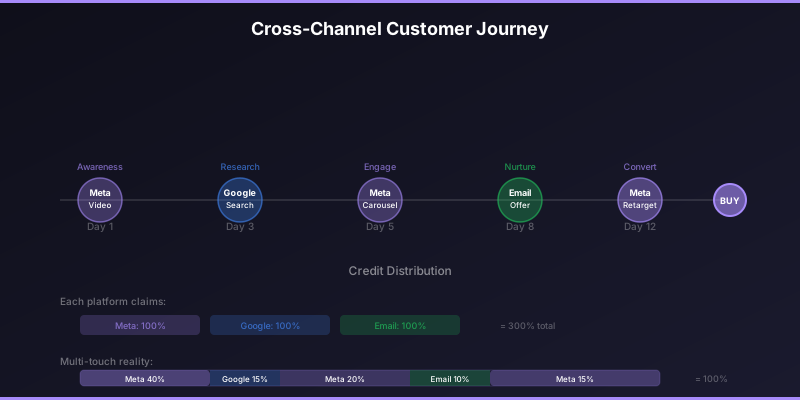
The reality is that customers do not live within a single advertising platform. A typical purchase journey might start with a Meta awareness ad, continue with an organic Google search, include an email interaction, and finish with a direct website visit. Each platform sees only its own touchpoints and claims full credit for the conversion.
Cross-channel attribution attempts to stitch together these fragmented journeys into a single view. This requires either a dedicated attribution platform, a data warehouse approach combining data from all channels, or incrementality testing to measure each channel's true contribution.
- Google Analytics 4 offers cross-channel attribution modeling but is inherently biased toward Google's ecosystem.
- Third-party attribution platforms like Triple Whale, Northbeam, or Rockerbox provide a more neutral multi-channel view.
- Data warehouse approaches using tools like dbt combine raw data from all channels for custom attribution modeling.
- Marketing mix modeling (MMM) uses statistical analysis of spend and outcomes across channels, bypassing individual user tracking entirely.
- Incrementality testing through holdout experiments measures the true causal impact of each channel.
Making Attribution Actionable
Attribution data is only valuable if it changes your decisions. Here is how to translate attribution insights into concrete actions for your Meta Ads campaigns.
- Budget allocation: If multi-touch attribution reveals that awareness campaigns assist more conversions than last-click shows, increase their budget proportionally.
- Creative investment: Identify which creative types appear most frequently in high-converting journeys and produce more of that format.
- Audience strategy: Analyze which audience segments have the shortest attribution paths (fewest touches to conversion) and allocate more budget there.
- Campaign structure: If certain campaigns consistently appear as first-touch or last-touch in converting journeys, optimize them for that specific role.
- Bidding strategy: Adjust bid caps based on the assisted conversion value of campaigns, not just their directly attributed ROAS.
The most actionable attribution insight is often the simplest: compare the ratio of 7-day click conversions to 1-day click conversions for each campaign. Campaigns with a high ratio are driving delayed conversions and deserve more credit and budget than last-click reporting suggests.
Common Attribution Mistakes
- Choosing an attribution model and never questioning it. Review your model quarterly as your marketing mix evolves.
- Comparing metrics across different attribution windows without accounting for the difference. A 3.0 ROAS on 1-day click is not worse than a 3.5 ROAS on 7-day click; they measure different things.
- Relying solely on platform-reported attribution, which inherently over-credits the reporting platform.
- Ignoring view-through conversions entirely. While they can over-count, they do capture real influence, especially for video-heavy campaigns.
- Paralysis by analysis: spending more time debating attribution models than acting on the insights they provide.
- Using attribution to justify cutting campaigns that drive assisted conversions, destroying the top of your funnel.
Multi-touch attribution is not about finding the perfect model, because no perfect model exists. It is about moving beyond the incomplete picture that last-click provides and making directionally better decisions about where to invest your Meta Ads budget. Start by comparing attribution windows within Ads Manager, graduate to a multi-channel attribution tool as your spend grows, and always validate your models against real-world incrementality tests. The brands that understand their full customer journey are the ones that scale efficiently and sustainably.
Novastorm AI automates Meta Ads routine — from monitoring to optimization. Learn more at novastorm.ai
Disclaimer: This article was generated with the assistance of AI and reviewed by the NovaStorm AI team. While we strive for accuracy, we recommend verifying specific data points and consulting official sources (linked where available) for critical business decisions.
Ready to automate your Meta Ads?
NovaStorm AI takes full responsibility for your campaigns — from monitoring to optimization.
Get Started FreeRelated Articles

Marketing Mix Modeling for Meta Ads: Beyond Last-Click Attribution
Discover how marketing mix modeling for Meta Ads reveals true channel impact beyond last-click attribution. Learn MMM methodology, implementation steps, and optimization strategies.

Omnichannel Marketing with Meta Ads: Connecting Online and Offline
Master omnichannel marketing Meta Ads strategies to connect online and offline channels. Build unified customer journeys that drive conversions everywhere.
Cross-Platform Retargeting: Meta + Google Unified Strategy
Build a unified cross-platform retargeting strategy combining Meta and Google Ads. Learn audience sync, sequential messaging, attribution, and budget allocation across platforms.