DTC Brand Growth With Meta Ads: From Zero to Million in Revenue
Learn how DTC brands scale from zero to million-dollar revenue using Meta Ads. Proven frameworks, budget allocation strategies, and real growth benchmarks inside.
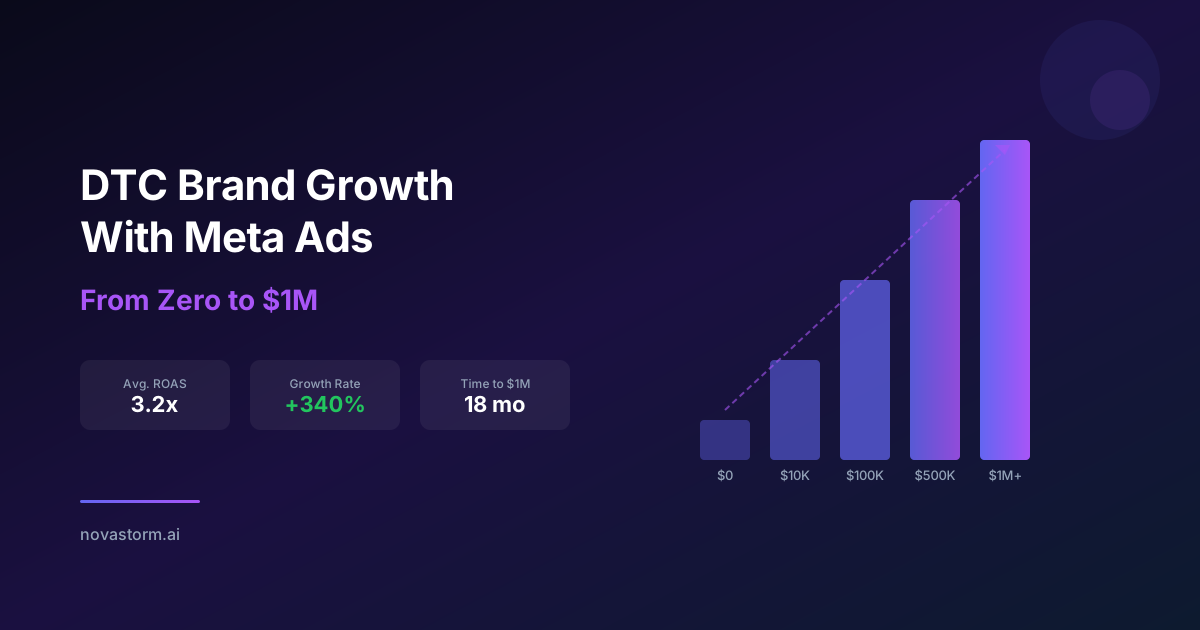
Scaling a direct-to-consumer brand from zero revenue to one million dollars is no longer a mythical achievement reserved for venture-backed startups. With the right Meta Ads strategy, DTC brand growth becomes a repeatable, data-driven process. Thousands of founders have proven that Facebook and Instagram advertising can be the primary engine that powers a brand from its first sale to seven-figure annual revenue.
The journey from zero to a million in revenue with DTC brand growth Meta Ads requires more than just throwing money at campaigns. It demands a structured approach to creative testing, audience building, and budget scaling that evolves as your brand matures. This guide breaks down exactly how successful DTC brands navigate each revenue milestone.
The Four Stages of DTC Brand Growth With Meta Ads
Every DTC brand that scales through Meta Ads follows a predictable growth curve. Understanding where you are in this curve determines which strategies will move the needle. Trying to scale like a million-dollar brand when you are still validating product-market fit is the fastest way to burn through your budget.
| Stage | Revenue Range | Monthly Ad Spend | Primary Objective | Key Metric |
|---|---|---|---|---|
| Validation | $0 – $10K | $1K – $3K | Prove product-market fit | Purchase conversion rate |
| Foundation | $10K – $100K | $3K – $15K | Build repeatable acquisition | Blended ROAS |
| Scaling | $100K – $500K | $15K – $75K | Expand audiences profitably | MER (Marketing Efficiency Ratio) |
| Acceleration | $500K – $1M+ | $75K – $200K+ | Maximize market share | Incremental ROAS |
Each stage requires different creative approaches, audience strategies, and measurement frameworks. The brands that fail typically try to skip stages or apply scaling tactics before their foundation is solid.
Stage One: Validating Product-Market Fit Through Meta Ads
Before spending heavily on DTC brand growth Meta Ads, you need to confirm that people actually want your product at the price you are selling it. Meta Ads provide the fastest feedback loop for this validation. With as little as one thousand dollars per month, you can test whether your product resonates with your target audience.
Start with three to five ad creatives that showcase your product from different angles. Use a mix of lifestyle imagery, product demonstrations, and founder-led content. Target broad audiences based on interest categories relevant to your niche. At this stage, you are not optimizing for efficiency — you are gathering data.
The validation stage is about learning, not scaling. If your cost per acquisition is above your target but you are getting consistent purchases, that signals product-market fit. You can optimize costs later through creative iteration and audience refinement.
- Launch 3-5 creative concepts testing different value propositions
- Use broad targeting with 2-3 interest-based ad sets
- Set daily budgets at $30-$100 per ad set
- Run each test for 7-14 days before making decisions
- Track add-to-cart rate, purchase rate, and average order value
Stage Two: Building a Repeatable Acquisition Engine
Once you have validated that people will buy your product through Meta Ads, the next stage is building a repeatable system. This is where most DTC brand growth Meta Ads strategies either solidify or collapse. The goal is to create a machine that reliably converts ad spend into revenue at a predictable ratio.
At the foundation stage, your creative testing cadence becomes critical. Plan to test five to ten new creatives every two weeks. Winning creatives have a limited lifespan on Meta — typically four to six weeks before fatigue sets in. Building a pipeline of fresh creative ensures your acquisition engine never stalls.
Budget Allocation Framework for Foundation Stage
| Budget Category | Percentage | Purpose |
|---|---|---|
| Prospecting campaigns | 60-70% | New customer acquisition through broad and interest targeting |
| Retargeting campaigns | 15-20% | Converting website visitors and engaged users |
| Creative testing | 10-15% | Testing new ad concepts and messaging angles |
| Retention campaigns | 5-10% | Re-engaging past purchasers for repeat sales |
Your prospecting campaigns should run on Advantage+ Shopping or broad targeting with purchase optimization. Avoid over-segmenting your audiences at this stage. Meta's algorithm performs best with larger audience pools and sufficient conversion data.
Stage Three: Scaling Revenue Past Six Figures
Stop wasting ad budget
NovaStorm AI cuts Meta Ads CPA by 40% on average. Start free.
Reaching one hundred thousand dollars in revenue means your DTC brand growth Meta Ads strategy has proven itself. Now the challenge shifts from finding what works to expanding what works without destroying efficiency. This is the most technically demanding phase of scaling.
The key principle at this stage is horizontal scaling over vertical scaling. Instead of simply increasing budgets on winning campaigns (vertical), create new campaigns targeting different audience segments, testing new creative formats, and expanding to new placements (horizontal).
- Identify your top three performing creatives and create five variations of each
- Expand into new audience segments including lookalike audiences built from purchasers
- Launch dedicated campaigns for Instagram Reels and Stories placements
- Implement a testing campaign with 10% of total budget for experimental concepts
- Begin international expansion with English-speaking markets first
- Add catalog-based dynamic ads for product retargeting
At this stage, you should also begin measuring marketing efficiency ratio (MER) alongside platform-reported ROAS. MER — calculated as total revenue divided by total ad spend — gives you a holistic view of how your marketing investment translates to business growth, accounting for attribution gaps.
Stage Four: Accelerating to Seven-Figure Revenue
The final push from five hundred thousand to one million dollars in revenue requires a mindset shift. At this level, DTC brand growth Meta Ads optimization is about incrementality and market share rather than campaign-level ROAS. You need to understand which dollars are driving truly incremental revenue versus cannibalizing organic growth.
Brands at this stage typically allocate fifty to seventy percent of their digital marketing budget to Meta. They run Advantage+ Shopping campaigns as their primary prospecting vehicle, supplemented by brand awareness campaigns that feed the top of the funnel.
Brands that successfully cross the million-dollar threshold with Meta Ads share one common trait: they treat creative as their primary scaling lever. At high spend levels, audience targeting becomes less important because Meta's algorithm optimizes delivery automatically. The creative is what determines your ceiling.
Creative Strategy That Powers DTC Brand Growth
Across all four stages, creative is the single most important variable in your DTC brand growth Meta Ads strategy. The brands that scale fastest produce the most creative volume and test the most aggressively. There is a direct correlation between creative testing velocity and revenue growth rate.
| Revenue Level | Creative Tests Per Month | Winning Creative Lifespan | Format Mix |
|---|---|---|---|
| $0 – $10K | 5-10 creatives | 6-8 weeks | 80% static, 20% video |
| $10K – $100K | 10-20 creatives | 4-6 weeks | 60% video, 40% static |
| $100K – $500K | 20-40 creatives | 3-4 weeks | 50% video, 30% UGC, 20% static |
| $500K – $1M+ | 40-80 creatives | 2-3 weeks | 40% UGC, 30% video, 20% static, 10% catalog |
User-generated content becomes increasingly important as you scale. Authentic testimonials, unboxing videos, and lifestyle content from real customers consistently outperform polished brand creative at higher spend levels. Build a system for collecting and repurposing UGC at every stage of growth.
Common Pitfalls That Stall DTC Brand Growth on Meta
Understanding what not to do is equally important. Many DTC brands plateau or decline because they fall into predictable traps during their scaling journey. Recognizing these pitfalls early saves both money and momentum.
- Scaling budgets too aggressively — increasing more than 20% per week destabilizes campaign learning
- Neglecting creative refresh — running the same ads for months leads to audience fatigue and rising CPMs
- Over-relying on retargeting — spending more than 25% of budget on retargeting limits new customer acquisition
- Ignoring landing page experience — a slow or confusing post-click experience wastes every ad dollar
- Chasing vanity metrics — optimizing for clicks or impressions instead of purchases and revenue
- Making decisions too quickly — not allowing campaigns 7 days of data before evaluating performance
The path from zero to one million in revenue through DTC brand growth Meta Ads is well-documented. The brands that succeed follow a disciplined, stage-appropriate strategy that evolves with their business. They invest heavily in creative production, measure what matters, and resist the temptation to scale before their foundation is ready.
Whether you are launching your first campaign or pushing toward seven figures, the principles remain the same: test relentlessly, scale systematically, and let the data guide every decision.
Novastorm AI automates Meta Ads routine — from monitoring to optimization. Learn more at novastorm.ai
Disclaimer: This article was generated with the assistance of AI and reviewed by the NovaStorm AI team. While we strive for accuracy, we recommend verifying specific data points and consulting official sources (linked where available) for critical business decisions.
Ready to automate your Meta Ads?
NovaStorm AI takes full responsibility for your campaigns — from monitoring to optimization.
Get Started FreeRelated Articles
DTC vs Wholesale: How Meta Ads Strategy Differs by Channel
Understand the key differences in Meta Ads strategy for DTC versus wholesale channels. Learn targeting, creative, and budget approaches for each distribution model.
Building a DTC Brand Identity Through Meta Ad Creative
Discover how to build a strong DTC brand identity through Meta ad creative. Learn visual systems, messaging frameworks, and consistency strategies that convert.
Boosting Organic Posts vs Running Ads: When Each Strategy Wins
Boosting organic posts vs running Meta Ads — learn when each strategy wins. Compare costs, targeting, and performance to make the right choice for your brand.