Boosting Organic Posts vs Running Ads: When Each Strategy Wins
Boosting organic posts vs running Meta Ads — learn when each strategy wins. Compare costs, targeting, and performance to make the right choice for your brand.
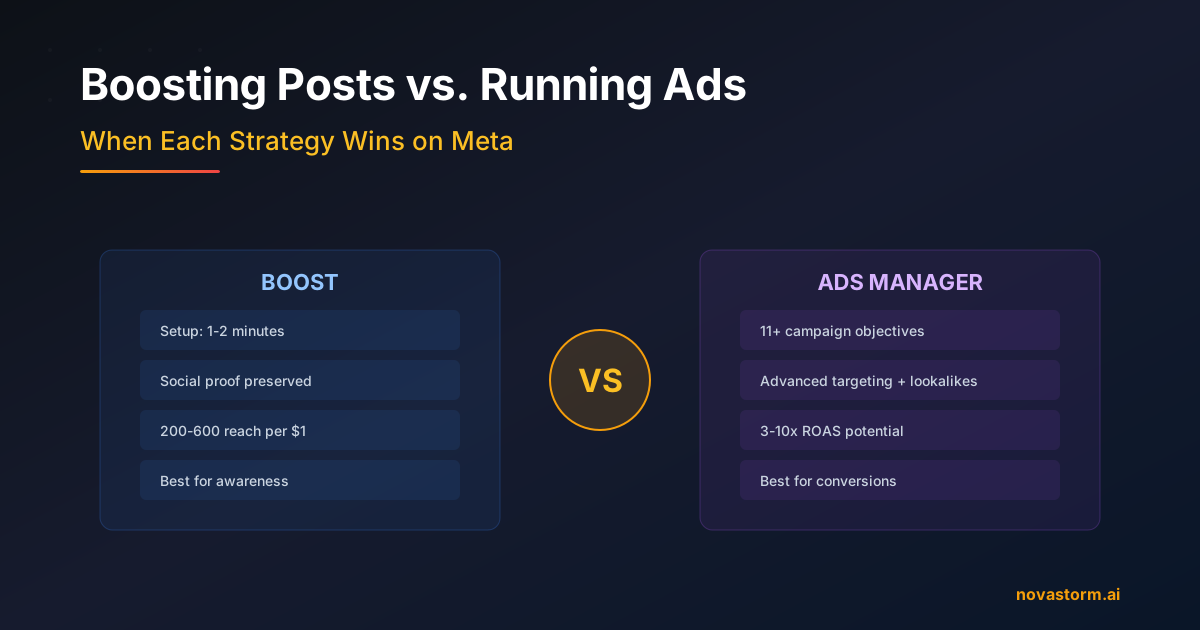
Every Meta advertiser faces this decision repeatedly: should you boost an organic post or build a dedicated ad campaign in Ads Manager? The answer is not always obvious. Boosting organic posts vs running ads involves trade-offs in control, targeting precision, cost efficiency, and scalability. Understanding when each strategy wins is essential for maximizing your return on Meta platforms.
This guide breaks down the differences, use cases, and decision framework so you can stop guessing and start choosing the right approach every time.
Understanding the Fundamental Difference
Boosting is a simplified promotion tool built into Facebook and Instagram. You select an existing organic post, set a budget and duration, choose a basic audience, and Meta distributes the post to more people. It takes two minutes and requires zero Ads Manager expertise.
Running ads through Ads Manager is the full-featured approach. You get access to every campaign objective, advanced audience targeting, placement controls, A/B testing, conversion tracking, and detailed reporting. It requires more setup but offers significantly more control.
The core distinction: boosting optimizes for engagement on existing content. Ads Manager optimizes for specific business outcomes. When you understand this, the decision of boosting organic posts vs running ads becomes much clearer.
When Boosting Organic Posts Wins
Boosting is not inherently inferior. There are specific scenarios where it outperforms full ad campaigns.
- Social proof amplification: A post with hundreds of organic likes, comments, and shares carries powerful social proof. Boosting preserves and extends that proof to new audiences. Ads Manager campaigns start with zero engagement.
- Speed and simplicity: When you need to promote time-sensitive content (event announcements, flash sales, trending topics), boosting takes seconds. Building a full campaign takes significantly longer.
- Brand awareness on a micro-budget: For budgets under $50, boosting often delivers more impressions than equivalent Ads Manager campaigns due to lower minimum thresholds and simpler optimization.
- Content validation: Boosting a post for $20-50 provides quick signal on whether a message resonates with a broader audience before committing larger budgets.
- Local business promotion: Small businesses targeting local audiences often see strong results from boosting posts that showcase products, customer reviews, or community involvement.
When Running Ads Wins
For most performance-driven objectives, Ads Manager campaigns deliver superior results. Here is where they dominate.
- Conversion optimization: Ads Manager lets you optimize for purchases, leads, sign-ups, and other bottom-funnel actions. Boosted posts optimize for engagement, which does not always translate to conversions.
- Advanced targeting: Lookalike audiences, custom audiences from CRM data, detailed exclusions, and layered interest targeting are only available through Ads Manager.
- A/B testing: Running structured tests on creative, audiences, and placements is essential for scaling. Ads Manager provides native testing tools that boosting cannot replicate.
- Retargeting campaigns: Reaching users who visited your website, added items to cart, or watched your videos requires Ads Manager's custom audience capabilities.
- Scaling budgets: Once you find a winning formula, Ads Manager offers campaign budget optimization, automated rules, and bid strategies that allow efficient scaling beyond what boosting supports.
Head-to-Head Comparison
| Feature | Boosted Post | Ads Manager Campaign |
|---|---|---|
| Setup Time | 1-2 minutes | 15-60 minutes |
| Campaign Objectives | Engagement, messages, website visits | Full range (11+ objectives) |
| Audience Targeting | Basic demographics, interests | Advanced: lookalikes, custom, exclusions |
| Placement Control | Automatic only | Manual placement selection |
| Creative Options | Existing post only | Multiple ad formats, dynamic creative |
| A/B Testing | Not available | Native split testing |
| Conversion Tracking | Limited | Full pixel/CAPI integration |
| Social Proof | Preserved from organic | Starts at zero (unless using existing post) |
| Minimum Budget | $1/day | $1/day (but more efficient at $5+) |
| Reporting Depth | Basic metrics | Detailed breakdown by demographic, placement, time |
The Decision Framework for Boosting Organic Posts vs Running Ads
Rather than defaulting to one approach, use this framework to decide case by case.
Stop wasting ad budget
NovaStorm AI cuts Meta Ads CPA by 40% on average. Start free.
Ask three questions before promoting any content: (1) What is the primary goal — engagement or conversion? (2) Is the content already performing well organically? (3) Do I need precise audience targeting or broad reach? If the goal is conversion, targeting is critical, or the content is new — use Ads Manager. If the goal is amplifying proven organic content to a broad audience — boost.
Many experienced advertisers use a hybrid approach. They boost top-performing organic posts for awareness and social proof, then build dedicated Ads Manager campaigns for conversion-focused objectives. This approach captures the benefits of both strategies.
Common Mistakes in the Boost vs Ads Decision
The most expensive mistake is boosting posts that never performed organically. If a post received minimal engagement from your existing audience, paying to show it to strangers will not change that. Boost winners, not losers.
Equally costly is using Ads Manager for simple awareness goals when a boost would suffice. The overhead of building a full campaign for a $30 promotion of an event announcement is unnecessary. Match the tool to the task.
Another frequent error is boosting with Meta's default audience settings. Always customize the audience, even if the options are limited compared to Ads Manager. Default targeting wastes a significant portion of your boost budget on irrelevant users.
Measuring Success Across Both Approaches
You need different metrics for each approach. Boosted posts should be measured by cost per engagement, reach expansion ratio (boosted reach divided by organic reach), and profile visits driven. Ads Manager campaigns should be measured by cost per acquisition, return on ad spend, and conversion rate.
| Metric | Boosted Post Benchmark | Ads Manager Benchmark |
|---|---|---|
| Cost Per Engagement | $0.02-$0.10 | $0.05-$0.25 |
| Cost Per Click (Link) | $0.30-$1.50 | $0.20-$1.00 |
| Reach per $1 Spent | 200-600 people | 100-400 people |
| Conversion Rate | 0.5-2% | 2-8% |
| ROAS (ecommerce) | 1-3x | 3-10x |
Notice the pattern: boosted posts deliver cheaper reach and engagement, while Ads Manager campaigns deliver better conversion efficiency. The right choice depends entirely on your objective.
Automating the Decision at Scale
When managing multiple brands or high-volume content calendars, manually evaluating every post for boost-worthiness becomes impractical. This is where automation delivers enormous value.
AI-powered tools can monitor organic performance in real time, automatically flag posts that exceed engagement thresholds, and either boost them or feed them into Ads Manager campaigns as proven creative. This removes the guesswork from boosting organic posts vs running ads and ensures every dollar goes to content that has already demonstrated potential.
Brands using automated boost-or-promote workflows report 35% higher engagement rates and 22% lower cost per result compared to manual decision-making.
The debate between boosting and running ads is not about choosing one forever. It is about choosing the right tool for each moment. Master both, automate the decision, and you will outperform competitors stuck in an either-or mindset.
Novastorm AI automates Meta Ads routine — from monitoring to optimization. Learn more at novastorm.ai
Disclaimer: This article was generated with the assistance of AI and reviewed by the NovaStorm AI team. While we strive for accuracy, we recommend verifying specific data points and consulting official sources (linked where available) for critical business decisions.
Ready to automate your Meta Ads?
NovaStorm AI takes full responsibility for your campaigns — from monitoring to optimization.
Get Started FreeRelated Articles

Accounting Firm Ads on Meta: Professional Services Lead Generation
Learn how to generate qualified leads for your accounting firm using Meta ads. Strategies for targeting, seasonal campaigns, and professional services marketing.
Coaching and Mentorship Ads on Meta: High-Ticket Service Marketing
Discover proven strategies for running coaching and mentorship ads on Meta. Learn audience targeting, funnel design, and creative approaches for high-ticket offers.
Consulting Business Ads on Meta: Selling Expertise Through Paid Social
Learn how to run high-performing Meta ads for consulting businesses. Strategies for lead generation, audience targeting, and converting prospects into clients.