Diminishing Returns in Meta Ads: Finding the Spend Sweet Spot
Learn how to identify diminishing returns in Meta Ads and find the optimal spend level where your budget delivers maximum efficiency without wasting ad dollars.
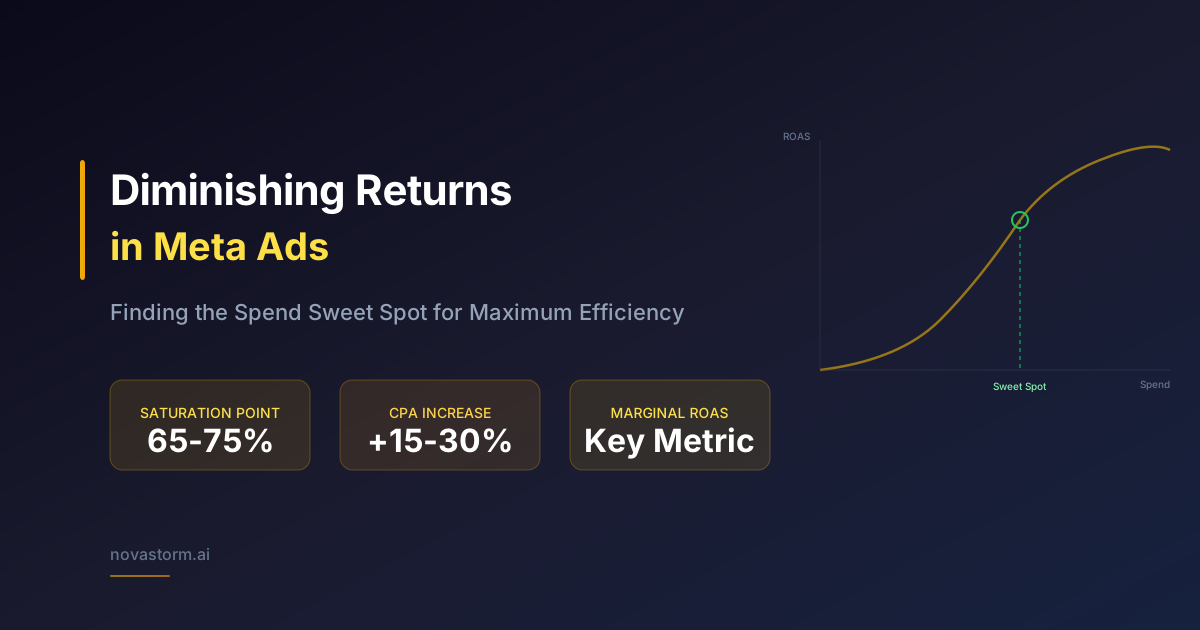
Every Meta Ads account has a point where spending more money produces less and less return. This is the law of diminishing returns, and it applies to digital advertising just as it applies to every other area of economics. The advertisers who thrive are the ones who know exactly where that point is.
Diminishing returns in Meta Ads means that your first dollar of ad spend generates significantly more value than your thousandth. As you scale, you exhaust the most responsive segments of your audience first. Each subsequent dollar reaches people who are less likely to convert, driving up your cost per acquisition and driving down your return on ad spend.
Why Diminishing Returns in Meta Ads Are Inevitable
Meta's auction system prioritizes showing your ads to users most likely to take your desired action. When your budget is modest, the algorithm can be selective, reaching only the highest-intent users. As you increase budget, the algorithm must expand to less responsive segments to spend your money.
Three forces drive diminishing returns in Meta Ads. First, audience saturation: you eventually reach everyone in your target audience, and frequency rises. Second, auction competition: higher budgets push you into more competitive auctions. Third, algorithmic expansion: Meta broadens targeting to find additional users, who are inherently less qualified.
Research across 500+ Meta Ads accounts shows that the average account hits significant diminishing returns at 65-75% of audience saturation. Beyond this point, CPA increases by 15-30% for every additional 10% of audience reach.
Identifying the Saturation Curve in Your Account
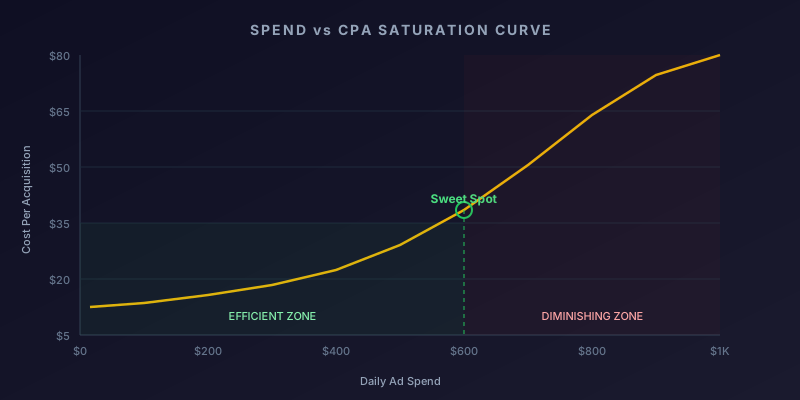
To find where diminishing returns in Meta Ads begin in your specific account, you need to map your spend-to-performance curve. This requires historical data showing how CPA and ROAS change as daily spend increases.
- Export 90 days of daily campaign-level data including spend, conversions, CPA, and ROAS
- Group days by spend ranges (e.g., $100-200, $200-300, $300-400)
- Calculate average CPA and ROAS for each spend bracket
- Plot the relationship between daily spend and CPA on a scatter chart
- Identify the inflection point where CPA begins accelerating upward
- This inflection point is your current diminishing returns threshold
The Marginal ROAS Framework
Average ROAS hides diminishing returns in Meta Ads because it blends high-efficiency early spend with low-efficiency later spend. Marginal ROAS isolates the return on your last dollar spent, giving you a true picture of whether increasing budget is worthwhile.
Calculate marginal ROAS by comparing performance at different spend levels. If spending $500/day produces $2,500 in revenue (5x ROAS) and spending $600/day produces $2,800 in revenue (4.67x ROAS), your marginal ROAS on that additional $100 is only 3x. Your average looks healthy, but your marginal spend is approaching breakeven.
| Daily Spend | Revenue | Average ROAS | Marginal ROAS | Signal |
|---|---|---|---|---|
| $200 | $1,200 | 6.0x | - | Strong efficiency |
| $400 | $2,200 | 5.5x | 5.0x | Healthy scaling |
| $600 | $3,000 | 5.0x | 4.0x | Early diminishing returns |
| $800 | $3,600 | 4.5x | 3.0x | Moderate diminishing returns |
| $1,000 | $4,000 | 4.0x | 2.0x | Approaching saturation |
| $1,200 | $4,200 | 3.5x | 1.0x | At or past sweet spot |
Finding Your Spend Sweet Spot
Stop wasting ad budget
NovaStorm AI cuts Meta Ads CPA by 40% on average. Start free.
The spend sweet spot is the budget level where marginal ROAS equals your breakeven ROAS. Below this point, every additional dollar generates profit. Above it, every additional dollar loses money on the margin, even though your average ROAS may still look acceptable.
For most e-commerce businesses, breakeven ROAS sits between 2x and 3x depending on margins. If your product has a 60% gross margin, your breakeven ROAS is approximately 1.67x. Your sweet spot for diminishing returns in Meta Ads is the spend level where marginal ROAS hits 1.67x.
Calculate your breakeven ROAS with this formula: 1 / gross margin percentage. If your gross margin is 50%, your breakeven ROAS is 1 / 0.50 = 2.0x. This is the floor for your marginal ROAS target.
Strategies to Push Back Diminishing Returns
While diminishing returns in Meta Ads cannot be eliminated, they can be delayed. Several strategies expand the efficient range of your spending curve, allowing you to scale further before hitting the wall.
- Expand your addressable audience with new interest targets, lookalikes, or geographic markets
- Refresh creative regularly to prevent ad fatigue, which accelerates diminishing returns
- Diversify ad formats across video, carousel, and collection to reach users in different contexts
- Improve landing page conversion rate so the same traffic generates more revenue
- Launch new product lines or offers to appeal to segments your current creative does not reach
- Test new placements like Reels and Messenger to access fresh inventory

Budget Allocation Across Campaigns at Scale
Different campaigns within your account hit diminishing returns in Meta Ads at different spend levels. Prospecting campaigns with broad audiences have a higher ceiling than retargeting campaigns targeting small audiences. Your budget allocation should reflect each campaign's saturation curve.
Map the marginal ROAS curve for each campaign independently. Allocate budget so that marginal ROAS is equalized across campaigns. When one campaign's marginal ROAS drops below another's, shift budget to the higher-opportunity campaign. This equalization approach maximizes total return across your portfolio.
Monitoring Diminishing Returns Over Time
Your diminishing returns threshold is not static. It shifts with seasonality, competition, creative freshness, and audience changes. Monitor your saturation curve monthly and adjust budgets accordingly. A sweet spot of $800/day in January may be $1,200/day during peak season when audiences are more active and responsive.
Build an automated dashboard that tracks marginal ROAS by spend bracket on a rolling 14-day basis. When marginal ROAS drops below your target, the dashboard should flag the campaign for budget reduction. When marginal ROAS is well above target, it signals room to scale. This data-driven approach to managing diminishing returns in Meta Ads ensures your budget always operates within the efficient zone.
Novastorm AI automates Meta Ads routine — from monitoring to optimization. Learn more at novastorm.ai
Disclaimer: This article was generated with the assistance of AI and reviewed by the NovaStorm AI team. While we strive for accuracy, we recommend verifying specific data points and consulting official sources (linked where available) for critical business decisions.
Ready to automate your Meta Ads?
NovaStorm AI takes full responsibility for your campaigns — from monitoring to optimization.
Get Started FreeRelated Articles

Meta Ads Not Spending Budget: Diagnosis and Fix Guide
Discover why your Meta Ads are not spending budget and how to fix delivery issues. Step-by-step diagnosis guide covering bid strategy, audience, and creative fixes.
Retargeting Exclusions: When to Stop Showing Ads to Converted Users
Master retargeting exclusions on Meta Ads. Learn when and how to stop showing ads to converted users to save budget and improve campaign performance.
Automated Creative Testing Frameworks for Meta Ads at Scale
Build an automated creative testing framework for Meta Ads that tests 50+ variants monthly. Structured systems boost winning creative rates by 3x at scale.