Daily vs Lifetime Budgets in Meta Ads: Which Strategy Wins
Compare daily vs lifetime budgets in Meta Ads. Learn when each strategy works best, the pros and cons, and how to choose the right approach for your campaigns.
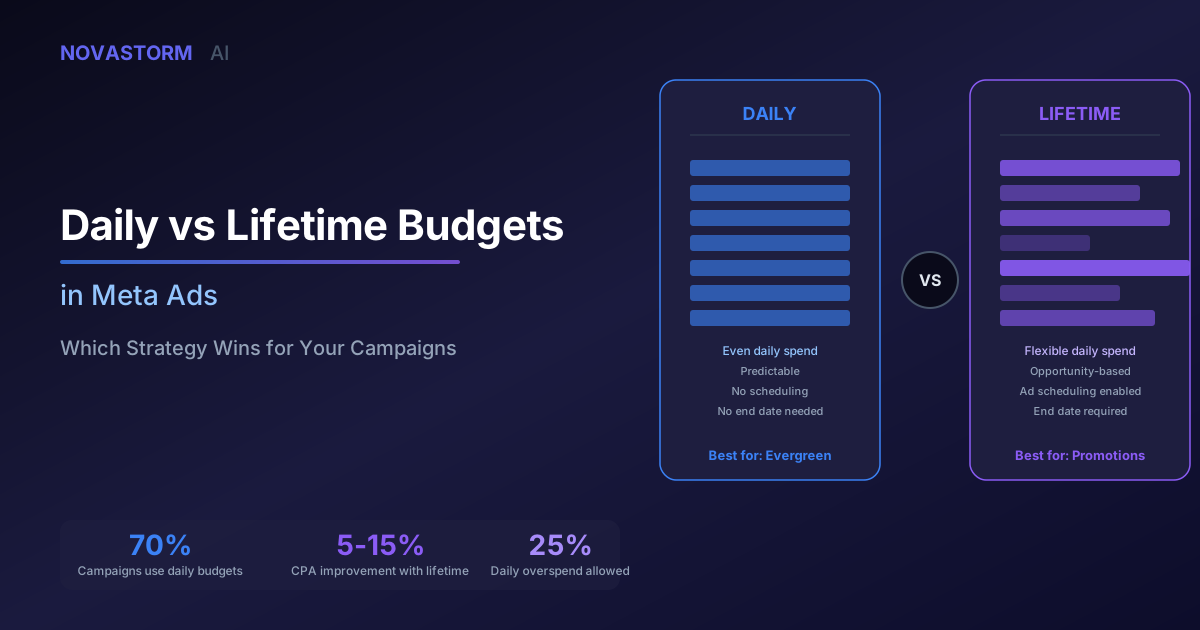
The choice between daily vs lifetime budgets in Meta Ads seems simple on the surface but has significant implications for how your campaigns spend, optimize, and perform. Each budget type tells Meta's algorithm something different about your spending priorities, and choosing wrong can cost you efficiency.
This guide breaks down when each budget type wins, the hidden advantages most advertisers miss, and a decision framework to choose the right approach for every campaign you run.
How Daily vs Lifetime Budgets Actually Work
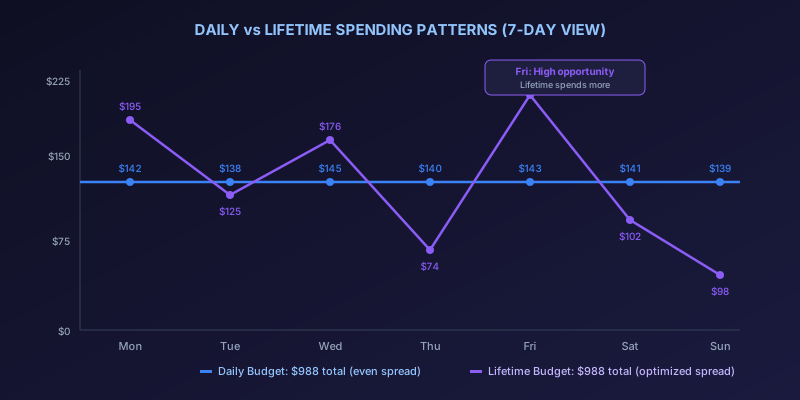
A daily budget sets the average amount Meta can spend per day. On some days, Meta may spend up to 25% more than your daily budget if it sees opportunities, balancing it on slower days. A lifetime budget sets the total amount for the campaign's entire run, giving Meta flexibility to distribute spend across days as it sees fit.
| Feature | Daily Budget | Lifetime Budget |
|---|---|---|
| Spend control | Average per day (can exceed by 25%) | Total for campaign duration |
| Daily flexibility | Low — roughly same spend each day | High — Meta shifts spend between days |
| Ad scheduling | Not available | Available (dayparting) |
| Pacing | Even throughout the day | Optimized across campaign lifetime |
| Budget changes | Change anytime, takes effect next day | Change total at any time |
| End date required | No | Yes |
| Best for | Evergreen campaigns | Time-bound promotions |
The most overlooked difference between daily vs lifetime budgets is pacing. Lifetime budgets let Meta spend more on high-opportunity days and less on low-opportunity days, potentially improving overall efficiency.
When Daily Budgets Win
Daily budgets are the default choice for most advertisers, and for good reason. They provide predictable spending and easier cash flow management. Here is when daily budgets are the superior choice:
- Evergreen campaigns with no end date — your always-on prospecting and retargeting
- When you need predictable daily spend for financial reporting
- Testing phase when you want consistent exposure to evaluate creative
- Campaigns where you plan to adjust budgets frequently based on performance
- When working with strict daily spending limits from clients or management
Daily budgets give you the most control over short-term spending. If you need to know within a tight range what today's ad spend will be, daily budgets are your answer.
When Lifetime Budgets Win
Lifetime budgets unlock capabilities that daily budgets cannot match. They are the stronger choice in several specific scenarios:
- Time-bound promotions with a clear start and end date
- When you want ad scheduling (dayparting) to avoid low-converting hours
- Product launches where initial days may need more spend than later days
- Seasonal campaigns like holiday sales or event promotions
- When Meta's day-to-day spending optimization can improve efficiency
The ad scheduling advantage alone makes lifetime budgets worth considering for any advertiser who has identified clear high-converting and low-converting time windows. If your data shows minimal conversions between midnight and 6 AM, daily vs lifetime budgets is not even a contest — lifetime with scheduling wins.
The Hidden Advantages of Lifetime Budgets
Stop wasting ad budget
NovaStorm AI cuts Meta Ads CPA by 40% on average. Start free.
Beyond ad scheduling, lifetime budgets have performance advantages that many advertisers overlook when comparing daily vs lifetime budgets.
| Advantage | How It Works | Impact |
|---|---|---|
| Opportunity-based pacing | Meta spends more on high-opportunity days | 5-15% better CPA in some cases |
| Weekend optimization | Algorithm can shift budget to high-converting weekdays | Reduces wasted weekend spend |
| Event response | Extra spend on days with viral organic content | Capitalizes on momentum |
| End-of-campaign optimization | Paces down as campaign nears end date | Avoids last-day overspend |
For time-bound campaigns, always choose lifetime budgets. They outperform daily budgets for promotions with fixed start and end dates because the algorithm can optimize spend distribution across the entire run.
Common Mistakes With Each Budget Type
Both budget types have pitfalls. Understanding these mistakes helps you avoid the most common errors in the daily vs lifetime budgets decision.
| Mistake | Budget Type | Consequence | Fix |
|---|---|---|---|
| Setting daily budget too low | Daily | Never exits learning phase | Ensure budget supports 50 weekly conversions |
| No end date on lifetime budget | Lifetime | Cannot set lifetime without end date | Always define campaign duration |
| Changing daily budget too often | Daily | Resets learning phase each time | Limit changes to once every 3-4 days |
| Not using ad scheduling with lifetime | Lifetime | Misses main advantage | Set schedule based on conversion data |
| Mixing types in one campaign | Both | Inconsistent pacing across ad sets | Use same type across campaign |
The Hybrid Approach
The best advertisers do not exclusively choose one side of the daily vs lifetime budgets debate. They use a hybrid approach that matches budget type to campaign purpose.
- Evergreen prospecting campaigns: Daily budgets for predictable ongoing spend
- Retargeting campaigns: Daily budgets for steady audience coverage
- Flash sales and promotions: Lifetime budgets with ad scheduling
- Product launches: Lifetime budgets to front-load spend on launch day
- Seasonal campaigns: Lifetime budgets to optimize across the promotion window
Decision Framework: Daily vs Lifetime Budgets
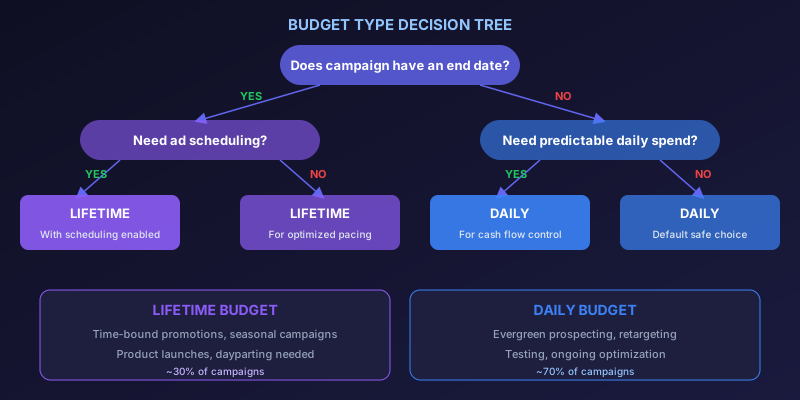
Use this three-question framework to make the right choice for every campaign:
- Does the campaign have a fixed end date? If yes, lean toward lifetime budgets.
- Do you need ad scheduling to avoid low-converting hours? If yes, lifetime budgets are required.
- Do you need predictable daily spending for cash flow or reporting? If yes, daily budgets are preferred.
If questions 1 and 2 are no, and question 3 is yes, use daily budgets. If either question 1 or 2 is yes, lifetime budgets are likely the better choice. The daily vs lifetime budgets decision ultimately depends on whether you value daily predictability or overall campaign efficiency.
Roughly 70% of evergreen Meta Ads campaigns should use daily budgets. But for time-bound promotions and campaigns where ad scheduling adds value, lifetime budgets consistently outperform.
Novastorm AI automates Meta Ads routine — from monitoring to optimization. Learn more at novastorm.ai
Disclaimer: This article was generated with the assistance of AI and reviewed by the NovaStorm AI team. While we strive for accuracy, we recommend verifying specific data points and consulting official sources (linked where available) for critical business decisions.
Ready to automate your Meta Ads?
NovaStorm AI takes full responsibility for your campaigns — from monitoring to optimization.
Get Started FreeRelated Articles
Viral Loop Campaigns on Meta: Designing Ads That Get Shared
Learn how to design viral loop campaigns on Meta that get shared organically. Build self-amplifying ad systems with referral mechanics and share triggers.
Conversion Campaigns vs Traffic Campaigns: Which to Choose on Meta
Compare conversion campaigns vs traffic campaigns on Meta. Learn which objective delivers better ROI, when to use each, and how to transition between them.

North Star Metric for Meta Ads: Choosing the Right Optimization Goal
Define your North Star Metric for Meta Ads to align every campaign toward a single meaningful goal. Stop optimizing for vanity metrics and start driving growth.