Customer Lifetime Value: How LTV Changes Your Meta Ads Strategy
Discover how customer lifetime value transforms your Meta Ads approach. Learn LTV calculation, LTV:CAC ratios, value-based lookalikes, and long-term ROAS strategy.
Why Customer Lifetime Value Is the Most Important Metric You Might Be Ignoring
Customer lifetime value is the metric that separates advertisers who scale profitably from those who hit a ceiling and cannot figure out why. Most Meta Ads managers optimize for immediate ROAS, judging every campaign by whether it returns more than it costs within a short attribution window. But this approach systematically undervalues customers who make small first purchases and then become loyal repeat buyers. When you understand the full lifetime value of your customers, your entire advertising strategy shifts from conservative short-term thinking to confident long-term growth.
Consider this scenario: a customer acquired through Meta Ads makes a first purchase of $40 at a cost per acquisition of $25. On a single-purchase basis, that looks barely profitable. But if that customer returns to buy three more times over the next 12 months, spending $200 total, the picture changes entirely. Your true CPA relative to customer value is now $25 against $200, a ratio that opens up far more aggressive bidding and budget allocation.
How to Calculate Customer Lifetime Value
There are several approaches to calculating LTV, ranging from simple to sophisticated. The right method depends on your data maturity and business model. Start with what you have and refine over time.
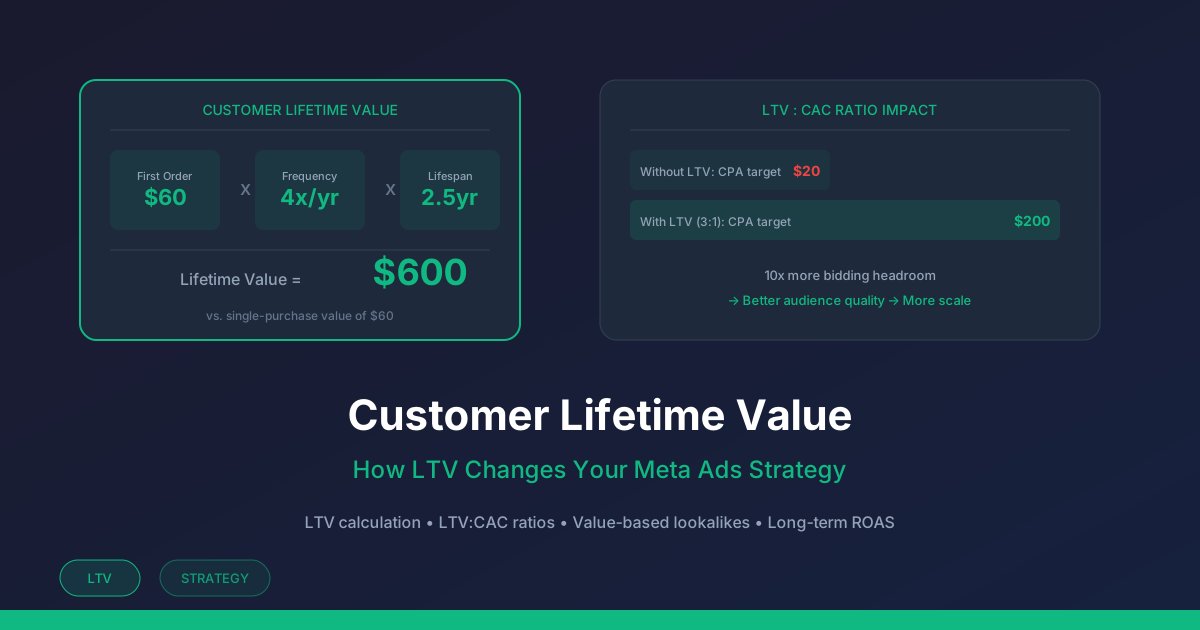
The simplest formula is: LTV = Average Order Value multiplied by Purchase Frequency multiplied by Customer Lifespan. For example, if your average order is $60, customers buy 4 times per year, and the average customer relationship lasts 2.5 years, then LTV = $60 x 4 x 2.5 = $600. This gives you a useful starting point even if the numbers are estimates.
| LTV Method | Formula | Best For | Accuracy |
|---|---|---|---|
| Simple LTV | AOV x Purchase Frequency x Lifespan | Quick estimates | Low-Medium |
| Historic LTV | Sum of all revenue from a cohort / Number of customers | Established businesses with 2+ years data | Medium-High |
| Predictive LTV | ML model using purchase history, behavior, demographics | Data-rich businesses with large customer bases | High |
| Cohort-based LTV | Revenue per cohort tracked over time | Comparing acquisition channels | High |
Start with simple LTV using your last 12 months of data. Even a rough number is infinitely more useful than no LTV figure at all. You can refine the calculation as you gather more data and implement better tracking.
The LTV:CAC Ratio and What It Means for Your Ads
The LTV to CAC ratio is the relationship between how much a customer is worth over their lifetime and how much it costs to acquire them. This single ratio tells you whether your customer acquisition is economically sustainable and how aggressively you can invest in growth.
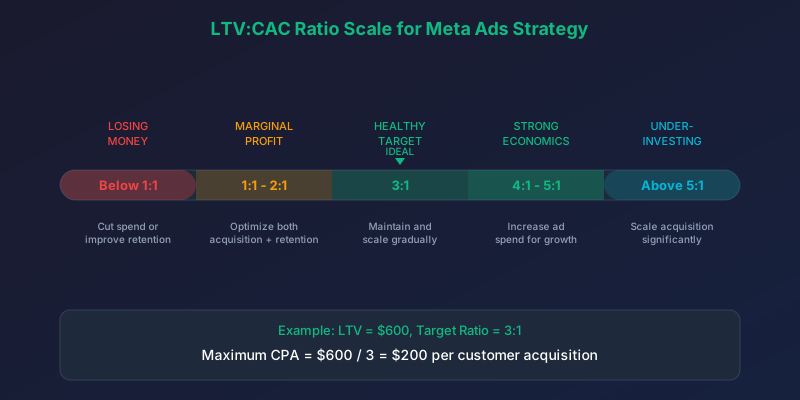
A healthy LTV:CAC ratio for most businesses is 3:1, meaning the lifetime value of a customer is at least three times the cost of acquiring them. A ratio of 1:1 means you are breaking even over the customer lifetime, which leaves no room for operational costs. A ratio above 5:1 might actually indicate you are underinvesting in acquisition and leaving growth on the table.
| LTV:CAC Ratio | Interpretation | Action |
|---|---|---|
| Below 1:1 | Losing money on every customer | Reduce CAC or increase LTV immediately |
| 1:1 to 2:1 | Marginal profitability | Optimize both acquisition and retention |
| 3:1 | Healthy and sustainable | Maintain and gradually scale |
| 4:1 to 5:1 | Strong unit economics | Consider increasing ad spend for growth |
| Above 5:1 | Potentially underinvesting | Scale acquisition spend significantly |
How LTV Affects Your Target CPA
When you know your LTV, you can set a target CPA that reflects the true value of a customer rather than just the first transaction. This is transformative for Meta Ads bidding strategy. Instead of bidding to break even on the first purchase, you bid based on the expected total revenue a customer will generate.
For example, if your LTV is $300 and you want a 3:1 LTV:CAC ratio, your target CPA is $100. That might seem expensive for a product that sells for $50, but if the average customer buys six times, you are acquiring $300 in revenue for $100 in ad spend. This higher CPA target gives Meta's algorithm more room to find quality customers, often resulting in better audience quality even though individual acquisition costs are higher.
Stop wasting ad budget
NovaStorm AI cuts Meta Ads CPA by 40% on average. Start free.
Value-Based Lookalikes
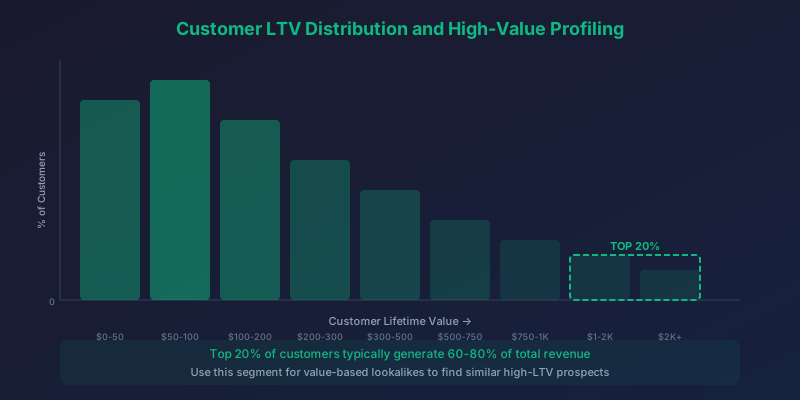
Meta allows you to create value-based lookalike audiences by uploading a customer list with associated purchase values. Instead of finding people similar to all your customers equally, the algorithm weights the lookalike toward people resembling your highest-value customers. This is LTV in action at the audience level.
To create a value-based lookalike, upload a customer list to Meta with a 'value' column representing LTV or total purchase amount. Meta then builds the lookalike audience prioritizing similarity to your top-spending customers. In practice, value-based lookalikes consistently outperform standard lookalikes for businesses with meaningful variance in customer value.
High-LTV Customer Profiling
Understanding who your highest-value customers are enables better targeting and creative strategy. Analyze your top 20% of customers by lifetime spend and look for common characteristics. What products did they first purchase? Which acquisition channel brought them in? What demographics do they share? What is their average time between purchases?
- First purchase product: High-LTV customers often enter through specific products that correlate with repeat buying behavior.
- Acquisition source: Certain channels and campaign types may attract higher-LTV customers even if the initial CPA appears higher.
- Purchase cadence: High-LTV customers often show a pattern of purchasing within a specific timeframe after their first order.
- Category breadth: Customers who buy across multiple categories tend to have higher LTV than single-category shoppers.
- Engagement signals: Email open rates, website visit frequency, and social media interaction often correlate with higher LTV.
LTV by Acquisition Channel
Not all acquisition channels produce equal-quality customers. Measuring LTV by acquisition channel reveals which sources attract customers with the highest long-term value, even if their initial CPA differs. A channel that looks expensive on a last-click basis might actually produce your most valuable customers.
Within Meta Ads specifically, compare LTV across different campaign types, audience segments, and even creative variations. You might find that lookalike audiences produce customers with 30% higher LTV than interest-based audiences, or that video ad acquisitions have better retention than static image acquisitions. These insights should directly inform your budget allocation decisions.
Long-Term vs Short-Term ROAS
The tension between short-term and long-term ROAS is where many advertisers get stuck. Short-term ROAS, typically measured within a 7-day or 28-day attribution window, captures only the first purchase value. Long-term ROAS accounts for all revenue generated by acquired customers over their lifetime.
A campaign might show 1.5x ROAS on a 7-day window but deliver 6x ROAS when measured over 12 months. If you optimize solely for short-term ROAS, you would cut this campaign. But understanding LTV reveals it is actually one of your most profitable acquisition investments. The challenge is building the tracking and patience to measure long-term performance while still maintaining short-term financial health.
The best approach is a blended model. Set minimum short-term ROAS thresholds to ensure cash flow, but make strategic budget decisions based on projected long-term ROAS. This prevents cutting profitable campaigns prematurely while maintaining financial discipline.
Integrating LTV into your Meta Ads strategy requires an upfront investment in data analysis and a willingness to think beyond immediate returns. But the payoff is substantial. You gain the confidence to bid higher, the insight to target better, and the patience to let profitable campaigns mature. In a competitive landscape where most advertisers optimize only for the first sale, understanding lifetime value gives you a decisive strategic advantage.
Novastorm AI automates Meta Ads routine — from monitoring to optimization. Learn more at novastorm.ai
Disclaimer: This article was generated with the assistance of AI and reviewed by the NovaStorm AI team. While we strive for accuracy, we recommend verifying specific data points and consulting official sources (linked where available) for critical business decisions.
Ready to automate your Meta Ads?
NovaStorm AI takes full responsibility for your campaigns — from monitoring to optimization.
Get Started FreeRelated Articles
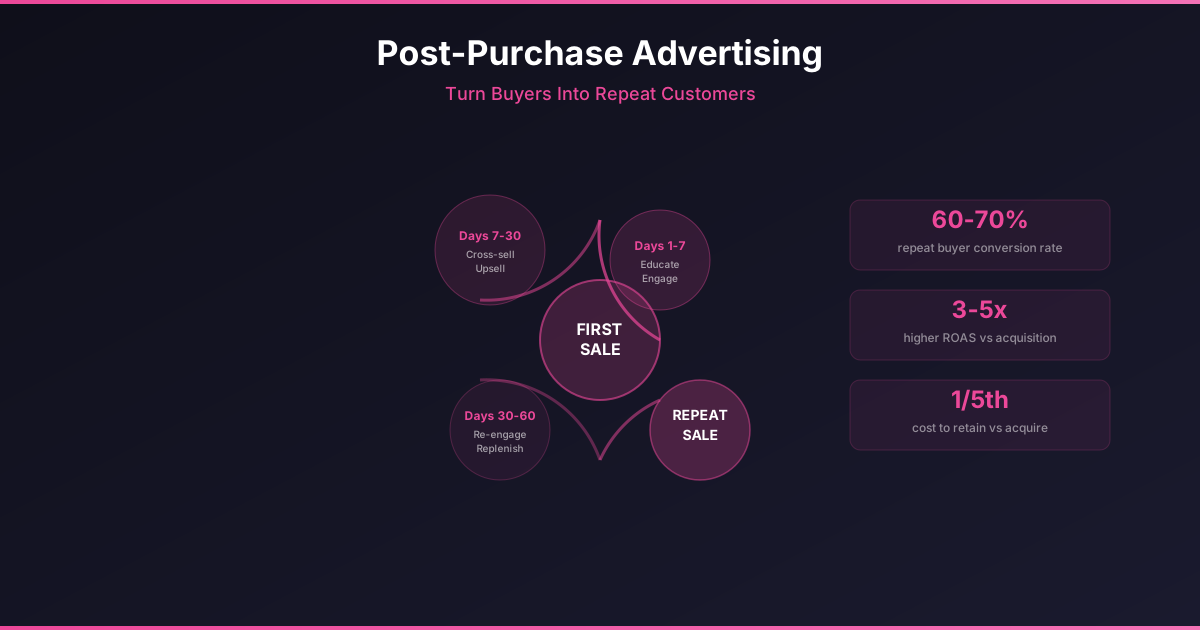
Post-Purchase Advertising: Turn Buyers Into Repeat Customers on Meta
Discover how post-purchase advertising on Meta turns one-time buyers into repeat customers. Includes timing strategies, cross-sell tactics, and retention vs acquisition spend analysis.
Value-Based Optimization in Meta Ads: Maximize Revenue Not Just Conversions
Master value-based optimization in Meta Ads to maximize revenue instead of just counting conversions. Learn VBO setup, data thresholds, and ROAS improvements.
ROAS: The Complete Guide to Return on Ad Spend
Master ROAS with this complete guide. Learn the formula, good ROAS by industry, breakeven ROAS calculation, and proven strategies for improving return on ad spend.