Budget Allocation Across Funnel Stages in Meta Ads
Master budget allocation across funnel stages in Meta Ads. Learn optimal spend ratios for TOF, MOF, and BOF campaigns to maximize full-funnel performance.

Allocating your Meta Ads budget across funnel stages is the difference between a campaign system that compounds growth and one that plateaus. Most advertisers either dump everything into prospecting or over-invest in retargeting audiences that are too small to scale. Smart budget allocation across funnel stages ensures every dollar works within a system designed for sustainable results.
This article breaks down exactly how to distribute your Meta Ads budget between top-of-funnel, mid-funnel, and bottom-of-funnel campaigns. You will learn the ratios, the reasoning, and the signals that tell you when to shift spend between stages.
Why Budget Allocation Across Funnel Stages Matters
Each funnel stage serves a distinct purpose and operates on different economics. Top-of-funnel campaigns build awareness and fill your pixel with data. Mid-funnel campaigns nurture consideration and build intent. Bottom-of-funnel campaigns convert warm audiences into buyers. Without proper budget allocation across funnel stages, one part of the system starves while another wastes money.
The most common mistake is evaluating each stage in isolation. A prospecting campaign with a $40 CPA looks expensive until you realize it feeds a retargeting campaign with a $12 CPA. Blended economics across the funnel is what matters for profitability.
Advertisers with structured funnel-based budget allocation see 31% lower blended CPA compared to those running single-stage campaigns.
The Standard Funnel Budget Framework
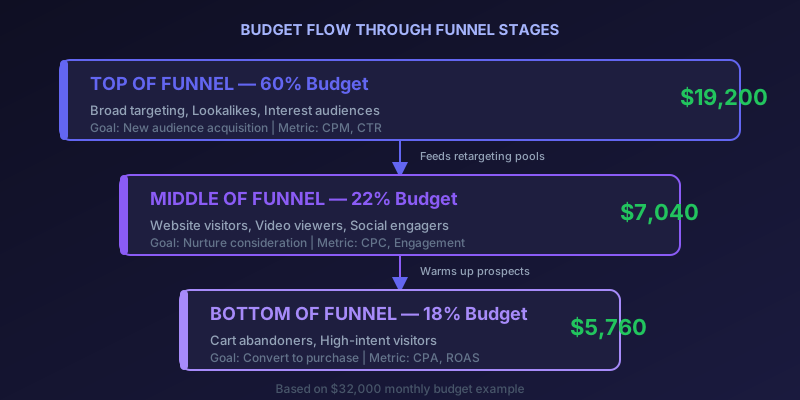
While every business is different, the following ratios serve as a reliable starting point for budget allocation across funnel stages in Meta Ads.
| Funnel Stage | Budget % | Objective | Key Metrics | Typical CPA Ratio |
|---|---|---|---|---|
| Top of Funnel (TOF) | 55-65% | Awareness / Reach | CPM, CTR, Thumbstop Rate | 3-5x of BOF |
| Middle of Funnel (MOF) | 20-25% | Consideration / Engagement | CPC, Engagement Rate, Video Views | 1.5-2x of BOF |
| Bottom of Funnel (BOF) | 15-20% | Conversion / Purchase | CPA, ROAS, Conversion Rate | 1x (baseline) |
The majority of your spend goes to TOF because that is where you acquire new audiences. Without fresh traffic entering the funnel, your retargeting pools shrink and frequency climbs. Budget allocation across funnel stages must always prioritize the top to maintain downstream volume.
Top-of-Funnel: The Growth Engine
Your TOF budget drives new audience discovery. These campaigns use broad targeting, lookalike audiences, and interest-based audiences to reach people who have never interacted with your brand.
- Broad targeting campaigns for Meta's algorithm to find converters
- Lookalike audiences based on top customers (1-3% similarity)
- Interest-based audiences for new market segments
- Video view campaigns to build retargeting pools cheaply
Expect higher CPAs at this stage. The goal is not immediate profitability from TOF alone but feeding qualified traffic into your mid-funnel and bottom-funnel campaigns. Judge TOF by the quality of downstream conversions it generates.
Mid-Funnel: The Nurture Layer
Mid-funnel campaigns target people who have shown initial interest: website visitors, video viewers, social engagers, and email subscribers who have not yet purchased. This stage is about building trust and moving prospects closer to a buying decision.
Stop wasting ad budget
NovaStorm AI cuts Meta Ads CPA by 40% on average. Start free.
| MOF Audience | Engagement Signal | Best Ad Format |
|---|---|---|
| Website visitors (7-30 days) | Browsed but did not buy | Product-focused carousel |
| Video viewers (50-95%) | Watched significant content | Testimonial or case study |
| Social engagers (90 days) | Liked, commented, shared | Offer-driven single image |
| Email subscribers (non-buyers) | Signed up but no purchase | Exclusive discount or bundle |
The mid-funnel budget should be proportional to the size of your retargeting audiences. If your website gets 50,000 monthly visitors, you need more MOF budget than someone with 5,000. Overspending on small audiences drives frequency through the roof and annoys potential customers.
Bottom-of-Funnel: The Conversion Layer
BOF campaigns target your hottest audiences: cart abandoners, product page viewers in the last 7 days, and repeat visitors. These people are closest to purchasing and typically convert at the lowest CPA.
- Cart abandoners within 3-7 days (highest intent)
- Product page viewers within 7 days
- Add-to-cart users who did not complete checkout
- Past purchasers for upsell and cross-sell campaigns
Do not over-allocate to BOF. These audiences are small and cap quickly. Spending more than 20% of your budget here usually results in high frequency and audience fatigue.
When to Adjust Your Funnel Budget Allocation
The standard ratios are starting points, not permanent fixtures. Several signals indicate that your budget allocation across funnel stages needs rebalancing.
| Signal | What It Means | Budget Action |
|---|---|---|
| BOF frequency above 8 | Audience saturated | Shift 5-10% from BOF to TOF |
| TOF CPA dropping consistently | Algorithm finding cheap converters | Increase TOF budget by 10-15% |
| MOF click-through rate falling | Creative fatigue in retargeting | Refresh creative, maintain budget |
| Blended ROAS above target | System performing well | Scale TOF to grow total volume |
| Retargeting pools shrinking | Not enough new traffic | Urgently increase TOF spend |

Measuring Full-Funnel Budget Efficiency
The ultimate metric for budget allocation across funnel stages is blended ROAS or blended CPA across your entire account. Individual stage metrics help with diagnostics, but business decisions should rest on the aggregate.
- Calculate total ad spend across all funnel stages
- Calculate total revenue attributed to Meta Ads
- Divide revenue by spend for blended ROAS
- Compare blended ROAS to your break-even ROAS threshold
- If blended ROAS exceeds threshold, scale TOF to grow volume
- If blended ROAS falls below threshold, optimize worst-performing stage first
This holistic view prevents the common trap of cutting TOF because its standalone ROAS looks weak, only to watch BOF performance collapse two weeks later from audience starvation. Budget allocation across funnel stages is a system-level decision, and it should be measured at the system level.
Set up a weekly dashboard that shows spend, conversions, and ROAS per funnel stage alongside blended totals. This gives you both the diagnostic detail and the strategic overview you need for smart allocation decisions.
Novastorm AI automates Meta Ads routine — from monitoring to optimization. Learn more at novastorm.ai
Disclaimer: This article was generated with the assistance of AI and reviewed by the NovaStorm AI team. While we strive for accuracy, we recommend verifying specific data points and consulting official sources (linked where available) for critical business decisions.
Ready to automate your Meta Ads?
NovaStorm AI takes full responsibility for your campaigns — from monitoring to optimization.
Get Started FreeRelated Articles
Viral Loop Campaigns on Meta: Designing Ads That Get Shared
Learn how to design viral loop campaigns on Meta that get shared organically. Build self-amplifying ad systems with referral mechanics and share triggers.
Conversion Campaigns vs Traffic Campaigns: Which to Choose on Meta
Compare conversion campaigns vs traffic campaigns on Meta. Learn which objective delivers better ROI, when to use each, and how to transition between them.

North Star Metric for Meta Ads: Choosing the Right Optimization Goal
Define your North Star Metric for Meta Ads to align every campaign toward a single meaningful goal. Stop optimizing for vanity metrics and start driving growth.