Bid Strategies Explained: Lowest Cost vs Cost Cap vs Bid Cap
Understand Meta Ads bid strategies — Lowest Cost, Cost Cap, and Bid Cap. Learn when to use each, how they interact with budget, and common mistakes to avoid.
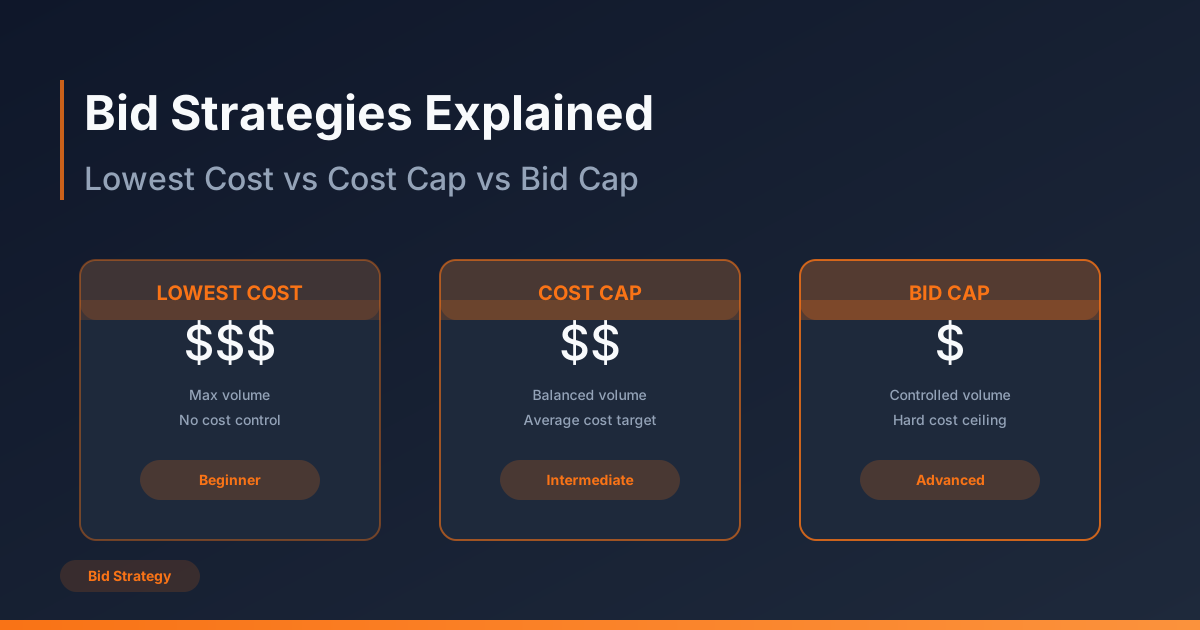
Choosing the right bid strategies in Meta Ads can mean the difference between profitable scaling and budget waste. Meta offers three primary bidding approaches — Lowest Cost, Cost Cap, and Bid Cap — each designed for different situations and advertiser skill levels. Understanding how each one works, when to deploy it, and what pitfalls to watch for is essential knowledge for anyone managing ad spend.
How Bid Strategies Work in Meta Ads
Every time an ad impression is available, Meta runs an auction. Your bid — combined with estimated action rates and ad quality — determines whether your ad wins that impression. Bid strategy tells Meta how aggressively to compete in these auctions and how to balance cost efficiency against volume.
Think of bid strategy as the throttle on your campaign. Lowest Cost pushes the pedal to the floor. Cost Cap sets a cruise control speed. Bid Cap gives you manual control of the exact RPM. Each has trade-offs between spend velocity, cost predictability, and volume.
Lowest Cost: The Default Starting Point
Lowest Cost is Meta's default bid strategy. It tells the algorithm to get you the most results possible for your budget while finding the lowest cost per result. There is no cost constraint — Meta will spend your full budget and optimize for volume.
This strategy works best when you are learning phase, exploring new audiences, or your primary goal is to maximize conversions without a strict CPA target. It is the simplest approach and requires the least manual intervention.
- Best for: New campaigns, learning phase, volume maximization.
- Advantage: Simplicity — set budget and let Meta optimize.
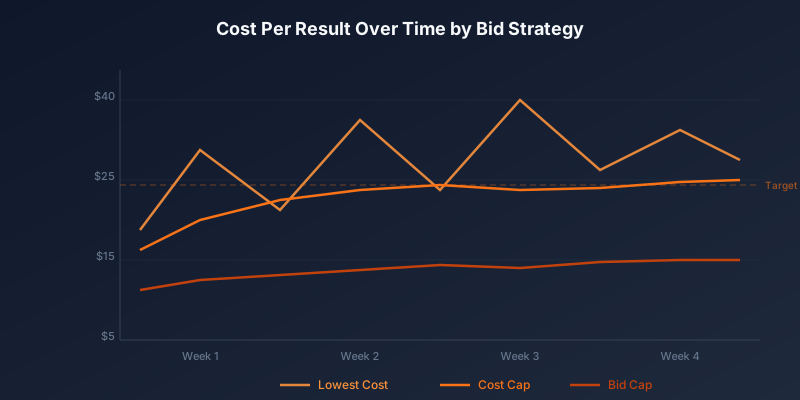
- Risk: Costs can fluctuate significantly, especially during high-competition periods.
- Budget behavior: Will always spend the full daily or lifetime budget.
Start with Lowest Cost when launching new campaigns. It gives the algorithm maximum flexibility to learn which users convert, building the data foundation you need before adding cost constraints.
Cost Cap: The Balanced Approach
Cost Cap tells Meta your target cost per result. The algorithm will try to get conversions at or below your specified amount, but it is an average target — individual conversions may cost more or less. Cost Cap balances volume with cost efficiency.
When you set a Cost Cap, Meta may not spend your full budget. If the algorithm cannot find conversions at your target cost, it will slow spending rather than overpay. This means your actual spend can be significantly less than your budget on some days.
Setting Up Cost Cap Correctly
- Run a Lowest Cost campaign first to establish your baseline CPA.
- Set your Cost Cap at or slightly above your baseline CPA — not at your dream CPA.
- Give the algorithm 3-5 days to calibrate before judging performance.
- If spend is too low, raise the cap by 10-20 percent increments.
- If costs are above cap, allow more time — Cost Cap is an average, not a hard limit.
The most common mistake with Cost Cap is setting it too low. If your baseline CPA is 25 dollars and you set a Cost Cap of 15 dollars, the algorithm will struggle to find conversions and may barely spend. Start realistic and tighten over time.
Bid Cap: Maximum Control for Advanced Buyers
Stop wasting ad budget
NovaStorm AI cuts Meta Ads CPA by 40% on average. Start free.
Bid Cap is the most restrictive strategy. It sets the maximum amount Meta can bid in any single auction. Unlike Cost Cap, which targets an average, Bid Cap is a hard ceiling — Meta will never bid above your specified amount for any individual auction.
This strategy is primarily used by experienced media buyers who understand auction dynamics and have enough data to set precise bid amounts. It offers the most cost control but also the most risk of under-delivery.
| Strategy | Cost Control | Volume | Spend Predictability | Skill Level |
|---|---|---|---|---|
| Lowest Cost | None | Maximum | Will spend full budget | Beginner |
| Cost Cap | Average target | Moderate | May underspend | Intermediate |
| Bid Cap | Hard ceiling | Variable | Often underspends | Advanced |
Budget and Bid Interaction
Your budget and bid strategy are two separate controls that interact. Budget determines the maximum you are willing to spend. Bid strategy determines how aggressively Meta pursues conversions within that budget.
With Lowest Cost, raising budget directly increases volume because Meta has no cost constraint. With Cost Cap, raising budget only increases volume if there are conversions available at your target cost. With Bid Cap, raising budget may not increase spend at all if your bid is too low to win auctions.
Never raise budget and change bid strategy simultaneously. Change one variable at a time, wait 3-5 days for stabilization, then adjust the other. Changing both at once makes it impossible to understand what caused any performance shift.
Common Bid Strategy Mistakes
- Setting Cost Cap below your actual baseline CPA and wondering why the campaign does not spend.
- Using Bid Cap without enough historical data to know the right bid amount.
- Switching strategies too frequently — each change resets the learning phase.
- Ignoring that Cost Cap is an average — some conversions will always cost more than your cap.
- Assuming Lowest Cost is always the worst option — for many accounts, it outperforms cost-constrained strategies.
- Setting Bid Cap based on gut feel rather than auction data and historical performance.
Switching Between Strategies
There is a natural progression for most advertisers. Start with Lowest Cost to build data and understand your baseline metrics. Once you have at least 50 conversions and a stable CPA, consider moving to Cost Cap to add cost guardrails. Only move to Bid Cap when you have deep auction insights and need precise cost control — typically for high-volume accounts with tight margins.
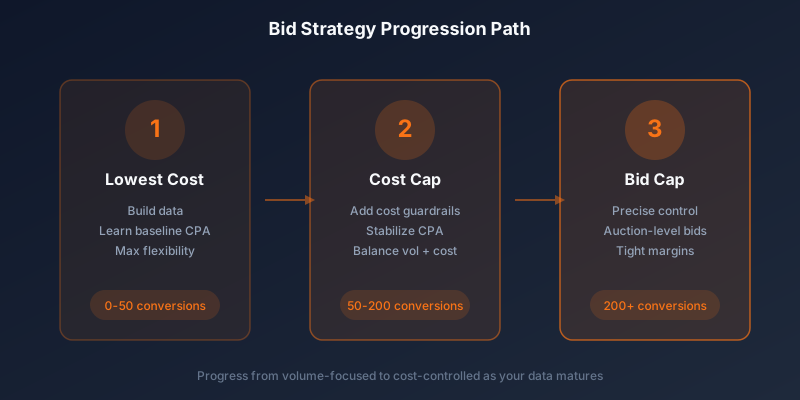
When switching, always duplicate the campaign rather than editing the existing one. This preserves your historical data and allows you to compare the two strategies running simultaneously for a brief overlap period.
The best bid strategy is the one that matches your current situation. There is no universally superior option — only the right tool for the job you need done right now.
Mastering bid strategies is a matter of understanding the trade-offs and matching them to your campaign goals. Whether you prioritize volume, cost efficiency, or predictability, Meta gives you the tools to control how your budget is deployed. Start simple, add constraints as your data matures, and never stop monitoring the results.
Novastorm AI automates Meta Ads routine — from monitoring to optimization. Learn more at novastorm.ai
Disclaimer: This article was generated with the assistance of AI and reviewed by the NovaStorm AI team. While we strive for accuracy, we recommend verifying specific data points and consulting official sources (linked where available) for critical business decisions.
Ready to automate your Meta Ads?
NovaStorm AI takes full responsibility for your campaigns — from monitoring to optimization.
Get Started FreeRelated Articles
Meta Advantage Suite: Complete Guide to All Automation Tools
Master every tool in the Meta Advantage Suite. Learn when to enable Advantage Campaign, Creative, Audience, Placements, and Shopping for maximum ad performance.

The Psychology of Color in Meta Ad Creative
Explore the psychology of color in Meta Ad creative. Learn how color associations, contrast, CTA button colors, and cultural meanings impact ad performance.
Managing Multiple Ad Accounts: Agency Best Practices
Agency best practices for managing multiple Meta Ad accounts including Business Manager setup, naming conventions, team permissions, cross-account reporting, and client onboarding.