Audience Testing Framework: Systematic Approach to Finding Winners
Build a systematic audience testing framework for Meta Ads. Learn the 4-tier approach that identifies profitable audiences 3x faster than random testing.
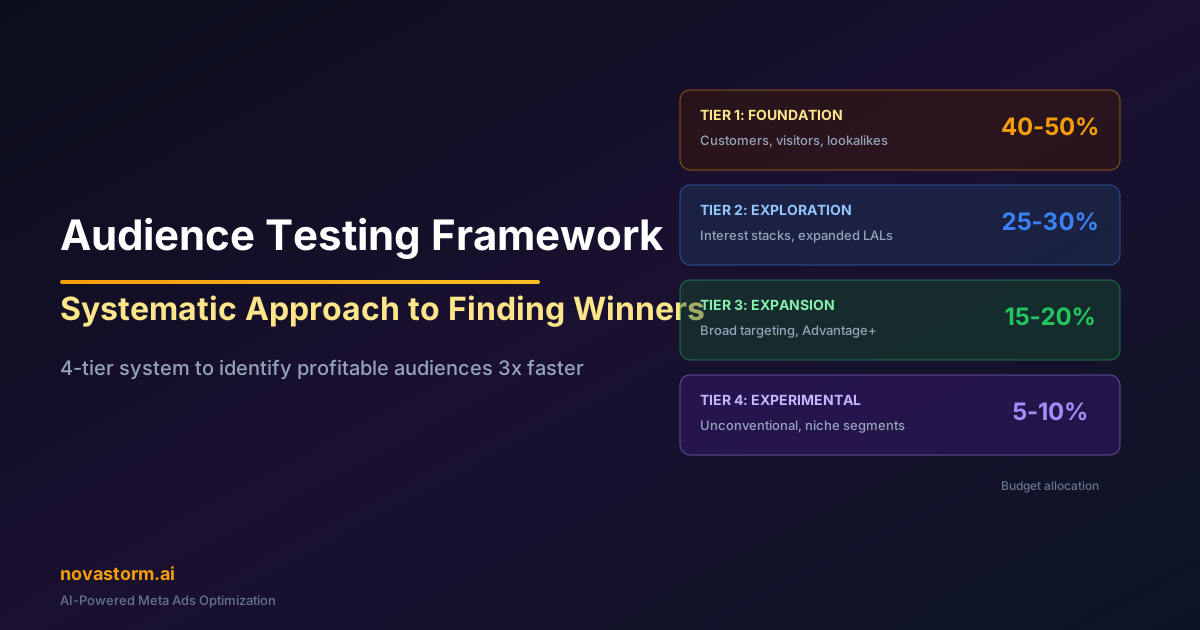
An audience testing framework transforms random targeting experiments into a disciplined system that surfaces profitable audience segments consistently. Most advertisers test audiences haphazardly: they try an interest here, a lookalike there, and make decisions based on whichever happens to perform best in any given week. This approach wastes budget and misses systematically discoverable opportunities.
A structured audience testing framework identifies winning audiences 3x faster than ad-hoc testing because it eliminates redundancy, controls for creative variables, and builds on previous learnings. This article presents the exact 4-tier system used by accounts spending $10,000 to $500,000 per month on Meta Ads.
The 4-Tier Audience Testing Framework
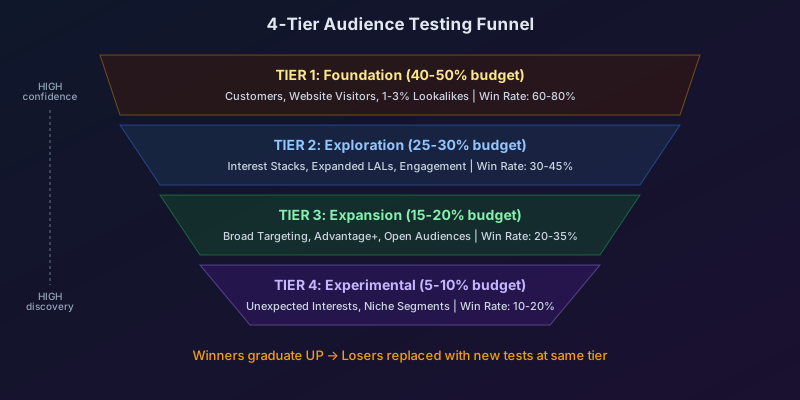
Tier 1 is your foundation: proven audiences that consistently deliver results. Tier 2 is exploration: systematically expanding from Tier 1 into adjacent segments. Tier 3 is expansion: testing broader and algorithmic audiences. Tier 4 is experimental: testing unconventional segments that challenge your assumptions.
| Tier | Audience Type | Budget Allocation | Expected Win Rate |
|---|---|---|---|
| Tier 1: Foundation | Existing customers, website visitors, high-intent lookalikes | 40-50% | 60-80% |
| Tier 2: Exploration | Interest stacks, expanded lookalikes, engagement audiences | 25-30% | 30-45% |
| Tier 3: Expansion | Broad targeting, Advantage+, open audiences | 15-20% | 20-35% |
| Tier 4: Experimental | Unexpected interests, demographic tests, niche segments | 5-10% | 10-20% |
Budget allocation follows expected win rates. You invest the most where success is most likely while reserving capacity for higher-risk, higher-reward exploration. This structure ensures your account grows steadily while continuously expanding its addressable market.
Tier 1: Testing Foundation Audiences
Foundation audiences are your warmest segments. They include website visitors (30, 60, 90, and 180-day windows), customer email lists, purchasers, and 1-3% lookalikes of your best customers. These audiences have the highest prior probability of converting because they either know your brand or closely resemble people who already buy.
- Test recency windows: 30-day vs. 60-day vs. 180-day website visitors often perform very differently
- Test lookalike source quality: lookalikes from purchasers vs. add-to-carts vs. all visitors
- Test lookalike percentage: 1% vs. 2% vs. 3% to find the optimal reach-quality balance
- Test customer list segments: high-LTV customers vs. all customers as lookalike seeds
- Layer geographic and demographic filters on top of lookalikes for tighter targeting
Always test your Tier 1 audiences with your proven best-performing creative. Isolate the audience variable by holding creative constant. Using untested creative with untested audiences makes it impossible to attribute performance differences.
Tier 2: Systematic Interest and Behavior Exploration
Once Tier 1 audiences are established, Tier 2 tests systematically expand your reach. The key is structure: instead of picking random interests, map your customer profile across five dimensions and test each one.
| Dimension | Example Interests/Behaviors | Test Method |
|---|---|---|
| Direct product interest | Your product category, competitor brands | 1 ad set per interest cluster |
| Adjacent lifestyle | Related hobbies, complementary products | 1 ad set per lifestyle segment |
| Professional attributes | Job titles, industries, company sizes | 1 ad set per professional segment |
| Media consumption | Publications, influencers, podcasts they follow | 1 ad set per media cluster |
| Purchase behavior | Online shoppers, engaged shoppers, frequent travelers | 1 ad set per behavior |
Stop wasting ad budget
NovaStorm AI cuts Meta Ads CPA by 40% on average. Start free.
Run 3-5 Tier 2 tests per week, each with a dedicated ad set and $30-50 daily budget. After 7 days, compare CPA and ROAS against your Tier 1 benchmarks. Audiences that come within 30% of Tier 1 performance graduate to sustained spending. Those that exceed Tier 1 become your new foundation.
Tier 3: Broad and Algorithmic Audience Testing
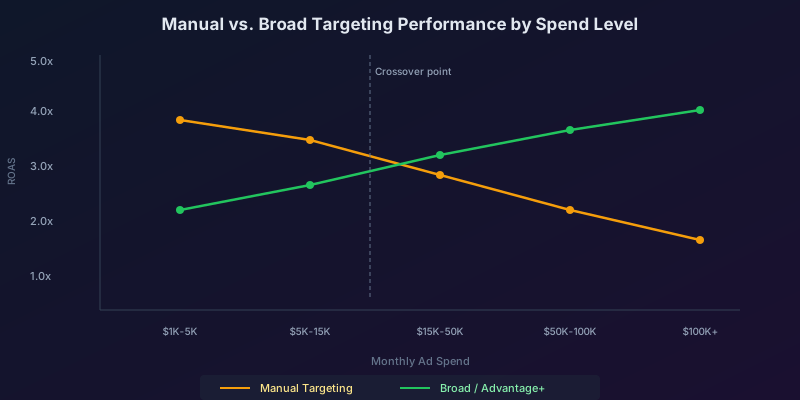
Meta's machine learning has become remarkably effective at finding converters within broad audiences. Tier 3 tests whether removing targeting constraints and letting the algorithm optimize delivery outperforms your manually defined segments.
Test these broad audience configurations: completely open targeting with only age and country constraints, Advantage+ Shopping Campaigns (ASC) with no audience suggestions, and broad targeting with only purchase intent behavior layers. Many accounts spending over $50,000 per month find that Advantage+ outperforms their best manually targeted audiences by 15-25%.
Controlling Variables Across Audience Tests
The most critical rule of any audience testing framework is variable isolation. When testing audiences, every other element must remain constant. Same creative, same bid strategy, same optimization event, same placement settings, same daily budget.
- Use identical ad creatives across all audience test ad sets
- Set equal daily budgets to prevent algorithm bias toward larger audiences
- Run all tests in the same campaign to share campaign-level learning
- Use the same optimization event (purchase, lead, etc.) across all ad sets
- Start all tests simultaneously to eliminate day-of-week and seasonal effects
Any deviation from these controls introduces confounding variables that make your results unreliable. If you want to test both audiences and creatives simultaneously, use a factorial design where you explicitly create every audience-creative combination.
Reading Results and Graduating Winners
After 7-14 days of testing, rank your audiences by CPA and ROAS. But do not stop there. Examine secondary metrics that predict long-term value: cost per landing page view (traffic quality), add-to-cart rate (intent quality), and purchase value (customer quality).
An audience with a slightly higher CPA but 40% higher average order value may deliver better lifetime ROAS. Similarly, an audience with lower CTR but higher conversion rate is sending more qualified traffic. The audience testing framework succeeds when you graduate audiences based on complete funnel performance, not just the cheapest top-line CPA.
Create an audience scorecard with weighted metrics: 40% weight on CPA, 25% on ROAS, 20% on conversion rate, and 15% on average order value. Score every tested audience on this card and rank them objectively. This removes gut-feel bias from graduation decisions.
Novastorm AI automates Meta Ads routine — from monitoring to optimization. Learn more at novastorm.ai
Disclaimer: This article was generated with the assistance of AI and reviewed by the NovaStorm AI team. While we strive for accuracy, we recommend verifying specific data points and consulting official sources (linked where available) for critical business decisions.
Ready to automate your Meta Ads?
NovaStorm AI takes full responsibility for your campaigns — from monitoring to optimization.
Get Started FreeRelated Articles
Cost Cap Bidding on Meta Ads: Advanced Strategy and Use Cases
Master cost cap bidding on Meta Ads with advanced strategies, real-world use cases, and optimization techniques to control CPA while maximizing conversions.
The End of Detailed Targeting Exclusions: What It Means for Advertisers
Meta is removing detailed targeting exclusions from Ads Manager. Learn what this change means for your campaigns and how to adapt your audience strategy.
Low Click-Through Rate on Meta Ads: Creative and Targeting Fixes
Boost your low click-through rate on Meta Ads with proven creative and targeting fixes. Improve CTR with hooks, formats, audience alignment, and ad copy tips.