The End of Detailed Targeting Exclusions: What It Means for Advertisers
Meta is removing detailed targeting exclusions from Ads Manager. Learn what this change means for your campaigns and how to adapt your audience strategy.
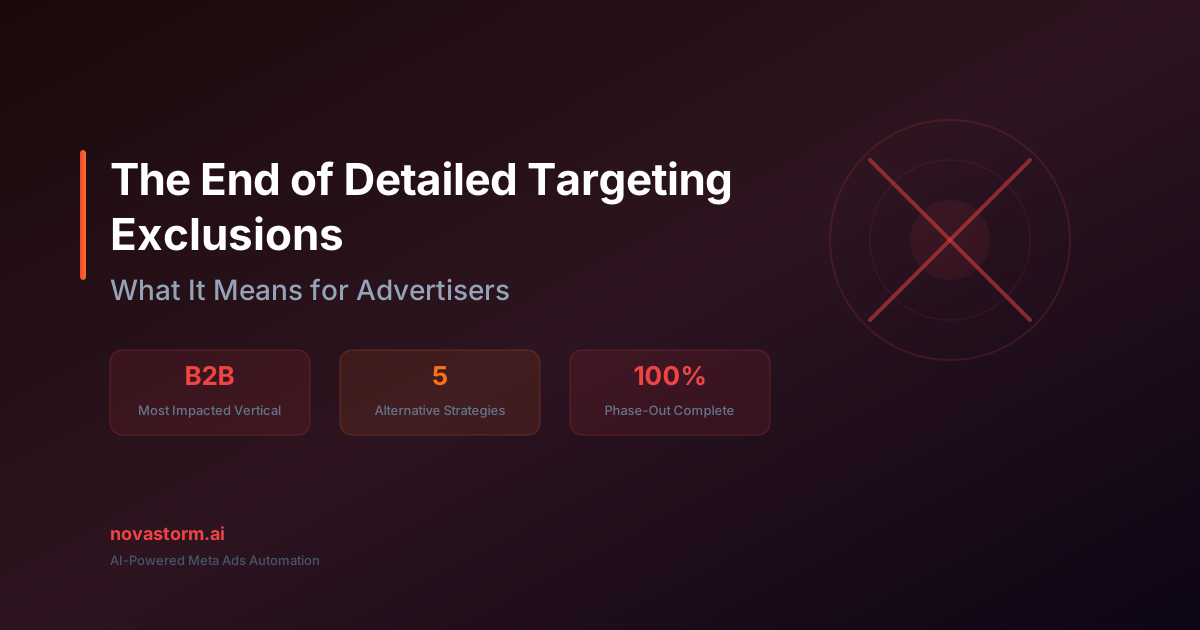
Meta has officially sunset detailed targeting exclusions across all campaign types, completing a phase-out that began in late 2024. For years, advertisers relied on exclusions to refine their audiences — blocking users interested in competitor brands, filtering out irrelevant demographics, or narrowing reach to avoid wasted spend. That lever is now gone.
The removal of detailed targeting exclusions represents one of the most significant shifts in Meta advertising controls in recent memory. This article explains exactly what changed, why Meta made this decision, and the concrete steps you should take to maintain — or even improve — campaign performance without exclusions.
What Detailed Targeting Exclusions Were and How They Worked
Detailed targeting exclusions allowed advertisers to remove specific interests, behaviors, and demographics from their audience definitions. If you were selling luxury watches, you could exclude users interested in budget accessories. If you were running a B2B campaign, you could exclude students and job seekers.
These exclusions sat alongside positive targeting selections in the ad set configuration. While custom audience exclusions (such as excluding past purchasers) remain available, the interest-based and behavior-based exclusions have been fully removed from the detailed targeting exclusions panel.
Custom audience exclusions (purchaser lists, website visitors, etc.) are NOT affected. Only interest-based and behavior-based detailed targeting exclusions have been removed.
Why Meta Removed Detailed Targeting Exclusions
Meta cites three primary reasons for this change. First, privacy regulations across the EU, US states, and other jurisdictions have made it increasingly difficult to maintain granular interest and behavior categories. Each exclusion category relied on inferred user data that now faces legal scrutiny.
Second, Meta's machine learning models have become sophisticated enough to identify and deprioritize low-value impressions without manual exclusions. The algorithm already avoids showing your luxury watch ad to users unlikely to convert, making manual exclusions redundant in many cases.
Third, Meta has found that campaigns using broad targeting with algorithmic optimization consistently outperform tightly constrained audiences. By removing detailed targeting exclusions, Meta is nudging advertisers toward the strategy that its data shows delivers better results.
Immediate Impact on Campaign Performance
The practical impact of losing detailed targeting exclusions varies by advertiser category. Brands that relied heavily on exclusions to separate product lines or avoid competitor audiences will see the most disruption. Advertisers already using broad targeting or Advantage+ audiences will notice minimal change.
| Advertiser Type | Exclusion Reliance | Expected Impact | Priority Actions |
|---|---|---|---|
| E-commerce (single brand) | Low | Minimal | Monitor frequency metrics |
| E-commerce (multi-brand) | High | Moderate | Restructure campaign segmentation |
| Lead generation (B2B) | High | Significant | Improve lead scoring post-click |
| Local services | Medium | Low-moderate | Lean into geographic targeting |
| App install campaigns | Low | Minimal | No immediate action needed |
| Agency (multiple clients) | Variable | Moderate | Audit all client campaigns |
Five Strategies to Replace Detailed Targeting Exclusions
Losing detailed targeting exclusions does not mean losing audience control. The following strategies provide alternative paths to audience refinement that work within Meta's current framework.
1. Strengthen Custom Audience Exclusions
Custom audience exclusions remain fully functional. Build robust exclusion lists based on your own first-party data: past purchasers, existing customers, disqualified leads, and users who have already completed your desired action. These exclusions are more precise than interest-based ones ever were.
2. Use Creative as a Targeting Mechanism
Your ad creative naturally filters audiences. A B2B ad featuring enterprise software screenshots and industry jargon will self-select for business decision-makers. Lean into creative specificity to attract your ideal customer and deter irrelevant clicks.
Stop wasting ad budget
NovaStorm AI cuts Meta Ads CPA by 40% on average. Start free.
3. Implement Post-Click Qualification
For lead generation campaigns that previously relied on detailed targeting exclusions to filter unqualified prospects, move your qualification step downstream. Add qualifying questions to your lead forms or landing pages that screen out irrelevant respondents before they enter your pipeline.
4. Leverage Conversion API Signals
Feed high-quality conversion data back to Meta through the Conversions API. When the algorithm knows which users actually become valuable customers — not just which ones click — it optimizes toward those profiles automatically, reducing the need for manual audience filtering.
5. Adopt Value-Based Optimization
Switch from optimizing for conversion count to optimizing for conversion value. This tells the algorithm to prioritize high-value prospects, effectively replacing the filtering role that detailed targeting exclusions used to play.
- Upload customer lifetime value data to create value-based lookalike audiences
- Set up value optimization events in your pixel or Conversions API
- Use minimum ROAS bidding to ensure spend goes toward high-value conversions
- Segment campaigns by product margin tiers for more accurate value signals
How to Audit Your Campaigns for Exclusion Dependencies
Before the change catches you off guard, run a systematic audit of every active campaign. Export your ad set configurations and flag any that used detailed targeting exclusions. For each flagged ad set, determine what role the exclusion played and which alternative strategy from the list above can replace it.
- Export all ad set configurations from Ads Manager
- Filter for ad sets that previously contained detailed targeting exclusions
- Categorize each exclusion by purpose: audience separation, quality filtering, or waste reduction
- Map each purpose to an alternative strategy (custom exclusions, creative targeting, post-click qualification, CAPI signals, or value optimization)
- Implement alternatives and monitor performance for 14 days before further adjustments
Long-Term Implications for Meta Advertising
The removal of detailed targeting exclusions is part of a broader industry trend toward privacy-first, algorithm-driven advertising. Advertisers who continue to fight this trend by seeking workarounds will fall behind. Those who embrace it — investing in creative quality, first-party data infrastructure, and conversion signal accuracy — will gain an edge.
The advertisers seeing the best results in 2026 are those who treat Meta's algorithm as a partner rather than a tool to be micromanaged. Provide strong signals through creative, conversion data, and audience hints. Let the machine learning handle the rest.
Start your transition now. Even if your current campaigns still perform acceptably, building alternative audience strategies today prevents disruption tomorrow as Meta continues restricting manual controls.
Preparing for What Comes Next
If Meta's trajectory tells us anything, it is that more manual controls will be deprecated over the coming quarters. Detailed targeting exclusions are unlikely to be the last feature removed. Advertisers should build campaign structures that are resilient to further simplification.
Focus on what you can fully control: the quality of your creative, the accuracy of your conversion signals, and the depth of your first-party data. These assets become more valuable with every manual lever Meta removes. The brands that invest in these fundamentals now will be the ones that thrive regardless of what Ads Manager looks like in 2027.
Novastorm AI automates Meta Ads routine — from monitoring to optimization. Learn more at novastorm.ai
Disclaimer: This article was generated with the assistance of AI and reviewed by the NovaStorm AI team. While we strive for accuracy, we recommend verifying specific data points and consulting official sources (linked where available) for critical business decisions.
Ready to automate your Meta Ads?
NovaStorm AI takes full responsibility for your campaigns — from monitoring to optimization.
Get Started FreeRelated Articles

Automated Audience Expansion: When to Let Meta Find New Segments
Automated audience expansion on Meta finds 20-40% more converters beyond your defined audiences. Learn when to enable it and when to keep targeting tight.
Low Click-Through Rate on Meta Ads: Creative and Targeting Fixes
Boost your low click-through rate on Meta Ads with proven creative and targeting fixes. Improve CTR with hooks, formats, audience alignment, and ad copy tips.
Confirmation Bias in Ad Targeting: Showing People What They Want to Believe
Learn how confirmation bias in ad targeting improves Meta Ads performance. Align your messaging with audience beliefs to increase CTR by 35% and reduce CPA.