Low Click-Through Rate on Meta Ads: Creative and Targeting Fixes
Boost your low click-through rate on Meta Ads with proven creative and targeting fixes. Improve CTR with hooks, formats, audience alignment, and ad copy tips.
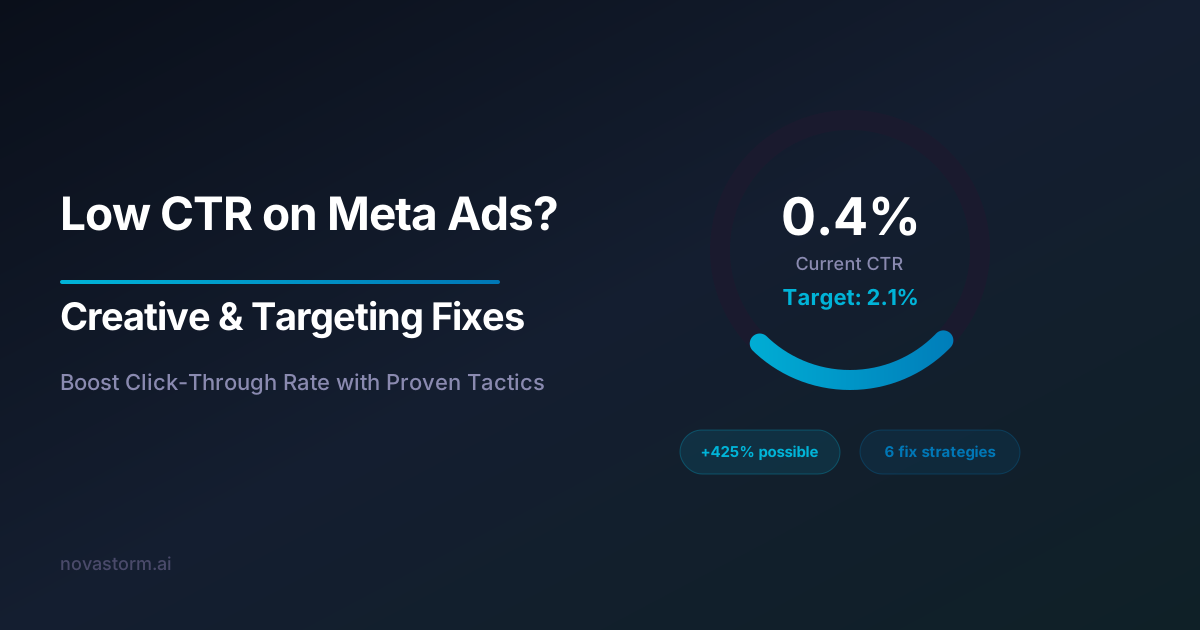
Your Meta Ads are getting impressions, but nobody is clicking. A low click-through rate on Meta Ads means your budget is buying visibility without engagement, and that disconnect cascades into higher CPAs and wasted spend. CTR is the bridge between reach and results.
The good news is that CTR is the metric most directly within your control. Unlike CPMs, which are driven by market forces, click-through rate is a reflection of how well your creative resonates with your audience. Fixing a low click-through rate on Meta Ads comes down to two pillars: better creatives and better targeting.
What Counts as a Low CTR on Meta Ads
Before optimizing, you need to understand what low actually means. CTR benchmarks vary dramatically by industry, placement, and campaign objective. Comparing your ecommerce Feed CTR to a lead generation Stories CTR is meaningless.
| Industry | Average CTR (Link) | Good CTR | Excellent CTR |
|---|---|---|---|
| E-commerce | 1.1% | 1.5-2.0% | 2.0%+ |
| SaaS / B2B | 0.8% | 1.2-1.8% | 1.8%+ |
| Education | 0.9% | 1.3-1.7% | 1.7%+ |
| Healthcare | 0.7% | 1.0-1.5% | 1.5%+ |
| Finance | 0.6% | 0.9-1.3% | 1.3%+ |
| Real Estate | 0.8% | 1.2-1.6% | 1.6%+ |
Always compare CTR within the same placement type. A 0.8% CTR on Audience Network is normal, while the same rate on Facebook Feed suggests creative underperformance.
Creative Fix 1: The Three-Second Hook Rule
Users scroll through Meta feeds at a speed that gives your ad roughly three seconds to earn attention. If your creative does not stop the scroll within that window, it will never get a click. This is the single biggest factor behind a low click-through rate on Meta Ads.
For video ads, the hook must be in the first three seconds. For static images, the visual hierarchy must draw the eye to the most compelling element instantly. Text-heavy images fail because they require cognitive effort that users will not invest for an ad.
- Lead with the most surprising or benefit-driven visual element
- Use movement or contrast in video thumbnails to interrupt scrolling
- Place the key message in the top third of the creative, visible without expanding
- Avoid stock photography — authentic and user-generated content outperforms by 30-50%
- Test bold text overlays with a single, clear value proposition
Creative Fix 2: Format Optimization by Placement
Running a single creative across all placements is a CTR killer. Each placement has different dimensions, user behavior patterns, and content expectations. A horizontal image designed for Feed will appear cropped and unappealing in Stories.
| Placement | Best Format | Aspect Ratio | Key Consideration |
|---|---|---|---|
| Facebook Feed | Video or Carousel | 1:1 or 4:5 | Captions essential for sound-off viewing |
| Instagram Feed | Carousel or Static | 1:1 | Aesthetic quality matters more |
| Reels | Vertical Video | 9:16 | Native-looking, not polished ads |
| Stories | Vertical Video/Image | 9:16 | Fast-paced, interactive elements |
| Right Column | Static Image | 1.91:1 | Simple, clear CTA text |
Creative Fix 3: Ad Copy That Drives Clicks
Visual creative captures attention, but ad copy closes the click. Your primary text, headline, and call-to-action button work together to give users a reason to leave the feed and visit your destination.
Stop wasting ad budget
NovaStorm AI cuts Meta Ads CPA by 40% on average. Start free.
The first line of primary text is the most important. It must either pose a question the user wants answered, state a benefit that creates desire, or present a problem the user recognizes. Everything after the See More truncation point has minimal impact on CTR.
- Write 3-5 primary text variations with different hooks: question, statistic, testimonial, bold claim
- Keep headlines under 40 characters for full visibility across placements
- Match CTA button to intent: Learn More for information, Shop Now for commerce, Sign Up for leads
- Include specificity: numbers, timeframes, and concrete outcomes beat vague promises
- Test emoji-free copy against emoji-rich copy — the winner varies by audience
Targeting Fix: Audience-Creative Alignment
A brilliant creative shown to the wrong audience will always produce a low click-through rate on Meta Ads. Alignment between who sees the ad and what the ad communicates is the multiplier that turns good creative into high-CTR creative.
Segment your audiences and create specific messaging for each segment. A first-time visitor needs different messaging than a cart abandoner. A broad prospecting audience responds to different hooks than a warm retargeting audience.
Create an audience-creative matrix: list your top 3 audiences across the top and your top 3 creative angles down the side. Test the 9 combinations to find the highest-CTR pairings.
Advanced Tactics: Dynamic Creative and Testing Frameworks
Dynamic Creative Optimization lets Meta assemble ad components (images, headlines, text, CTAs) into the best-performing combinations for each user. This is particularly effective when you have multiple assets but are not sure which combinations will produce the highest CTR.
For structured testing, use the A/B test feature in Ads Manager to isolate variables. Test one element at a time: creative concept first, then copy variations, then audience segments. Each test should run for at least 7 days with sufficient budget to reach statistical significance.
- Upload 5-10 image or video variations into Dynamic Creative
- Write 4-5 primary text options with distinct hooks
- Test 3 headline variations against each other
- Let the system run for 7-14 days before analyzing results
- Graduate top performers into dedicated ads for further scaling
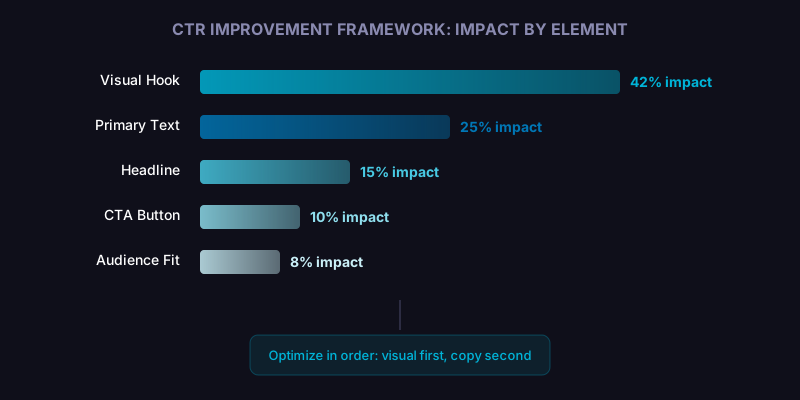
The framework above illustrates how each creative element contributes to overall CTR. The visual hook has the largest impact, followed by primary text and headline. Optimizing in this order produces the fastest CTR improvements.

Addressing a low click-through rate on Meta Ads is not about guessing what might work. It is about systematically testing creative formats, hooks, copy, and audience alignment until you find the combinations that consistently earn clicks. Every percentage point of CTR improvement directly reduces your cost per result.
Novastorm AI automates Meta Ads routine — from monitoring to optimization. Learn more at novastorm.ai
Disclaimer: This article was generated with the assistance of AI and reviewed by the NovaStorm AI team. While we strive for accuracy, we recommend verifying specific data points and consulting official sources (linked where available) for critical business decisions.
Ready to automate your Meta Ads?
NovaStorm AI takes full responsibility for your campaigns — from monitoring to optimization.
Get Started FreeRelated Articles
The End of Detailed Targeting Exclusions: What It Means for Advertisers
Meta is removing detailed targeting exclusions from Ads Manager. Learn what this change means for your campaigns and how to adapt your audience strategy.

Audience Testing Framework: Systematic Approach to Finding Winners
Build a systematic audience testing framework for Meta Ads. Learn the 4-tier approach that identifies profitable audiences 3x faster than random testing.

Automated Audience Expansion: When to Let Meta Find New Segments
Automated audience expansion on Meta finds 20-40% more converters beyond your defined audiences. Learn when to enable it and when to keep targeting tight.