Advantage+ Audience: How Meta's AI Targeting Actually Works
Discover how Advantage+ Audience works under the hood. Learn when to use AI targeting vs traditional audiences and avoid common misconceptions about Meta AI.
What Advantage+ Audience Does Under the Hood
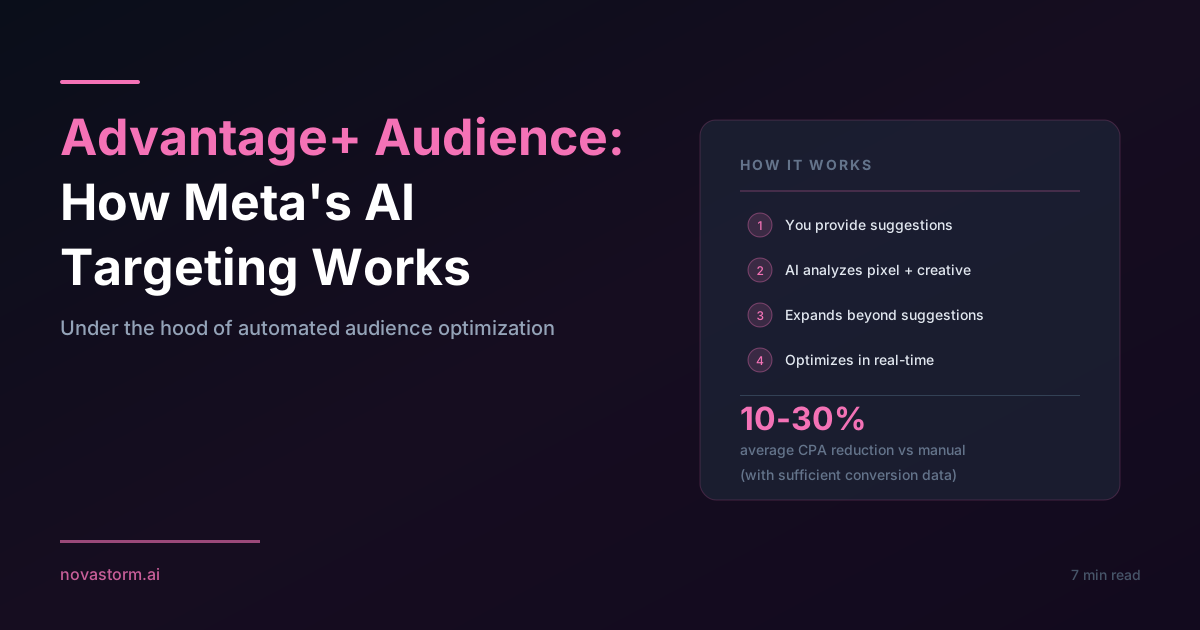
Advantage+ Audience is Meta's AI-powered targeting system that replaces traditional manual audience selection. Instead of you defining exactly who sees your ads, you provide suggestions, and Meta's machine learning decides who to target. Understanding how Advantage+ Audience works is essential for any modern Meta advertiser.
At its core, Advantage+ Audience analyzes signals from your pixel data, conversion history, creative content, and landing page to build a real-time model of your ideal customer. It starts with your suggestions but quickly expands beyond them if the algorithm finds better-performing segments.
This is fundamentally different from the old system. Traditional detailed targeting said "show my ads to people interested in yoga." Advantage+ Audience says "here are people interested in yoga as a starting point, but I will also test runners, meditation enthusiasts, and health food shoppers if they convert better."
How Audience Suggestions vs Constraints Work in Advantage+
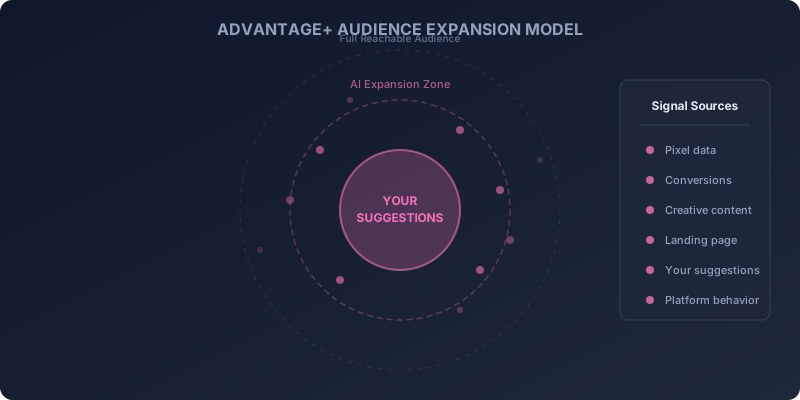
Advantage+ Audience has two modes: suggestions and constraints. This distinction is the most misunderstood part of the system.
Audience suggestions are soft signals. When you add interests, custom audiences, or lookalikes as suggestions, you are telling Meta "start here, but feel free to go beyond." The algorithm uses your suggestions to prioritize initial delivery but will expand to other audiences if performance data supports it.
Audience constraints are hard limits. Age, gender, and location constraints are absolute. If you set age to 25-45, Meta will never show ads to someone outside that range. Custom audience exclusions also function as constraints.
| Input Type | Function | Can AI Override? | Example |
|---|---|---|---|
| Interest suggestions | Starting signal | Yes | Yoga, fitness |
| Custom audience suggestion | Priority signal | Yes | Website visitors |
| Lookalike suggestion | Seed signal | Yes | 1% purchaser LAL |
| Age constraint | Hard limit | No | 25-55 only |
| Gender constraint | Hard limit | No | Female only |
| Location constraint | Hard limit | No | US only |
| Exclusion audience | Hard limit | No | Exclude buyers 30-day |
If you add detailed targeting interests as suggestions, Meta treats them as optional hints. Do not assume your ads only reach those interest groups. The AI will expand aggressively when it finds better audiences.
When to Use Advantage+ Audience vs Traditional Targeting
Advantage+ Audience is not universally better than traditional targeting. The right choice depends on your data maturity, budget, and business type.
Advantage+ excels when you have strong pixel data with at least 50 conversions per week, a large potential audience, and creative that clearly communicates who your product is for. The algorithm uses creative as a targeting signal, so compelling visuals and copy help it find the right people.
Traditional targeting is better when you have a very small niche audience, limited pixel data, strict regulatory requirements about who can see your ads, or when you need granular control for testing specific audience hypotheses.
| Scenario | Best Choice | Why |
|---|---|---|
| E-commerce with 100+ purchases/week | Advantage+ | Rich data for AI optimization |
| New brand, no pixel history | Traditional | AI needs data to optimize |
| B2B with narrow ICP | Traditional | AI may waste budget on wrong people |
| Scaling proven campaign | Advantage+ | AI finds new pockets efficiently |
| Regulated industry (pharma, finance) | Traditional | Need strict audience control |
| Testing new audience angle | Traditional | Need clear signal on specific hypothesis |
Advantage+ Audience Performance Compared to Manual Targeting
In aggregate data across advertisers, Advantage+ Audience tends to deliver 10-30% lower cost per result compared to traditional detailed targeting. However, this average masks significant variation.
Accounts with mature pixels and high conversion volume see the biggest gains, sometimes 40-50% lower CPA. New accounts or those with fewer than 20 conversions per week often see worse performance with Advantage+ because the algorithm does not have enough signal to optimize effectively.
The performance gap also depends on how well your traditional targeting was set up. If your manual audiences were already well-optimized, the lift from Advantage+ may be modest. If your manual targeting was poorly configured with too many narrow ad sets, the lift can be dramatic.
Run a proper A/B test using Meta's Experiments tool. Create identical campaigns with the only variable being Advantage+ Audience vs manual targeting. Run for at least 7 days with sufficient budget to generate statistical significance.
Stop wasting ad budget
NovaStorm AI cuts Meta Ads CPA by 40% on average. Start free.
How to Set Up Advantage+ Audience Correctly
Setting up Advantage+ Audience correctly is straightforward, but a few details make a meaningful difference in performance.
- Create a new campaign and select your objective (Conversions, Leads, or Sales)
- At the ad set level, you will see Advantage+ Audience as the default option
- Add audience suggestions: include your best-performing custom audiences and interests
- Set hard constraints: age range, gender, and locations that are non-negotiable
- Add exclusions: always exclude recent purchasers and any irrelevant audiences
- Set your budget high enough to generate 50+ conversion events per week
- Upload diverse creative that speaks to different audience segments
The most impactful setup decision is your audience suggestion. Adding a custom audience of past purchasers as a suggestion gives Meta a strong signal of who your ideal customer looks like. This is more effective than interest-based suggestions alone.
Common Misconceptions About Advantage+ Audience
Several myths persist about how Advantage+ Audience works. These misconceptions lead to poor setup decisions and inaccurate performance attribution.
Misconception 1: Advantage+ Only Targets Your Suggestions
False. Suggestions are starting points, not boundaries. Advantage+ will actively explore outside your suggestions. In many cases, the majority of your impressions will be served to people outside your suggested audiences.
Misconception 2: Advantage+ Replaces the Need for Good Creative
The opposite is true. Advantage+ relies heavily on creative signals to determine targeting. Your ad content is effectively a targeting input. Weak, generic creative gives the algorithm less signal to work with, resulting in broader, less efficient delivery.
Misconception 3: You Should Remove All Suggestions for Maximum AI Freedom
While Meta can optimize with zero suggestions, providing good ones accelerates the learning process. Think of suggestions as a head start. They help the algorithm converge on the right audience faster, especially in the first 3-7 days of a campaign.
Misconception 4: Advantage+ Is Always Cheaper
Not always. In some cases, particularly with limited conversion data or niche B2B audiences, manual targeting outperforms Advantage+. Always test before committing your full budget.
Key Takeaways for Advantage+ Audience
Advantage+ Audience represents the future of Meta Ads targeting. The trend is clear: Meta is moving toward AI-driven delivery, and advertisers who learn to work with the algorithm rather than against it will have a significant advantage.
- Understand the difference between suggestions (soft) and constraints (hard).
- Use Advantage+ when you have strong pixel data and sufficient conversion volume.
- Stick with traditional targeting for niche audiences, new accounts, and regulated industries.
- Provide high-quality audience suggestions to accelerate the learning process.
- Invest in diverse, compelling creative since it is now a targeting input.
- Always A/B test Advantage+ vs manual before scaling.
The advertisers who thrive with Advantage+ are the ones who treat it as a partnership with the algorithm. You bring the strategy, the creative, and the data. Meta's AI brings the scale and optimization. Together, the results are powerful.
Novastorm AI automates Meta Ads routine — from monitoring to optimization. Learn more at novastorm.ai
Disclaimer: This article was generated with the assistance of AI and reviewed by the NovaStorm AI team. While we strive for accuracy, we recommend verifying specific data points and consulting official sources (linked where available) for critical business decisions.
Ready to automate your Meta Ads?
NovaStorm AI takes full responsibility for your campaigns — from monitoring to optimization.
Get Started FreeRelated Articles
Predictive Analytics in Meta Ad Optimization
Discover how predictive analytics in Meta Ad optimization works, from predicted CTR and CVR to the machine learning feedback loop that determines ad delivery.
The Psychology of Color in Meta Ad Creative
Explore the psychology of color in Meta Ad creative. Learn how color associations, contrast, CTA button colors, and cultural meanings impact ad performance.
Managing Multiple Ad Accounts: Agency Best Practices
Agency best practices for managing multiple Meta Ad accounts including Business Manager setup, naming conventions, team permissions, cross-account reporting, and client onboarding.