Minimum ROAS Bidding on Meta Ads: Value-Based Optimization
Master minimum ROAS bidding on Meta Ads to optimize for revenue, not just conversions. Setup guide, best practices, and advanced value-based strategies.
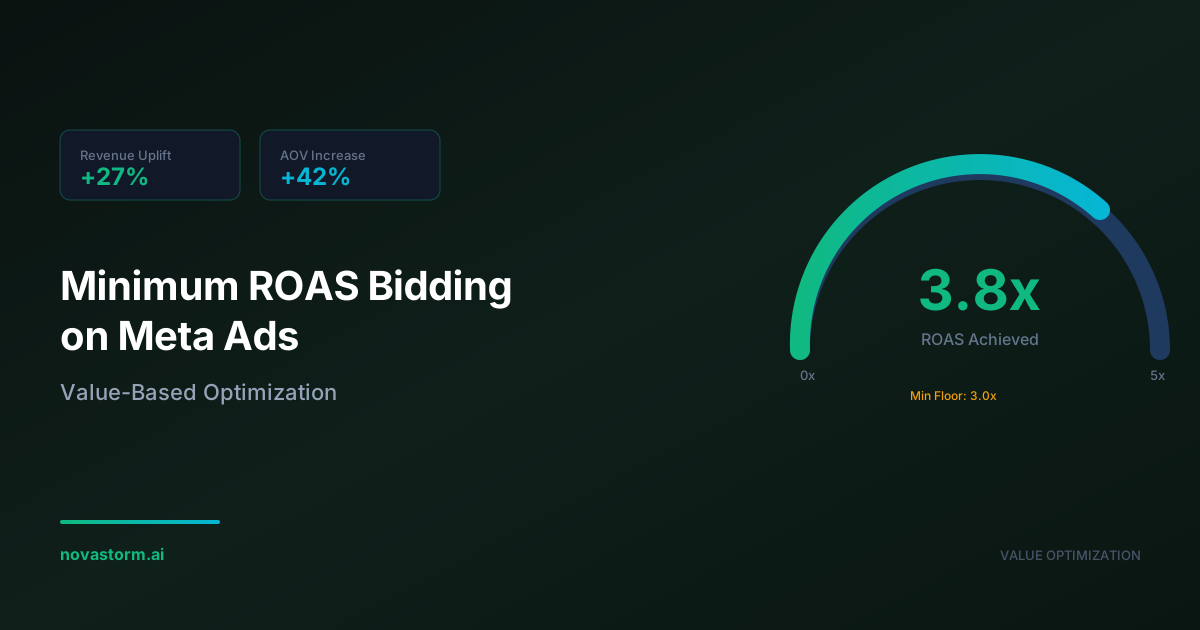
Minimum ROAS bidding on Meta Ads represents the most revenue-focused approach in Meta's bidding toolkit. Instead of optimizing for the lowest cost per conversion, minimum ROAS tells the algorithm to prioritize conversions that generate a specified return on ad spend. This shifts the optimization target from volume to value — a critical distinction for e-commerce brands and businesses with variable transaction sizes.
While most advertisers default to CPA-based strategies, minimum ROAS bidding on Meta Ads unlocks a fundamentally different optimization logic. The algorithm stops treating all conversions equally and starts weighting delivery toward users most likely to generate higher-value transactions. For businesses where a $200 order and a $20 order both count as one conversion but contribute very differently to the bottom line, this distinction is everything.
How Minimum ROAS Bidding Works
When you set a minimum ROAS target, you tell Meta: 'For every dollar I spend on ads, I want at least X dollars in return.' A minimum ROAS of 3.0 means you expect $3 in revenue for every $1 spent. The algorithm then evaluates each auction opportunity against this threshold.
For each potential impression, Meta estimates two things: the probability that the user will convert, and the predicted value of that conversion. It multiplies these together to estimate the expected revenue per impression, then only enters auctions where the expected return meets or exceeds your ROAS floor.
Minimum ROAS bidding on Meta Ads requires the purchase value to be passed back via the Meta Pixel or Conversions API. Without accurate revenue data, the algorithm cannot optimize for value. Ensure your purchase events include the 'value' parameter.
Prerequisites for Value-Based Bidding
Minimum ROAS bidding demands more data infrastructure than standard CPA bidding. The algorithm needs reliable value signals to optimize effectively.
- Meta Pixel or Conversions API must pass purchase value with every conversion event.
- You need at least 30-50 purchase events per week with value data for stable optimization.
- Transaction values should have meaningful variance — if 90% of orders are the same price, ROAS bidding adds no value over CPA bidding.
- Value data must be accurate — inflated or deflated values will mislead the algorithm.
- The optimization event must be 'Purchase' with value optimization enabled in the ad set settings.
Setting the Right ROAS Floor
The ROAS floor you set directly determines how aggressively the algorithm will bid and how much volume you will receive. Setting it too high starves delivery. Setting it too low provides no meaningful control. Here is how to calculate your optimal minimum ROAS target.
| Business Metric | Formula | Example |
|---|---|---|
| Break-Even ROAS | 1 / Profit Margin | 1 / 0.40 = 2.5x |
| Target ROAS | Break-Even ROAS + Profit Buffer | 2.5 + 0.5 = 3.0x |
| Starting ROAS Floor | 80% of Current Actual ROAS | If actual is 4.0x, start at 3.2x |
| Aggressive ROAS Floor | 90% of Current Actual ROAS | If actual is 4.0x, set 3.6x |
| Conservative ROAS Floor | 60-70% of Current Actual ROAS | If actual is 4.0x, set 2.4-2.8x |
Start with a ROAS floor at 80% of your current blended ROAS. This gives the algorithm room to find high-value users while maintaining profitability. You can tighten the floor incrementally as the algorithm learns your customer base.
Minimum ROAS vs. Lowest Cost for E-Commerce
The difference between minimum ROAS bidding on Meta Ads and lowest-cost bidding is best illustrated with a concrete example. Consider an e-commerce store selling products ranging from $30 to $300.
With lowest-cost bidding, Meta targets the easiest conversions. These are often lower-value products because budget shoppers convert more readily. You might get 100 conversions at $15 CPA, but average order value is $45, yielding $4,500 in revenue on $1,500 ad spend — a 3.0x ROAS.
With minimum ROAS bidding on Meta Ads set at 3.0x, Meta shifts delivery toward users likely to buy higher-value items. You might get 60 conversions at $25 CPA, but average order value is $95, yielding $5,700 in revenue on $1,500 ad spend — a 3.8x ROAS. Fewer conversions, but significantly more revenue and profit.
Stop wasting ad budget
NovaStorm AI cuts Meta Ads CPA by 40% on average. Start free.
Run a split test: duplicate your best-performing ad set and switch one to minimum ROAS bidding. After 14 days, compare total revenue (not conversion count) to determine which strategy drives more profit.
Common Pitfalls and How to Avoid Them
Minimum ROAS bidding fails for predictable reasons. Understanding these failure modes lets you proactively avoid them.
| Pitfall | Why It Happens | Prevention |
|---|---|---|
| Zero delivery | ROAS floor exceeds what the audience can deliver | Lower ROAS floor by 20% and expand audience |
| Inflated reported ROAS | Pixel firing on non-purchase events with value | Audit pixel events — ensure only purchases carry value |
| Declining delivery over time | Algorithm exhausted high-value users in audience | Expand lookalike sources or broaden targeting |
| ROAS met but revenue dropped | Algorithm chose few, high-value conversions over volume | Lower ROAS floor slightly to allow more volume |
| Inconsistent daily ROAS | Insufficient conversion volume for stable optimization | Increase budget or use broader audience |
Advanced Value-Based Optimization Techniques
Once you have minimum ROAS bidding on Meta Ads running successfully, several advanced techniques can further improve performance.
Customer Lifetime Value Optimization
Instead of passing single-transaction value, pass predicted lifetime value (LTV) through your Conversions API. This trains the algorithm to find customers who will make repeat purchases, not just one-time buyers. Even an approximate LTV model significantly improves long-term ROAS.
Product-Tier Segmentation
Create separate campaigns for different product tiers with different ROAS floors. Your premium product line might run at a 2.5x ROAS floor (lower because higher margins), while your commodity line runs at 4.0x (higher because thinner margins). This prevents the algorithm from defaulting to one product category.
Seasonal ROAS Adjustments
During promotional periods, temporarily lower your ROAS floor to account for discounted prices. If you run a 20% off sale, your AOV drops proportionally, and a rigid ROAS floor will choke delivery. Pre-calculate the adjusted floor based on expected promotional pricing.
Monitoring and Automation
Minimum ROAS campaigns require consistent monitoring because value signals can shift with product mix, seasonality, and audience saturation. Key metrics to track beyond ROAS include average order value trends, conversion volume, and delivery rate.
- Track 7-day rolling ROAS and compare against your floor — consistent overperformance means you can tighten the floor.
- Monitor AOV trends — declining AOV suggests the algorithm is drifting toward lower-value conversions.
- Watch delivery rate — if spend drops below 70% of budget, your ROAS floor may be too aggressive.
- Compare revenue per impression across ad sets to identify top performers.
- Use automated rules or platforms like Novastorm AI to adjust ROAS floors based on real-time performance data.
Minimum ROAS bidding on Meta Ads is the most sophisticated bidding strategy available on the platform. It requires clean data infrastructure, sufficient conversion volume, and ongoing calibration. But for advertisers who meet these prerequisites, it transforms campaign optimization from a cost-minimization exercise into a revenue-maximization engine. The shift from 'cheapest conversions' to 'most valuable conversions' is the difference between surviving and thriving in competitive markets.
Novastorm AI automates Meta Ads routine — from monitoring to optimization. Learn more at novastorm.ai
Disclaimer: This article was generated with the assistance of AI and reviewed by the NovaStorm AI team. While we strive for accuracy, we recommend verifying specific data points and consulting official sources (linked where available) for critical business decisions.
Ready to automate your Meta Ads?
NovaStorm AI takes full responsibility for your campaigns — from monitoring to optimization.
Get Started FreeRelated Articles
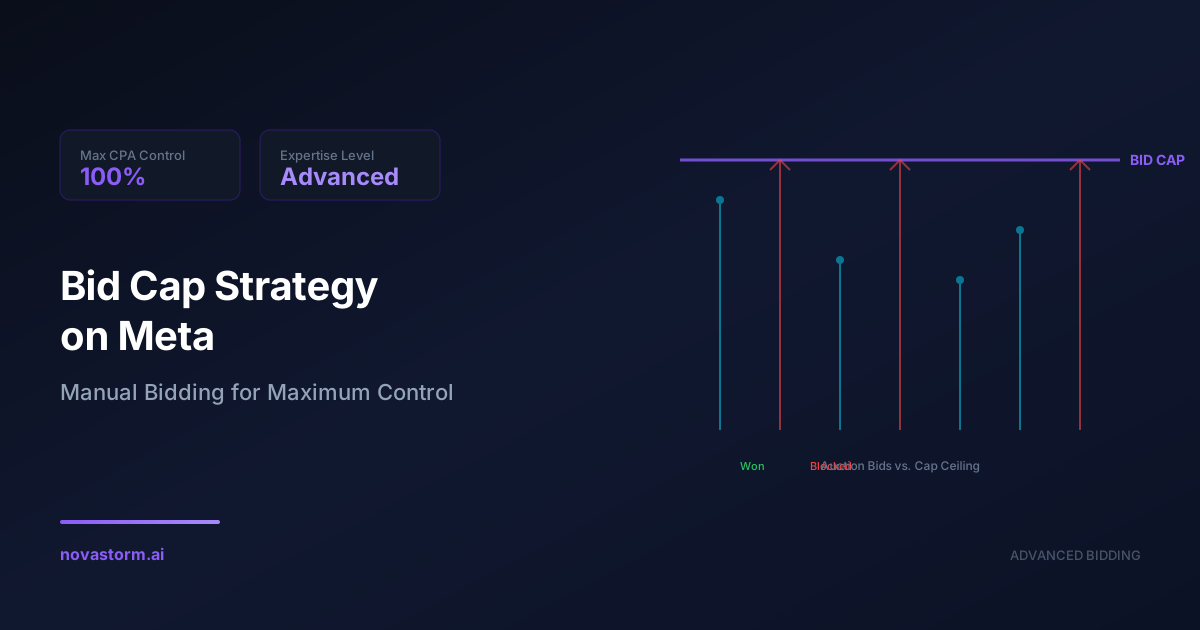
Bid Cap Strategy on Meta: Manual Bidding for Maximum Control
Learn how to use bid cap strategy on Meta for maximum auction control. Advanced techniques for setting manual bids, avoiding delivery issues, and scaling.
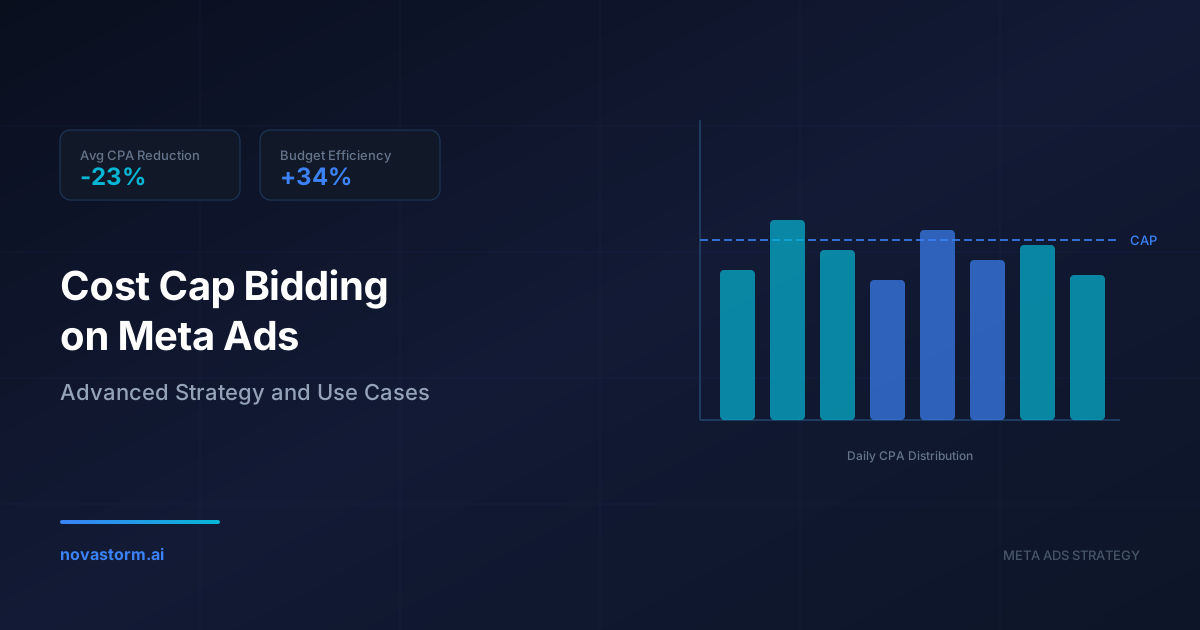
Cost Cap Bidding on Meta Ads: Advanced Strategy and Use Cases
Master cost cap bidding on Meta Ads with advanced strategies, real-world use cases, and optimization techniques to control CPA while maximizing conversions.
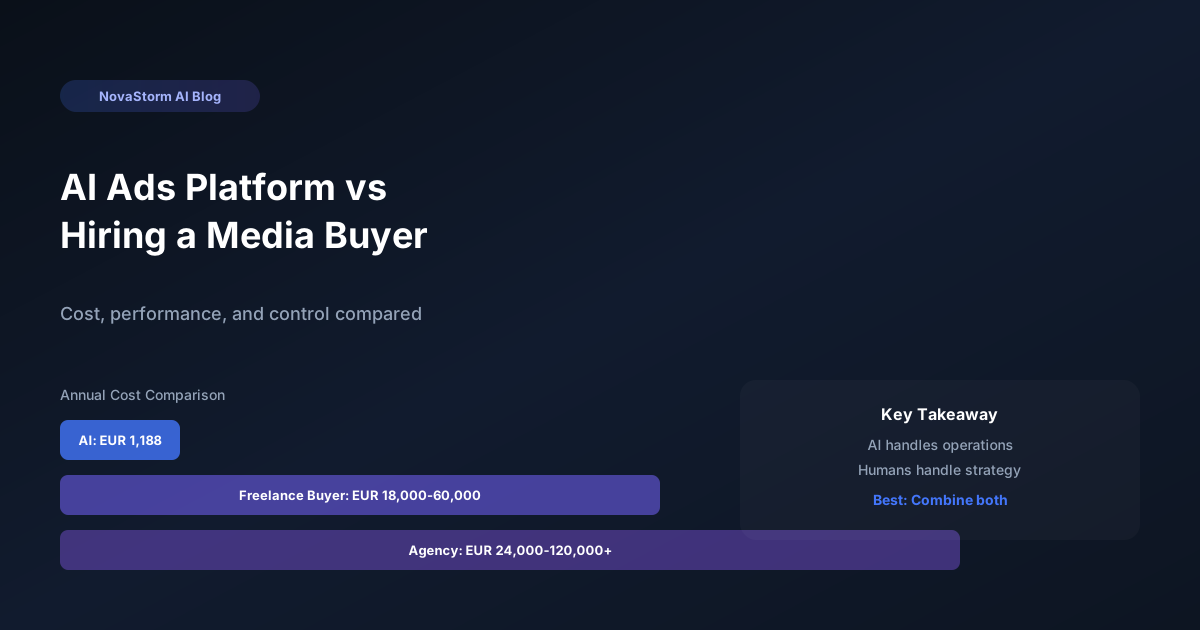
AI Ads Platform vs Hiring a Media Buyer: Cost, Performance, and Control Compared
Should you hire a media buyer or use an AI platform for Meta Ads? Comparing costs, performance, control, and scalability to help you decide.