The Future of Meta Ads: AI, Privacy, and Automation Trends
Explore the future of Meta Ads shaped by AI automation, evolving privacy regulations, and machine learning. Discover key trends redefining paid social in 2026.
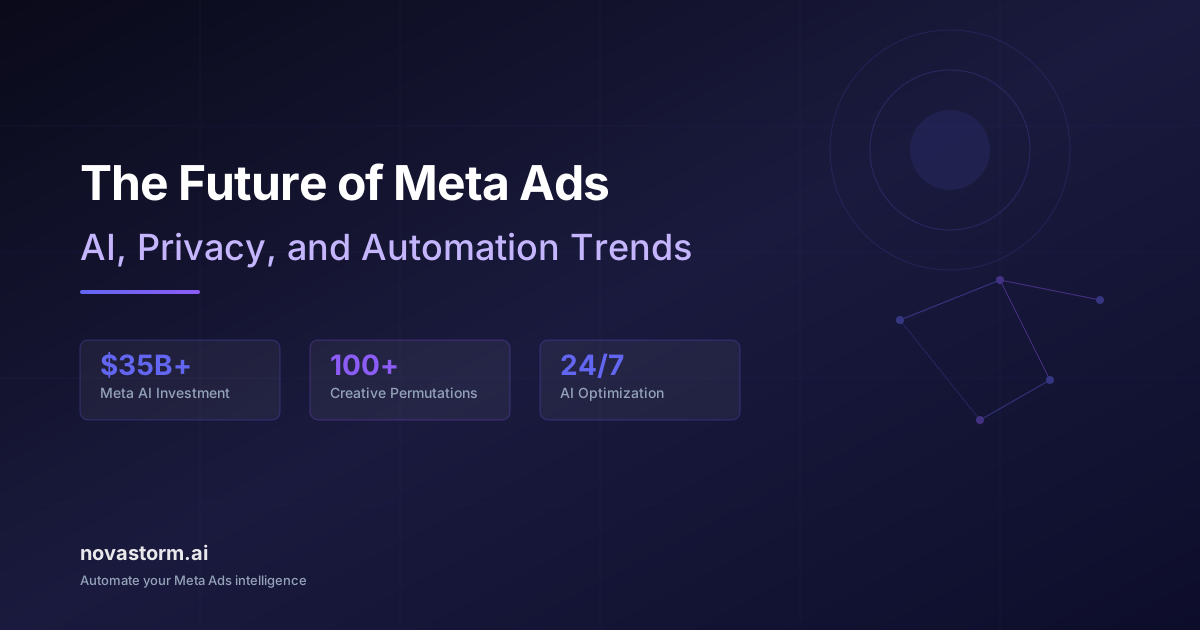
The future of Meta Ads is being rewritten by three converging forces: artificial intelligence, tightening privacy regulations, and end-to-end automation. Advertisers who understand these shifts will dominate paid social over the next decade. Those who cling to manual optimizations and legacy tracking methods will find their campaigns increasingly inefficient.
Meta has invested over $35 billion in AI infrastructure since 2023, and the results are reshaping every layer of its advertising stack. From creative generation to audience targeting, the future of Meta Ads is inseparable from the AI models powering them.
AI-Driven Campaign Optimization Is Becoming the Default
Advantage+ campaigns already account for the majority of new ad set creation on Meta platforms. But the next generation of AI-driven optimization goes much further. Meta's internal models now analyze thousands of creative permutations in real time, selecting not just the best-performing ad but the best-performing ad for each individual user.
This shift fundamentally changes the advertiser's role. Instead of manually testing audiences and placements, the future of Meta Ads demands that marketers become creative strategists and data interpreters. The algorithm handles execution; humans set the strategic direction.
| Capability | 2023 State | 2026 State |
|---|---|---|
| Audience Targeting | Manual interest/lookalike selection | Fully AI-modeled broad targeting |
| Creative Testing | A/B tests with 3-5 variants | Dynamic assembly of 100+ permutations |
| Budget Allocation | Campaign-level manual budgets | Cross-campaign AI budget distribution |
| Reporting | 7-day click attribution | Probabilistic multi-touch modeling |
| Optimization Speed | 24-48 hour learning phase | Sub-hour signal processing |
Privacy Regulations Are Reshaping Data Collection
The deprecation of third-party cookies, combined with stricter enforcement of GDPR, CCPA, and new federal privacy legislation, has forced Meta to fundamentally rethink how it collects and processes user data. The future of Meta Ads depends on privacy-compliant signal collection that still delivers performance.
Meta's Conversions API has become essential infrastructure. Advertisers who rely solely on browser-based pixel tracking see 30-40% signal loss compared to those running server-side implementations. First-party data strategies are no longer optional; they are the foundation of effective targeting.
Advertisers using Conversions API alongside the Meta Pixel report 15-25% improvement in cost per acquisition compared to pixel-only setups, according to Meta's 2025 performance benchmarks.
Automation Extends Beyond Campaign Management
Automation in the future of Meta Ads is not limited to bid strategies and audience expansion. It now encompasses the entire advertising workflow: creative production, budget pacing, anomaly detection, and performance reporting.
Platforms like Novastorm AI represent this shift. Instead of logging into Ads Manager multiple times daily to check for spend anomalies or creative fatigue, automated systems monitor campaigns continuously, flag issues in real time, and execute optimizations without human intervention.
- Real-time spend monitoring that catches budget overruns within minutes
- Automated creative rotation based on fatigue signals
- Cross-campaign budget reallocation driven by ROAS thresholds
- Scheduled reporting with AI-generated insights and action items
- Anomaly detection for CPM spikes, CTR drops, and conversion dips
Predictive Analytics Replace Reactive Optimization
The most significant change in the future of Meta Ads is the move from reactive to predictive campaign management. Traditional approaches wait for data to accumulate, identify underperformance, and then adjust. Predictive systems use historical patterns and real-time signals to forecast outcomes before they materialize.
This means detecting that a campaign will exhaust its audience before frequency metrics spike. It means predicting creative fatigue before CTR declines become statistically significant. Predictive analytics compress the optimization cycle from days to hours.
Key Predictive Metrics to Watch
Stop wasting ad budget
NovaStorm AI cuts Meta Ads CPA by 40% on average. Start free.
- Projected audience saturation rate based on current delivery velocity
- Creative performance decay curves modeled on historical data
- Budget depletion forecasts with confidence intervals
- Conversion probability scoring at the impression level
- Cross-campaign cannibalization risk assessment
The Creative Renaissance in AI-Powered Advertising
As algorithms take over media buying decisions, creative quality becomes the primary competitive differentiator. The future of Meta Ads belongs to advertisers who can produce high-volume, high-quality creative assets that give AI systems more material to optimize against.
Meta's generative AI tools now allow advertisers to create background variations, text overlays, and format adaptations automatically. But the strategic creative direction, the core messaging, value propositions, and brand narratives, remains a human responsibility.
| Creative Element | AI Role | Human Role |
|---|---|---|
| Background imagery | Generate variations at scale | Define brand aesthetic guidelines |
| Ad copy | Produce headline/body variants | Set messaging strategy and tone |
| Format adaptation | Resize and reformat automatically | Design hero concepts |
| A/B testing | Select winners algorithmically | Define test hypotheses |
| Personalization | Match creative to user segments | Build segment-specific narratives |
Measurement Evolution: From Attribution to Incrementality
Attribution models based on last-click or even multi-touch frameworks are giving way to incrementality testing. The future of Meta Ads measurement is about answering a harder question: did the ad cause the conversion, or would it have happened anyway?
Meta's conversion lift studies, geo-based experiments, and holdout testing frameworks are becoming standard practice for sophisticated advertisers. These approaches require larger budgets and longer testing windows, but they deliver far more accurate performance assessments.
Brands that rely solely on platform-reported ROAS without incrementality validation often overestimate Meta Ads performance by 20-40%. Calibrate your measurement strategy with lift studies at least quarterly.
Preparing Your Strategy for the Next Era
Adapting to the future of Meta Ads requires action across multiple dimensions. Start by auditing your current technical infrastructure: is your Conversions API implementation complete and sending all relevant events? Is your first-party data strategy mature enough to support targeting in a cookieless environment?
Next, invest in creative production capacity. The advertisers seeing the best results in 2026 produce 5-10x more creative variants than they did two years ago. AI tools accelerate production, but they require structured creative workflows and clear brand guidelines.
Finally, embrace automation for operational tasks. Manual campaign monitoring and optimization cannot compete with AI-driven systems that operate 24/7 with sub-second response times. The competitive advantage lies in strategic thinking, not execution speed.
Sources & Further Reading: Meta Business Help Center — Conversions API — official documentation on server-side event tracking. Statista — AI Use in Marketing — market data on AI adoption in advertising. Think with Google — Privacy & Trust — research on privacy-first advertising trends.
- Implement Conversions API with full event coverage
- Build a first-party data collection and activation strategy
- Scale creative production using AI-assisted workflows
- Adopt incrementality testing as your primary measurement framework
- Deploy automated monitoring and optimization tools
- Train teams on strategic oversight rather than manual execution
The future of Meta Ads rewards advertisers who combine strategic clarity with technological leverage. AI handles the complexity; your job is to point it in the right direction.
Novastorm AI automates Meta Ads routine — from monitoring to optimization. Learn more at novastorm.ai
Disclaimer: This article was generated with the assistance of AI and reviewed by the NovaStorm AI team. While we strive for accuracy, we recommend verifying specific data points and consulting official sources (linked where available) for critical business decisions.
Ready to automate your Meta Ads?
NovaStorm AI takes full responsibility for your campaigns — from monitoring to optimization.
Get Started FreeRelated Articles
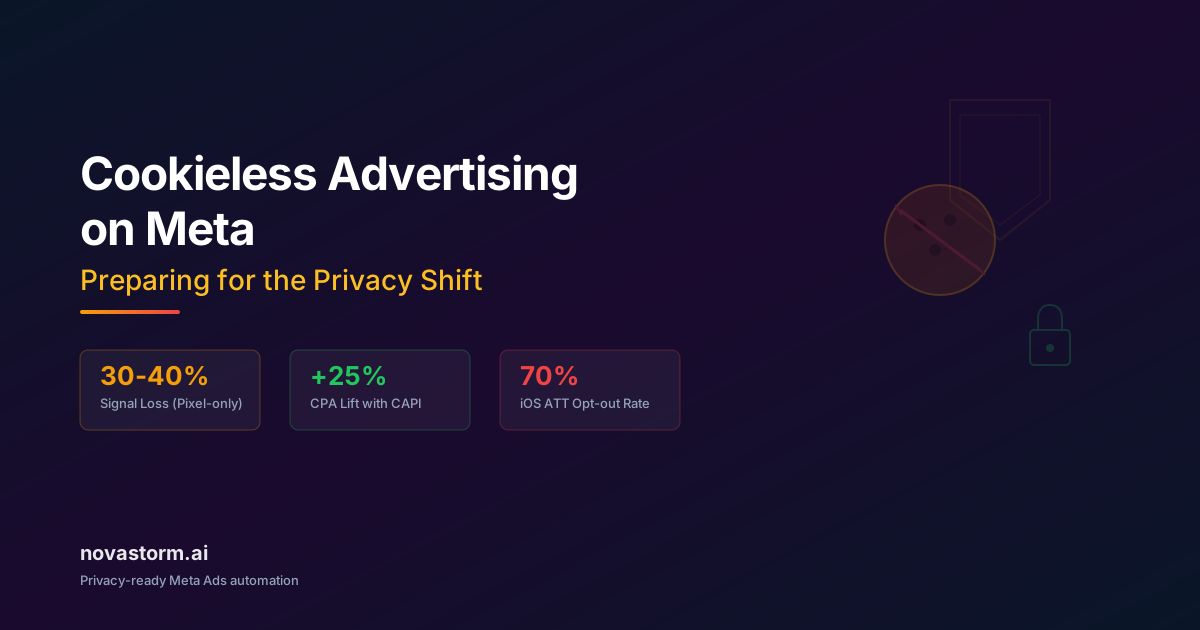
Cookieless Advertising on Meta: Preparing for the Privacy Shift
Learn how to prepare your Meta Ads strategy for a cookieless world. First-party data, Conversions API, and privacy-compliant targeting techniques explained.
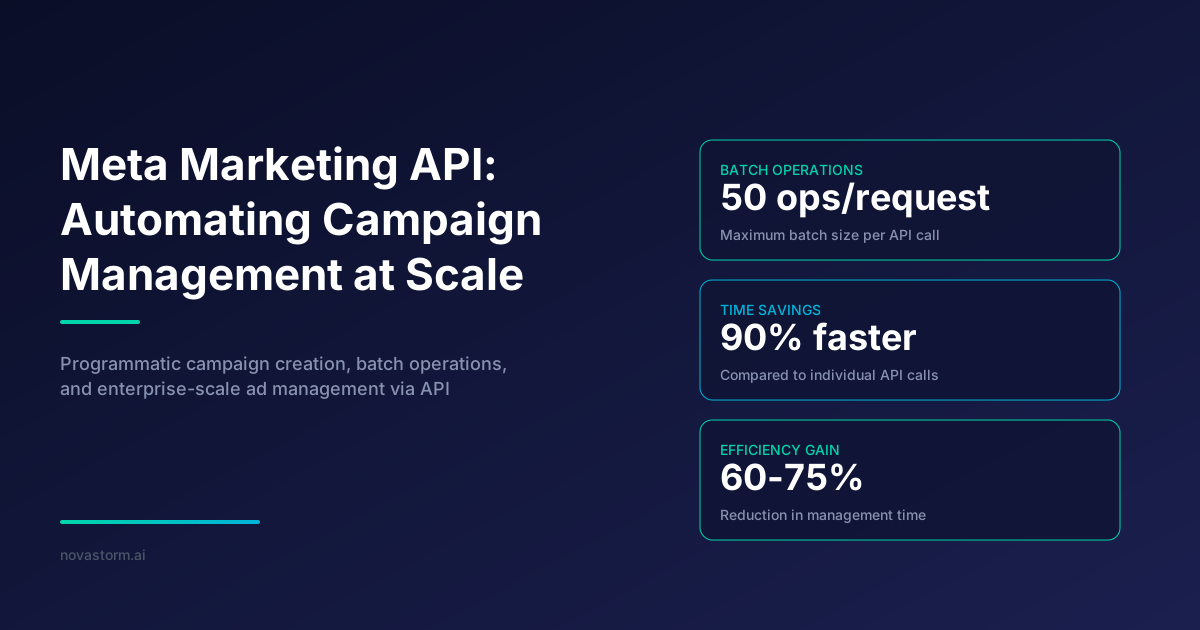
Meta Marketing API: Automating Campaign Management at Scale
Learn how to use the Meta Marketing API to automate campaign management at scale. Covers authentication, bulk operations, and real-world automation patterns.

Automated Audience Expansion: When to Let Meta Find New Segments
Automated audience expansion on Meta finds 20-40% more converters beyond your defined audiences. Learn when to enable it and when to keep targeting tight.