Cookieless Advertising on Meta: Preparing for the Privacy Shift
Learn how to prepare your Meta Ads strategy for a cookieless world. First-party data, Conversions API, and privacy-compliant targeting techniques explained.
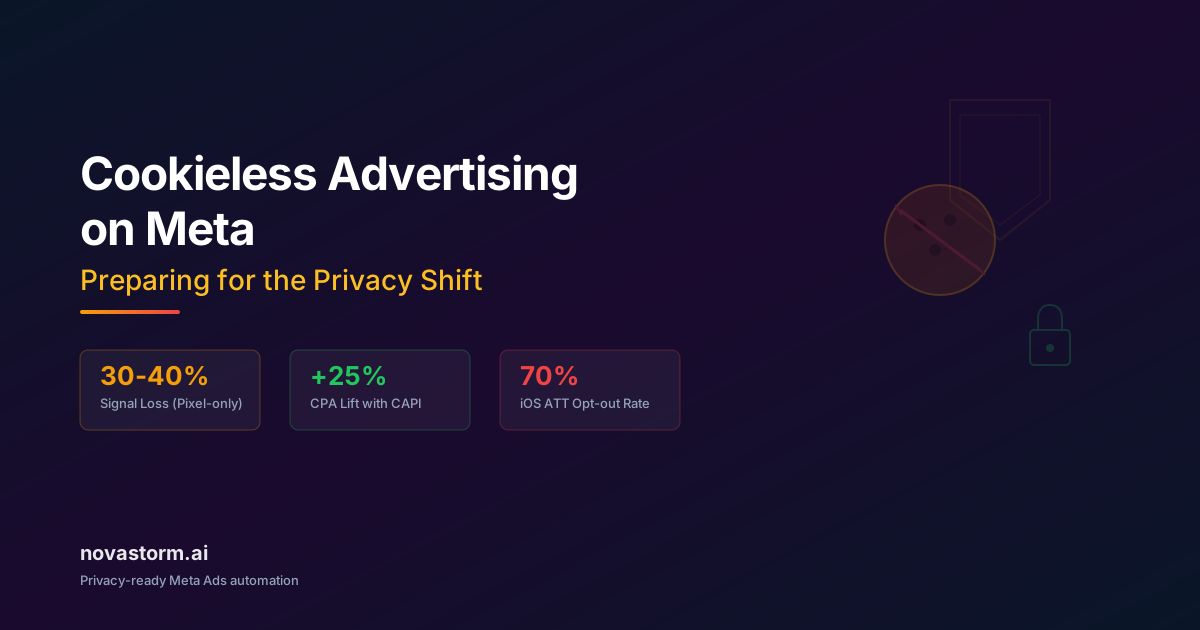
Cookieless advertising on Meta is no longer a future scenario; it is the present reality for millions of advertisers. With third-party cookies effectively deprecated across major browsers and privacy regulations tightening globally, the entire digital advertising ecosystem has undergone a fundamental shift. Meta platforms are at the center of this transformation.
The good news is that Meta has been preparing for this moment for years. The Conversions API, enhanced match signals, and AI-powered targeting models were built specifically to maintain advertising performance in a privacy-restricted environment. Advertisers who adopt these tools proactively will maintain their competitive edge.
Why Cookies Mattered and Why They Are Disappearing
Third-party cookies served as the backbone of digital advertising for over two decades. They enabled cross-site tracking, retargeting, frequency capping, and conversion attribution. For Meta advertisers, cookies powered the Pixel's ability to connect ad impressions to website actions.
The decline of cookies stems from converging pressures: browser vendors like Apple and Google limiting tracking capabilities, legislation including GDPR and CCPA mandating user consent, and growing consumer awareness about data privacy. Cookieless advertising on Meta requires new approaches to every aspect of campaign management.
| Browser | Cookie Status | Impact on Tracking |
|---|---|---|
| Safari | Blocked since 2020 (ITP) | 30-40% signal loss for pixel-only setups |
| Firefox | Blocked by default | 15-20% signal loss |
| Chrome | Privacy Sandbox active | Gradual signal reduction |
| Edge | Following Chrome model | Aligned with Privacy Sandbox |
| Mobile in-app | ATT framework (iOS) | 50-70% opt-out rates on iOS |
The Conversions API: Your Primary Signal Source
The Meta Conversions API (CAPI) is the most critical tool for cookieless advertising on Meta. Unlike the browser-based Pixel, CAPI sends conversion data directly from your server to Meta's servers, bypassing browser restrictions entirely. This server-to-server connection is immune to cookie blocking, ad blockers, and browser privacy features.
Implementing CAPI is no longer optional. Advertisers running CAPI alongside the Pixel consistently see 15-25% better cost per acquisition and more accurate attribution. The combination ensures maximum signal coverage: CAPI captures events that the Pixel misses, while the Pixel provides real-time browser-side signals.
Meta recommends sending events through both the Pixel and Conversions API simultaneously. Their deduplication logic ensures events are not double-counted, while signal coverage is maximized.
CAPI Implementation Approaches
- Direct integration: Custom server-side implementation with full control over data sent
- Partner integrations: Shopify, WooCommerce, and other platforms offer built-in CAPI connectors
- Gateway approach: Meta's CAPI Gateway runs in your cloud environment for simplified setup
- Tag management: Server-side Google Tag Manager with Meta templates
First-Party Data Strategies for Meta Advertisers
In a cookieless world, first-party data becomes your most valuable advertising asset. This is data your customers willingly share with you: email addresses, phone numbers, purchase history, website behavior, and engagement data. For cookieless advertising on Meta, first-party data powers Custom Audiences, lookalike modeling, and conversion optimization.
Building a robust first-party data strategy requires investment across your entire customer journey. Every touchpoint is an opportunity to collect consented data that strengthens your advertising capabilities.
| Data Source | Collection Method | Meta Activation |
|---|---|---|
| Email lists | Newsletter signup, account creation | Custom Audiences, Enhanced Match |
| Purchase data | Transaction records, CRM sync | Value-based lookalikes |
| Website behavior | Consented tracking, CAPI events | Retargeting, optimization events |
| App activity | SDK events, in-app actions | App Custom Audiences |
| Offline conversions | POS data, call tracking | Offline Conversions API |
| Survey data | Post-purchase surveys, feedback | Audience segmentation insights |
Enhanced Match and Advanced Matching
Stop wasting ad budget
NovaStorm AI cuts Meta Ads CPA by 40% on average. Start free.
Enhanced Match is a critical component of cookieless advertising on Meta. It works by sending hashed customer information (email, phone, name, location) alongside Pixel or CAPI events. Meta uses this hashed data to match conversions to ad impressions without relying on cookies.
When properly configured, Enhanced Match can recover 20-30% of conversions that would otherwise go unattributed. The data is hashed (SHA-256) before transmission, ensuring personal information is never sent in plain text. This approach satisfies privacy requirements while dramatically improving measurement accuracy.
- Enable automatic Enhanced Match in Events Manager for quick wins
- Implement manual Enhanced Match for higher match rates with CAPI
- Send multiple identifiers per event (email + phone + name) for best results
- Verify match quality in Events Manager's diagnostics tab
- Monitor Event Match Quality score and target above 6.0
AI-Powered Targeting in a Privacy-First Environment
Meta's AI targeting models have evolved specifically to perform well with fewer individual-level signals. Advantage+ audience targeting uses broad machine learning models trained on aggregate behavior patterns rather than individual tracking. This approach is inherently more privacy-friendly and increasingly outperforms manual targeting.
The counterintuitive truth about cookieless advertising on Meta is that broad, AI-driven targeting often delivers better results than the narrow, cookie-dependent audiences of the past. Meta's models process signals that no human media buyer could manually analyze, finding conversion patterns across billions of data points.
Avoid over-constraining your audiences with narrow interest targeting. Meta's AI models need sufficient audience scale to optimize effectively. Start broad and let the algorithm find your buyers.
Measurement Strategies Without Cookie-Based Attribution
Cookie-based attribution is being replaced by a combination of probabilistic modeling, incrementality testing, and marketing mix modeling (MMM). For cookieless advertising on Meta, this means accepting that deterministic, user-level attribution is no longer the gold standard.
Meta's Aggregated Event Measurement (AEM) protocol, built for iOS 14.5+ restrictions, provides a framework for privacy-compliant conversion tracking. Combined with conversion lift studies and geo-based experiments, advertisers can build a measurement stack that delivers actionable insights without compromising user privacy.
- Implement conversion lift studies to measure true incremental impact
- Use Meta's marketing mix modeling tools for budget allocation decisions
- Deploy geo-based testing for campaigns where lift studies are not feasible
- Combine CAPI + Enhanced Match for maximum attributed conversion coverage
- Track leading indicators (add to cart, initiate checkout) alongside final conversions
Action Plan: Becoming Cookieless-Ready
Preparing for cookieless advertising on Meta is a multi-step process that touches technology, strategy, and organizational culture. The advertisers who start this transition now will have significant advantages over those who wait.
- Audit your current tracking setup and quantify signal loss from cookie restrictions
- Implement Conversions API with full event coverage and Enhanced Match
- Build a first-party data collection strategy across all customer touchpoints
- Migrate from narrow targeting to Advantage+ broad audiences
- Establish incrementality testing as your primary measurement framework
- Deploy automated monitoring to track signal quality and attribution accuracy
- Train your team on privacy-first advertising principles and new measurement standards
The shift to cookieless advertising does not mean the end of effective Meta advertising. It means the beginning of a more sustainable, privacy-respecting approach that ultimately builds greater consumer trust and long-term brand value.
Novastorm AI automates Meta Ads routine — from monitoring to optimization. Learn more at novastorm.ai
Disclaimer: This article was generated with the assistance of AI and reviewed by the NovaStorm AI team. While we strive for accuracy, we recommend verifying specific data points and consulting official sources (linked where available) for critical business decisions.
Ready to automate your Meta Ads?
NovaStorm AI takes full responsibility for your campaigns — from monitoring to optimization.
Get Started FreeRelated Articles
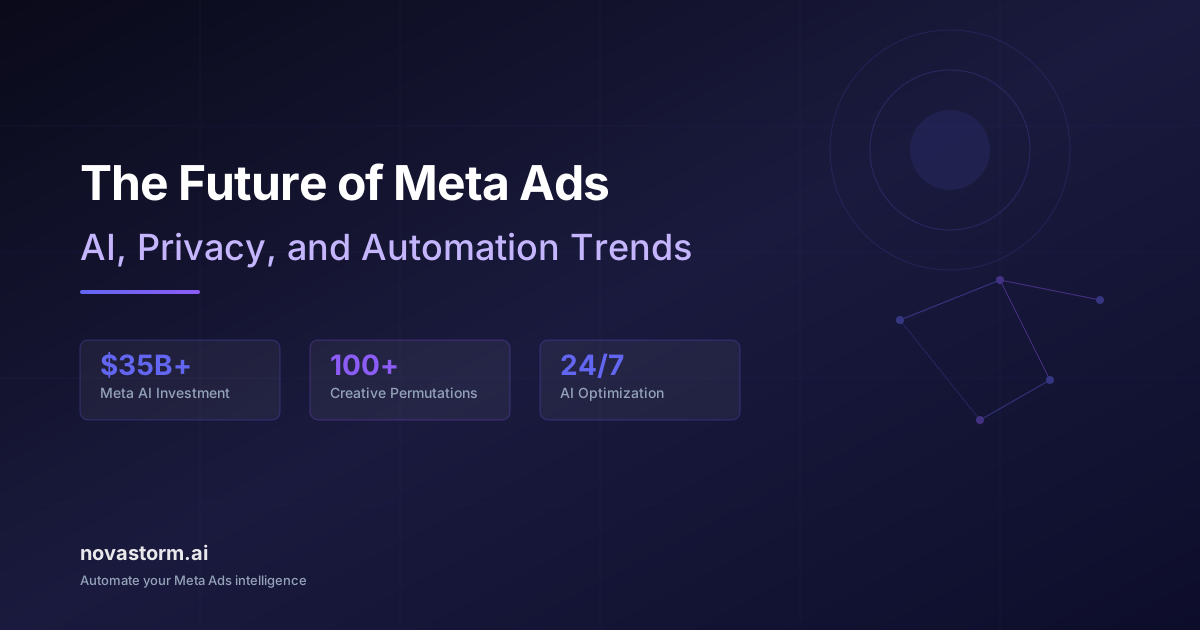
The Future of Meta Ads: AI, Privacy, and Automation Trends
Explore the future of Meta Ads shaped by AI automation, evolving privacy regulations, and machine learning. Discover key trends redefining paid social in 2026.
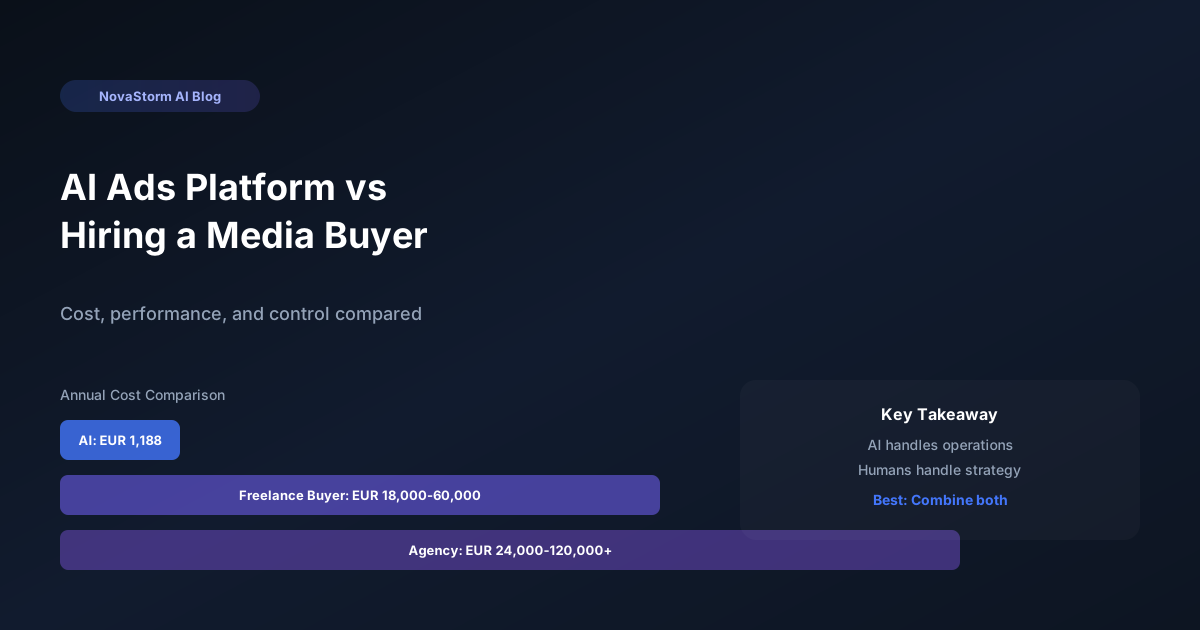
AI Ads Platform vs Hiring a Media Buyer: Cost, Performance, and Control Compared
Should you hire a media buyer or use an AI platform for Meta Ads? Comparing costs, performance, control, and scalability to help you decide.

AI Automation vs Manual Meta Ads Management: Which Approach Wins?
Comparing AI-automated Meta Ads management against manual approaches. See where automation excels, where human oversight matters, and how to combine both.