Campaign Naming Conventions for Meta Ads: Organize at Scale
Master campaign naming conventions for Meta Ads to organize at scale. Structured naming taxonomy for campaigns, ad sets, and ads with real-world examples.
Every Meta Ads account tells a story through its campaign names. In well-managed accounts, that story is clear, searchable, and instantly informative. In poorly managed accounts, it reads like a cryptic puzzle that only its original creator can decipher — and sometimes not even them.
Campaign naming conventions for Meta Ads are the foundation of account organization. They determine how quickly you can find campaigns, how effectively you can filter and report, and how seamlessly team members can collaborate. Yet naming is one of the most overlooked aspects of campaign management.
Why Campaign Naming Conventions for Meta Ads Matter
A campaign named 'Summer Sale v2 FINAL' tells you almost nothing useful. What objective does it serve? What audience does it target? What date range does it cover? Without consistent campaign naming conventions for Meta Ads, every analysis begins with a detective exercise.
The consequences extend beyond inconvenience. Poor naming leads to duplicate campaigns because team members cannot find existing ones. It makes cross-account reporting unreliable because the same campaign type has different names in different accounts. It slows down audits, increases errors, and makes automation nearly impossible.
Accounts without naming conventions accumulate technical debt rapidly. The longer you wait to implement a taxonomy, the more painful the migration becomes. Start standardizing now, even if you can only apply it to new campaigns.
Anatomy of a Strong Naming Convention
Effective campaign naming conventions for Meta Ads follow a structured taxonomy with delimiters separating each component. The most common delimiter is the pipe character (|) or underscore (_), though some teams prefer hyphens (-). Choose one and enforce it universally.
A strong naming convention encodes the information you most frequently need when scanning campaign lists. It answers who, what, where, when, and how — all within the campaign name itself.
| Component | Description | Example Values |
|---|---|---|
| Region/Market | Geographic targeting | US, UK, EU, APAC, GLOBAL |
| Funnel Stage | Campaign position in funnel | TOF, MOF, BOF, RET |
| Objective | Meta campaign objective | CONV, TRAF, REACH, LEAD |
| Audience Type | Targeting strategy | BROAD, LAL-1, LAL-5, INT, CRM |
| Product/Offer | What is being promoted | SHOES-SS26, TRIAL-7D, WEBINAR |
| Date | Launch date or flight | 2026Q1, 202602, 20260223 |
| Version | Iteration identifier | V1, V2, TEST-A |
Campaign-Level Naming Structure
The campaign level should capture the broadest strategic information. Keep it high-level — audience granularity and creative details belong at the ad set and ad levels respectively.
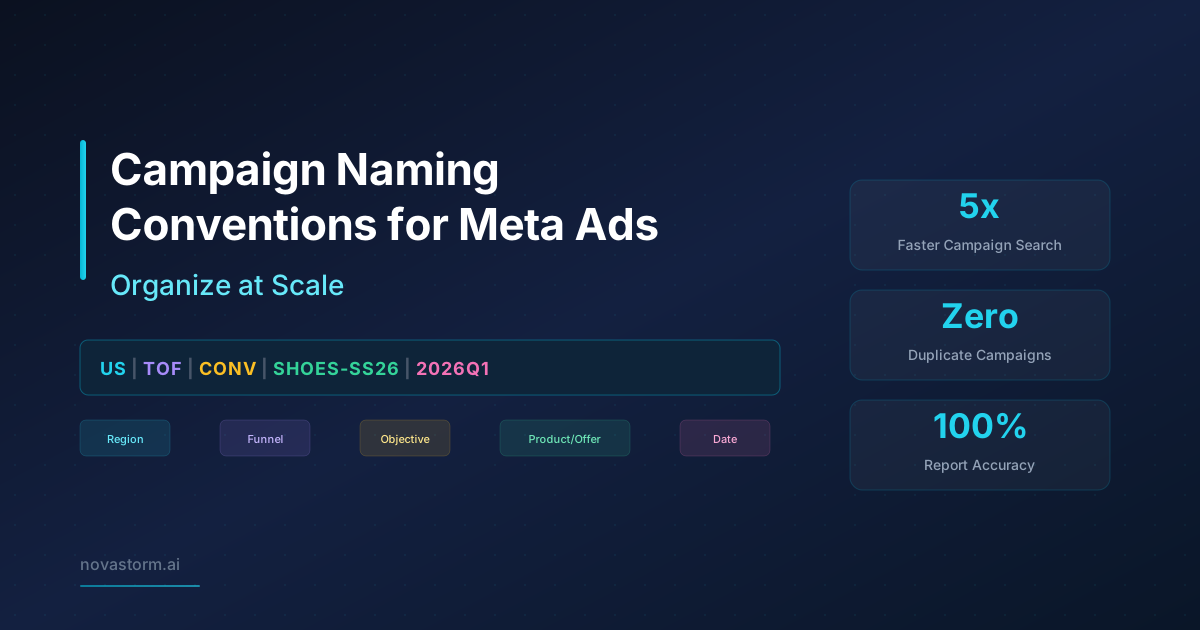
A recommended campaign naming structure follows this pattern: [Region] | [Funnel Stage] | [Objective] | [Product/Offer] | [Date]. For example: US | TOF | CONV | SHOES-SS26 | 2026Q1. This tells you everything you need to know at a glance.
Ad Set-Level Naming Structure
Ad set names should inherit context from the campaign and add targeting-specific details. The pattern becomes: [Audience Type] | [Audience Detail] | [Placement] | [Bid Strategy]. For example: LAL-1 | PURCHASERS-180D | AUTO | LOWEST-COST.
Ad-Level Naming Structure
Ad names encode creative-specific information: [Format] | [Creative Concept] | [CTA] | [Version]. For example: VIDEO-15S | TESTIMONIAL-SARAH | SHOP-NOW | V2. This makes creative performance analysis straightforward without opening each ad.
Standardized Abbreviations and Code Books
Stop wasting ad budget
NovaStorm AI cuts Meta Ads CPA by 40% on average. Start free.
Campaign naming conventions for Meta Ads only work when everyone uses the same abbreviations. Create a code book — a reference document that maps every abbreviation to its meaning. Distribute it to every team member and make it a required resource during onboarding.
- TOF / MOF / BOF / RET — Top of Funnel, Middle, Bottom, Retargeting
- CONV / TRAF / REACH / LEAD / AWR — Campaign objectives
- LAL-X — Lookalike audience with X% expansion
- INT — Interest-based targeting
- CRM — Customer list audience
- BROAD — Broad/open targeting with no interest or lookalike constraints
- AUTO / MANUAL — Placement selection
- LC / BID-CAP / ROAS — Lowest Cost, Bid Cap, ROAS target
Implementing Naming Conventions Across Teams
Rolling out campaign naming conventions for Meta Ads requires more than publishing a document. It requires enforcement. Teams that rely on voluntary compliance will see conventions degrade within weeks as shortcuts and personal preferences creep in.
Implementation should follow a structured approach. Start with a pilot period where one team adopts the convention and provides feedback. Refine based on real-world usage. Then roll out to all teams with a mandatory training session. Assign a naming convention steward who reviews new campaigns weekly.
- Draft initial naming taxonomy with input from all stakeholders
- Pilot with one team or account for two weeks
- Collect feedback and refine ambiguities
- Create the code book and training materials
- Conduct mandatory training for all team members
- Implement automated validation for new campaign names
- Assign a steward for weekly compliance reviews
- Quarterly review to update for new products, markets, or objectives
Automated Naming Validation
Manual naming enforcement is tedious and unreliable. Automated validation catches non-compliant names before campaigns go live. Validation rules check that names follow the correct structure, use approved abbreviations, and contain all required components.
Automated tools can parse campaign names against regex patterns, flag missing components, and even suggest corrections. This is particularly valuable for agencies managing multiple accounts where naming compliance scales linearly with account volume.
Use regex patterns to validate naming conventions automatically. A simple pattern like ^[A-Z]{2,5}\|[A-Z]{3}\|[A-Z]{3,5}\| can validate the first three components of your campaign names in real time.
Migrating Existing Campaigns to New Naming Conventions
Renaming hundreds of existing campaigns is rarely practical. Instead, apply the new campaign naming conventions for Meta Ads to all new campaigns going forward. For historical data, create a mapping table that translates old names to the new taxonomy for reporting purposes.
If renaming is necessary — for example, during an account restructure — do it in batches. Rename campaigns during low-activity periods and verify that no automations, rules, or external integrations break when names change. Always document the old-to-new mapping.
| Scenario | Approach | Timeline |
|---|---|---|
| New account setup | Apply conventions from day one | Immediate |
| Active account, few campaigns | Rename all during low-activity window | 1-2 days |
| Active account, many campaigns | New conventions forward, mapping table for old | Ongoing |
| Agency with multiple accounts | Phased rollout by account priority | 4-8 weeks |
| Post-acquisition integration | Align to acquiring company's taxonomy | 2-4 weeks |
Campaign naming conventions for Meta Ads are a small investment that pays enormous dividends. They transform chaotic ad accounts into organized, searchable, and analyzable systems. Every minute spent establishing and enforcing naming standards saves hours of confusion, rework, and inaccurate reporting downstream.
Start with the structure outlined above, adapt it to your specific needs, and commit to enforcement. Your future self — and every team member who touches the account — will thank you.
Novastorm AI automates Meta Ads routine — from monitoring to optimization. Learn more at novastorm.ai
Disclaimer: This article was generated with the assistance of AI and reviewed by the NovaStorm AI team. While we strive for accuracy, we recommend verifying specific data points and consulting official sources (linked where available) for critical business decisions.
Ready to automate your Meta Ads?
NovaStorm AI takes full responsibility for your campaigns — from monitoring to optimization.
Get Started FreeRelated Articles

AI Automation vs Manual Meta Ads Management: Which Approach Wins?
Comparing AI-automated Meta Ads management against manual approaches. See where automation excels, where human oversight matters, and how to combine both.
Meta Ads Delivery Issues: Why Your Campaign Is Not Running
Fix Meta Ads delivery issues with this comprehensive guide. Learn why your campaign is not running and how to resolve approval, billing, and targeting problems.
Meta Marketing API: Automating Campaign Management at Scale
Learn how to use the Meta Marketing API to automate campaign management at scale. Covers authentication, bulk operations, and real-world automation patterns.