Social Proof Widgets on Landing Pages: Boosting Meta Ad Conversions
Deploy social proof widgets on landing pages to boost Meta Ad conversions by 34%. Learn which social proof types work best for paid social traffic.
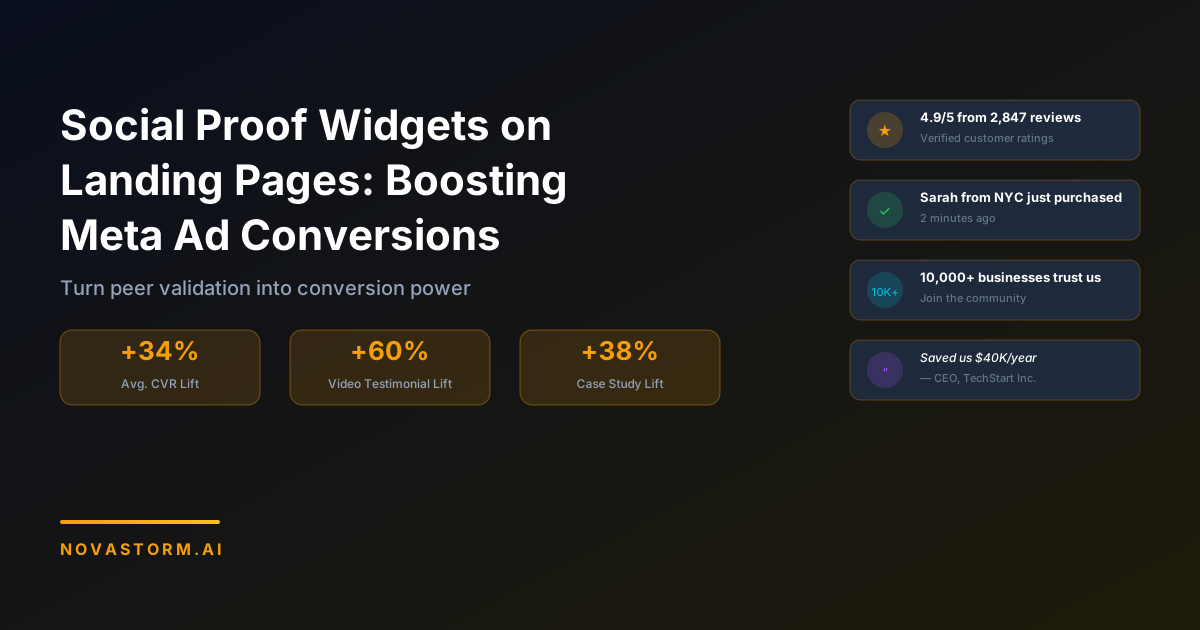
Social proof widgets are among the most effective conversion tools for Meta Ads landing pages. When visitors arrive from a social platform where peer validation drives behavior, seeing evidence of others who have already purchased, signed up, or endorsed your product creates powerful psychological momentum. Landing pages with strategically placed social proof widgets see conversion rate increases of 34% on average from Meta Ads traffic.
The effectiveness of social proof is rooted in behavioral psychology. Robert Cialdini's research established that people look to the actions of others to determine correct behavior, especially in uncertain situations. Meta Ads visitors landing on an unfamiliar brand's page are in precisely this state of uncertainty, making them highly receptive to social proof signals.
Types of Social Proof Widgets That Drive Conversions
Not all social proof is created equal. The impact varies significantly based on the type of proof, its placement, and the audience segment viewing it. Understanding which social proof formats work best for Meta Ads traffic allows you to maximize their conversion impact.
| Social Proof Type | Best For | Avg. CVR Lift | Trust Level |
|---|---|---|---|
| Customer testimonials with photos | B2C products, services | +28% | High |
| Real-time activity notifications | E-commerce, SaaS free trials | +15% | Medium |
| Review aggregate scores | Products with 100+ reviews | +22% | High |
| Client logos and brand badges | B2B services, enterprise | +19% | High |
| User count / community size | SaaS, apps, memberships | +12% | Medium |
| Before/after case studies | Fitness, beauty, results-based | +38% | Very High |
| Media mentions and press logos | New brands, thought leadership | +16% | Medium-High |
Social Proof Widgets Placement Strategy
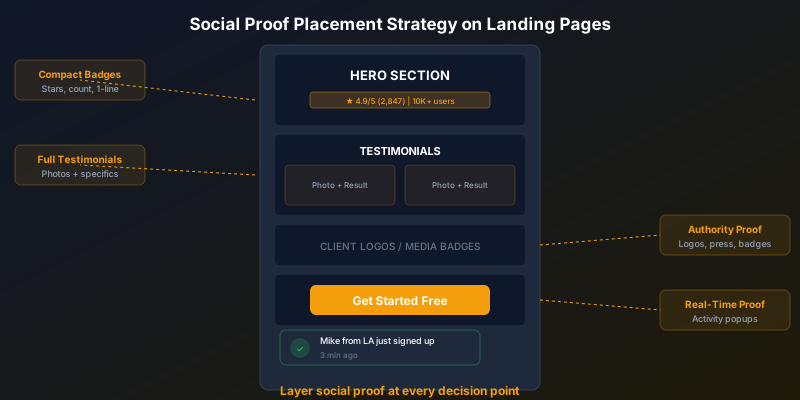
Where you place social proof on your landing page matters as much as what type you use. The optimal placement follows the visitor's decision journey: light social proof above the fold to build initial confidence, detailed proof in the middle to overcome objections, and reassuring proof near the CTA to eliminate last-second hesitation.
Above the fold, use compact signals like a star rating with review count, a customer count badge, or a single-line testimonial. These establish credibility without consuming valuable viewport space. In the middle sections, deploy full testimonials, case studies, or logo grids. Near the CTA, show real-time activity notifications or a guarantee backed by social proof.
- Above the fold: star rating badge, customer count, or one-line testimonial (compact)
- After the value proposition: 2-3 full testimonials with photos and specific results
- Near pricing or offer details: client logos or media mention badges
- Next to the form or CTA: real-time notifications (X people signed up today)
- Below the primary CTA: money-back guarantee supported by review score
- Footer area: comprehensive trust badges, certifications, and award logos
Real-Time Activity Notifications
Real-time activity notifications, those small popups showing recent purchases or signups, are particularly effective for Meta Ads traffic. They create urgency and social validation simultaneously. When a visitor from Instagram sees that 12 people purchased this product in the last hour, it activates both fear of missing out and herd behavior.
Implement these notifications authentically. Fake notifications are detectable and destroy trust instantly. Use real data, display actual customer first names and locations, and show genuine timestamps. Tools like Proof, TrustPulse, and Fomo integrate with most e-commerce platforms and landing page builders.
Limit real-time notifications to one popup every 15-20 seconds on mobile. More frequent popups feel spammy and can obstruct the page content, leading to higher bounce rates instead of conversions.
Testimonials That Convert Meta Ads Traffic
Stop wasting ad budget
NovaStorm AI cuts Meta Ads CPA by 40% on average. Start free.
Generic testimonials like Great product, highly recommend have minimal impact. Effective testimonials for Meta Ads landing pages are specific, relatable, and results-oriented. They include the customer's photo, full name, and a concrete outcome that mirrors what the ad promised.
Structure your testimonials to address the specific objections your Meta Ads audience might have. If your ad targets small business owners, feature testimonials from small business owners who describe their specific results. Match the testimonial demographics to your ad audience for maximum relevance.
| Testimonial Element | With Element | Without Element | Impact |
|---|---|---|---|
| Customer photo | 4.2% CVR | 3.1% CVR | +35% |
| Specific numbers/results | 4.8% CVR | 3.4% CVR | +41% |
| Full name (not initials) | 3.9% CVR | 3.2% CVR | +22% |
| Company/role mentioned | 4.1% CVR | 3.3% CVR | +24% |
| Video testimonial | 5.6% CVR | 3.5% CVR | +60% |
Social Proof for Different Funnel Stages
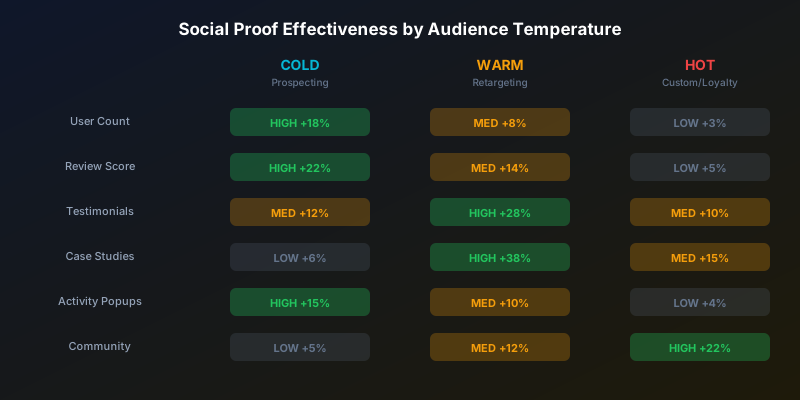
Meta Ads campaigns target users at different funnel stages, and the type of social proof that resonates changes accordingly. Cold prospecting audiences respond best to high-volume signals: user counts, review aggregates, and brand recognition. They need proof that your brand is legitimate and widely used.
Warm retargeting audiences already know your brand. They need social proof that addresses their specific hesitation. Detailed case studies, comparison testimonials (I switched from X to this), and results-oriented proof work best. Custom audiences and past customers respond to community proof and loyalty signals.
Measuring Social Proof Widget Performance
Track the impact of social proof widgets with controlled A/B tests. Remove all social proof from a variant and compare conversion rates against the full-proof version. This gives you the aggregate lift. Then test individual social proof elements to identify which types drive the most value for your specific audience.
Monitor engagement metrics for each social proof element. Scroll depth data reveals whether users pause at testimonial sections. Click-through rates on review widgets show active engagement. Heatmaps indicate which testimonials attract the most attention. Use these signals to continuously optimize your social proof strategy.
- A/B test pages with and without social proof to measure aggregate conversion lift
- Test individual social proof types in isolation to identify top performers
- Track scroll depth to confirm users are seeing your social proof sections
- Monitor click engagement on review widgets and testimonial carousels
- Refresh testimonials quarterly to prevent staleness and maintain relevance
- Segment social proof performance by Meta Ads audience type (prospecting vs retargeting)
Request testimonials that specifically mention the transformation or result your Meta Ads promise. When the ad says Save 10 hours per week and the testimonial says I save 12 hours per week, the conversion impact is 3x stronger than a generic positive review.
Social proof widgets transform Meta Ads landing pages from sales pitches into peer-validated experiences. By choosing the right types of social proof, placing them strategically along the conversion path, matching proof to audience temperature, and measuring their impact rigorously, you can unlock significant conversion gains from your existing Meta Ads traffic. Start with customer testimonials and real-time notifications, then expand your social proof toolkit based on performance data.
Novastorm AI automates Meta Ads routine — from monitoring to optimization. Learn more at novastorm.ai
Disclaimer: This article was generated with the assistance of AI and reviewed by the NovaStorm AI team. While we strive for accuracy, we recommend verifying specific data points and consulting official sources (linked where available) for critical business decisions.
Ready to automate your Meta Ads?
NovaStorm AI takes full responsibility for your campaigns — from monitoring to optimization.
Get Started FreeRelated Articles
Herd Mentality in Meta Ads: Using Crowd Behavior to Boost Conversions
Leverage herd mentality in Meta Ads to boost conversions. Learn how crowd behavior, social proof, and bandwagon tactics increase CTR by 43% and drive action.
Post-Click Conversion Optimization for Meta Ads
Learn post-click conversion optimization strategies for Meta Ads that boost landing page performance by up to 47%. Actionable techniques for higher ROAS.
A/B Testing Landing Pages for Meta Ads Traffic
Learn how A/B testing landing pages for Meta Ads traffic can boost conversions by 30-50%. Step-by-step framework with sample sizes, duration, and tools.