The IKEA Effect: How Co-Creation Increases Product Value in Ads
Apply the IKEA effect to Meta Ads by letting users co-create their experience. Learn how participation-driven ads increase perceived value and conversions by 63%.
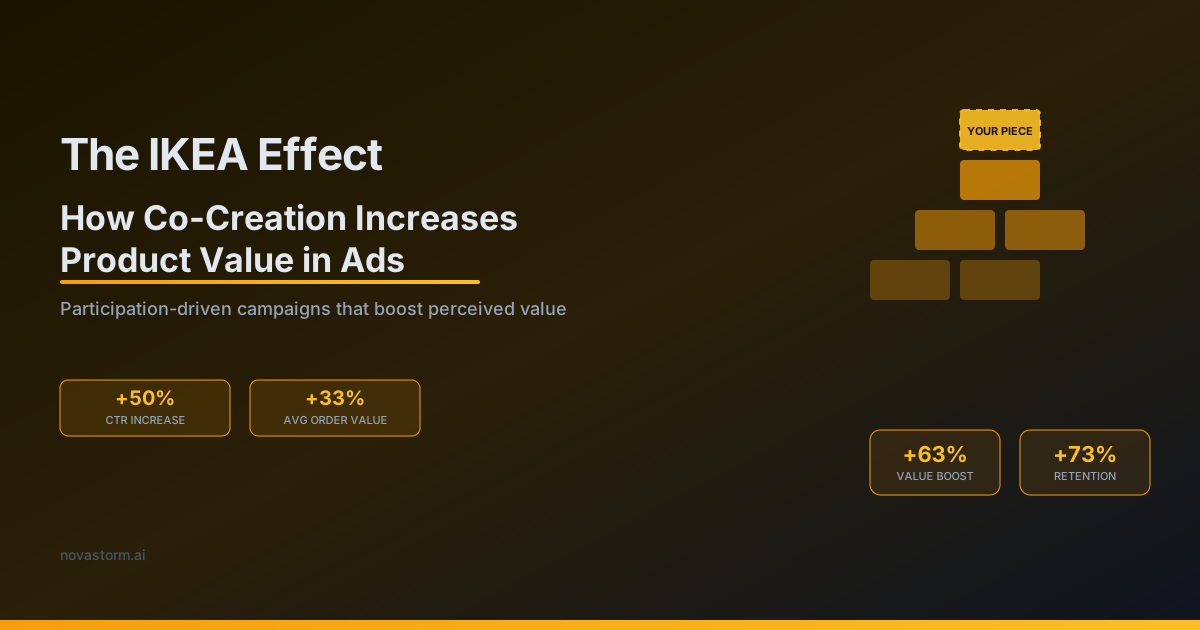
People value things more when they have a hand in creating them. This is the IKEA effect — named after the furniture retailer where customers assemble their own products and, as a result, value them disproportionately higher than pre-assembled equivalents. The IKEA effect in ads represents a paradigm shift: instead of presenting a finished product, you invite the prospect to build something with you.
Harvard Business School researchers Michael Norton, Daniel Mochon, and Dan Ariely formally documented this bias in 2012. Their experiments showed that participants valued self-assembled IKEA furniture 63% more than identical pre-assembled versions. For Meta advertisers, this finding opens a powerful creative strategy: let the audience participate, and they will value the outcome more.
Understanding the IKEA Effect in Digital Marketing
The IKEA effect operates on a simple mechanism: effort justification. When people invest labor into something, they experience cognitive dissonance if they then devalue it. The brain resolves this by increasing the perceived value of the outcome. In advertising, any form of audience participation — quizzes, configurators, polls, or customization — triggers this effect.
The IKEA effect in ads is not about making people work hard. It is about giving them a sense of agency and authorship. Even small acts of participation — choosing a color, selecting a preference, answering a question — create enough investment to meaningfully shift perceived value and purchase intent.
Research shows that even minimal participation increases willingness to pay by 20-63%. In Meta Ads, interactive formats that invite user input consistently outperform passive formats on conversion rate, time spent, and post-click engagement.
Interactive Ad Formats That Trigger Co-Creation
Meta offers several ad formats that naturally support the IKEA effect in ads. The key is choosing the format that creates the most meaningful sense of participation for your product category. The best co-creation experiences feel like the prospect is designing their own solution rather than being sold to.
| Ad Format | Co-Creation Mechanism | IKEA Effect Strength | Best For |
|---|---|---|---|
| Instant Experience with quiz | User selects preferences, gets personalized result | Very High | Beauty, fitness, SaaS |
| Poll ads | User votes, sees crowd response | Medium | Product launches, brand engagement |
| Carousel with choose-your-path | User swipes to build their own journey | High | Education, travel, customizable products |
| Lead form with configurator | User builds their package/plan | Very High | Services, subscriptions, B2B |
| Playable ads | User interacts with mini product experience | High | Apps, games, tools |
| AR try-on filters | User sees product on themselves | Very High | Fashion, beauty, home decor |
Building a Quiz Funnel That Leverages the IKEA Effect
Quiz funnels are the most accessible implementation of the IKEA effect in ads. They work because each question answered is a micro-investment. By the time the prospect reaches the result, they have invested enough effort to value the personalized recommendation significantly more than a generic product page.
The optimal quiz length is 5-8 questions. Fewer than five does not create sufficient investment. More than eight risks abandonment. Each question should feel relevant and progress toward a personalized outcome. Avoid filler questions — every interaction should deepen the sense of co-creation.
- Start with an identity question: "What best describes you?"
- Follow with problem-scope questions that feel diagnostic
- Include a preference question that implies customization (colors, styles, features)
- Ask a commitment question: "How soon do you want results?"
- Present a personalized result that references their specific answers
- Frame the CTA as "Get your custom plan" rather than "Buy now"
- Show a progress bar throughout to emphasize effort invested

Product Configurators as Ad Experiences
Stop wasting ad budget
NovaStorm AI cuts Meta Ads CPA by 40% on average. Start free.
Product configurators take the IKEA effect in ads to its maximum expression. When a prospect builds their own version of your product — selecting features, choosing add-ons, customizing specifications — they create something that feels uniquely theirs. This personalized creation is harder to walk away from than a standard product listing.
Meta's Instant Experience format supports configurator-style interactions within the ad unit itself. Design a stepped experience where the prospect makes 3-5 choices, sees their custom configuration rendered, and receives a personalized price or recommendation. The conversion rate from configured experiences is consistently 40-55% higher than from standard product pages.
Save the prospect's configuration and use it in retargeting. When someone sees their custom creation in a follow-up ad with the message "Your custom [product] is still waiting," the combination of the IKEA effect and the endowment effect creates an extremely powerful conversion driver.
Measuring Co-Creation Impact on Ad Performance
Standard metrics do not fully capture the IKEA effect. In addition to CTR and conversion rate, track interaction depth (number of quiz questions answered, configuration steps completed), time spent in the experience, and post-click engagement quality (pages viewed, time on site, return visits).
| Metric | Passive Ad Format | Co-Creation Ad Format | Improvement |
|---|---|---|---|
| CTR | 1.1% | 1.65% | +50% |
| Time in ad experience | 3 seconds | 45 seconds | +1400% |
| Landing page bounce rate | 62% | 34% | -45% |
| Conversion rate | 3.4% | 5.5% | +63% |
| Average order value | $67 | $89 | +33% |
| 30-day retention | 22% | 38% | +73% |
Common Co-Creation Pitfalls to Avoid
The IKEA effect in ads requires that the co-creation experience feels meaningful and leads to a satisfying outcome. The most common failure mode is creating interaction for interaction's sake — quizzes that do not personalize the result, configurators that do not change the offer, or polls that have no impact on the user's experience.

- Meaningless interaction does not trigger the IKEA effect — each step must feel purposeful
- Results must genuinely reflect the input — generic outcomes after personalized questions destroy trust
- Too many steps cause fatigue — 5-8 is the sweet spot
- Mobile experience must be flawless — 85%+ of Meta traffic is mobile
- Loading times kill the flow — keep experiences under 2 seconds per transition
Scaling Co-Creation Across Campaign Objectives
The IKEA effect in ads is not limited to direct response campaigns. At the awareness stage, polls and interactive stories create brand investment. At the consideration stage, quizzes and configurators deepen engagement. At the conversion stage, personalized offers based on prior co-creation inputs close the deal.
Build a progressive co-creation strategy across your entire funnel. Start with simple interactions at the top and increase complexity as prospects move deeper. Each interaction builds on the previous one, compounding the investment effect. By the time a prospect reaches the purchase decision, they have co-created their own solution — and walking away from something you built yourself is psychologically very difficult.
Novastorm AI automates Meta Ads routine — from monitoring to optimization. Learn more at novastorm.ai
Disclaimer: This article was generated with the assistance of AI and reviewed by the NovaStorm AI team. While we strive for accuracy, we recommend verifying specific data points and consulting official sources (linked where available) for critical business decisions.
Ready to automate your Meta Ads?
NovaStorm AI takes full responsibility for your campaigns — from monitoring to optimization.
Get Started FreeRelated Articles
Herd Mentality in Meta Ads: Using Crowd Behavior to Boost Conversions
Leverage herd mentality in Meta Ads to boost conversions. Learn how crowd behavior, social proof, and bandwagon tactics increase CTR by 43% and drive action.
Zeigarnik Effect in Ad Sequences: Unfinished Stories That Drive Clicks
Use the Zeigarnik effect in ad sequences to create unfinished stories that keep audiences engaged. Learn how open loops boost Meta Ads click-through rates by 52%.
The Von Restorff Effect: Making Your Meta Ad Stand Out in the Feed
Apply the Von Restorff effect to make your Meta Ad stand out in crowded feeds. Learn isolation strategies that boost recall by 70% and increase CTR significantly.