Competitive Intelligence for Meta Ads: Monitoring Rival Campaigns
Master competitive intelligence for Meta Ads with proven frameworks for monitoring rival campaigns. Learn systematic approaches to track competitor ad spend, creative, and targeting.

Competitive intelligence for Meta Ads has become one of the most valuable capabilities an advertising team can develop. In a marketplace where thousands of brands compete for the same audiences, understanding what your rivals are doing on Meta platforms gives you the strategic edge needed to outperform them. Without systematic monitoring, you are essentially running campaigns blind to the competitive landscape.
The brands that consistently win on Meta are not necessarily those with the largest budgets. They are the ones that combine strong creative execution with deep competitive awareness. By building a structured competitive intelligence framework, you transform scattered observations into actionable insights that directly improve campaign performance and return on ad spend.
Why Competitive Intelligence for Meta Ads Matters More Than Ever
The Meta advertising ecosystem has matured significantly. Average CPMs have increased by over 40% in the past three years across most verticals. Audience saturation is real. The algorithm has become more sophisticated, but so have your competitors. In this environment, competitive intelligence is not a nice-to-have; it is a fundamental component of campaign strategy.
When you monitor rival campaigns systematically, you gain visibility into messaging shifts, creative trends, promotional cadences, and audience targeting strategies before they impact your own results. This early warning system allows proactive adjustments rather than reactive scrambling when performance suddenly declines.
| Intelligence Category | What to Monitor | Strategic Value |
|---|---|---|
| Creative Strategy | Ad formats, copy themes, visual styles | Identify messaging gaps and creative opportunities |
| Offer Structure | Discounts, bundles, free trials | Anticipate competitive pricing pressure |
| Targeting Signals | Audience overlap, placement choices | Discover untapped audience segments |
| Campaign Cadence | Launch timing, seasonal patterns | Plan counter-campaigns and pre-empt competitors |
| Ad Volume | Number of active ads, refresh frequency | Gauge competitor investment and commitment |
| Landing Pages | Post-click experience, conversion flows | Benchmark full-funnel competitor strategy |
Building Your Competitive Monitoring Framework
An effective competitive intelligence system for Meta Ads requires structure. Ad hoc competitor checks deliver fragmented insights. A systematic framework ensures consistent coverage and longitudinal trend analysis that reveals strategic patterns invisible in snapshot views.
- Define your competitive set: Identify 5-10 direct competitors and 3-5 aspirational brands in adjacent categories
- Establish monitoring cadence: Weekly checks for active competitors, monthly deep-dive analysis for strategic planning
- Create a tracking database: Log competitor ads with dates, creative types, messaging themes, and offers
- Set up automated alerts: Use third-party tools to receive notifications when competitors launch new campaigns
- Assign ownership: Designate a team member responsible for competitive intelligence updates and reporting
- Build a reporting template: Standardize how insights are shared across the marketing organization
Core Tools for Monitoring Rival Meta Campaigns
Meta's own Ad Library is the starting point, but serious competitive intelligence requires supplementary tools. Each tool in your stack serves a different purpose, from creative monitoring to spend estimation and audience overlap analysis.
The Ad Library provides transparency into every active ad on Meta platforms. Third-party tools like Pathmatics, Sensor Tower, and Semrush add layers of intelligence including estimated spend data, audience demographic breakdowns, and historical trend analysis. Combining these sources creates a comprehensive competitive picture.
Always cross-reference data from multiple tools. Estimated spend figures from third-party platforms are directionally accurate but not precise. Use them for relative comparisons between competitors rather than absolute budget figures.
Analyzing Competitor Creative Patterns
Creative analysis is where competitive intelligence for Meta Ads delivers the most immediate value. When you systematically catalog competitor ads, patterns emerge: which formats they favor, how often they refresh creative, what messaging angles they test, and which ads run longest indicating strong performance.
Stop wasting ad budget
NovaStorm AI cuts Meta Ads CPA by 40% on average. Start free.
Long-running ads are particularly valuable signals. If a competitor has been running the same ad for 60+ days, it is almost certainly performing well. Analyze these evergreen ads closely for structural elements, copy frameworks, and visual techniques you can adapt for your own campaigns.
- Track ad longevity: Ads running 30+ days are likely winners worth studying
- Catalog format preferences: Note shifts between video, carousel, static image, and collection ads
- Map messaging themes: Identify whether competitors lead with price, quality, social proof, or urgency
- Monitor CTA evolution: Changes in calls-to-action often signal funnel strategy shifts
- Screenshot and timestamp: Build a visual archive for longitudinal creative trend analysis
Translating Intelligence into Campaign Action
Raw competitive data is worthless without a clear translation process that converts observations into campaign decisions. Every competitive insight should pass through three filters: relevance to your brand positioning, feasibility given your resources, and potential impact on key performance metrics.
The goal is not to copy competitors. It is to identify whitespace opportunities where competitors are absent, counter-position against their weaknesses, and anticipate their next moves. Brands that simply mimic competitor creative end up in a race to the bottom. Brands that use intelligence strategically find differentiation opportunities.
| Competitor Signal | Possible Action | Expected Impact |
|---|---|---|
| Competitor increases ad volume | Raise frequency caps, test new audiences | Maintain share of voice |
| New messaging angle appears | Test counter-messaging, reinforce unique value | Differentiated positioning |
| Competitor drops pricing | Emphasize quality, add value bundles | Protect margins and brand |
| Creative format shift | Test same format with brand-native execution | Format-audience fit improvement |
| Seasonal campaign launch | Pre-empt with earlier launch timing | First-mover advantage in season |
Common Pitfalls in Competitive Monitoring
Many teams fall into predictable traps when implementing competitive intelligence programs. The most common mistake is spending excessive time collecting data without a clear action framework. Another frequent error is reactive copying rather than strategic differentiation. Competitive intelligence should inform your unique strategy, not replace it.
Avoid the imitation trap. Competitors may be running ads that perform poorly. Just because a rival is doing something does not mean it is working. Focus on ads with longevity signals rather than new launches that may be in testing phases.
Automating Competitive Intelligence at Scale
Manual competitive monitoring is unsustainable as your competitive set grows. Automation allows you to maintain comprehensive coverage without dedicating disproportionate team resources. Modern tools can track competitor ad changes, alert you to new campaign launches, and aggregate data into dashboards that highlight trends automatically.
The most effective approach combines automated data collection with human analysis. Let tools handle the monitoring and aggregation while your team focuses on interpreting patterns, identifying opportunities, and making strategic decisions. This division of labor ensures both comprehensive coverage and nuanced strategic thinking.
Building a competitive intelligence capability for Meta Ads is an investment that compounds over time. As your historical database grows, pattern recognition improves, seasonal forecasting becomes more accurate, and your team develops an intuitive understanding of the competitive landscape that accelerates decision-making across all campaign activities.
Novastorm AI automates Meta Ads routine — from monitoring to optimization. Learn more at novastorm.ai
Disclaimer: This article was generated with the assistance of AI and reviewed by the NovaStorm AI team. While we strive for accuracy, we recommend verifying specific data points and consulting official sources (linked where available) for critical business decisions.
Ready to automate your Meta Ads?
NovaStorm AI takes full responsibility for your campaigns — from monitoring to optimization.
Get Started FreeRelated Articles
Price Comparison Ads on Meta: Positioning Against Competitors
Learn how to create effective price comparison ads on Meta that position your brand against competitors. Discover legal, creative, and strategic frameworks.
Competitor Ad Spy Tools: How to Research Meta Ads Competitors
Master competitor ad spy tools for Meta Ads research. Learn systematic methods to analyze competitor creatives, targeting, and spend for better campaign performance.
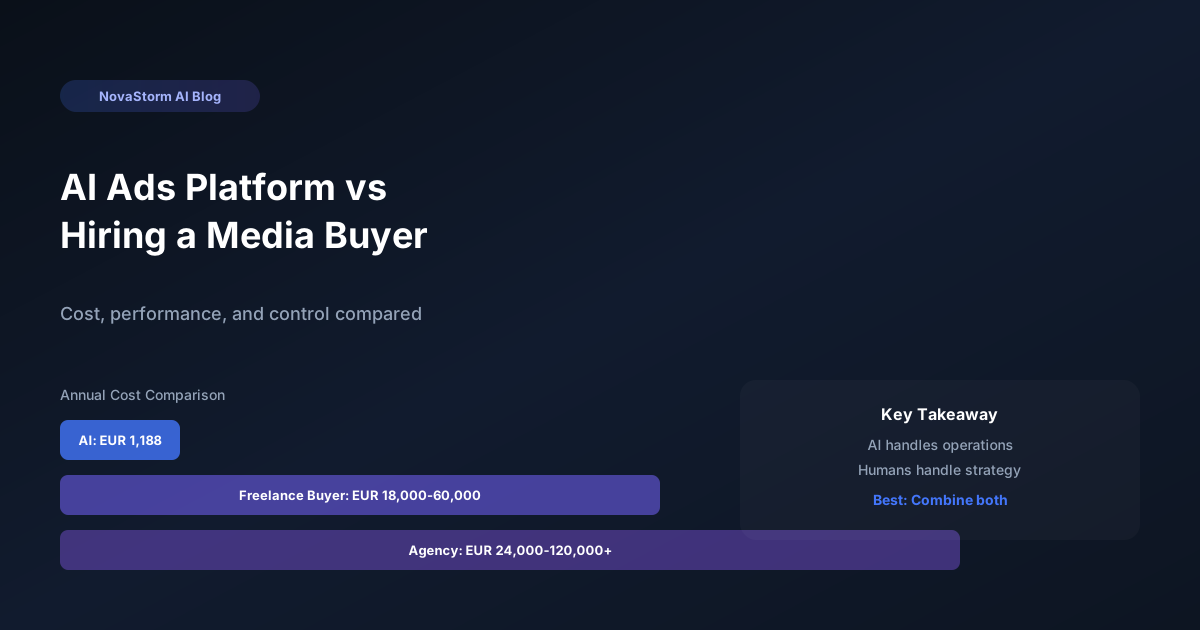
AI Ads Platform vs Hiring a Media Buyer: Cost, Performance, and Control Compared
Should you hire a media buyer or use an AI platform for Meta Ads? Comparing costs, performance, control, and scalability to help you decide.