Audience Overlap in Meta Ads: How to Diagnose and Fix It
Learn how to diagnose and fix audience overlap in Meta Ads. Understand real impact on performance, check overlap in Ads Manager, and consolidate effectively.

What Audience Overlap in Meta Ads Really Means
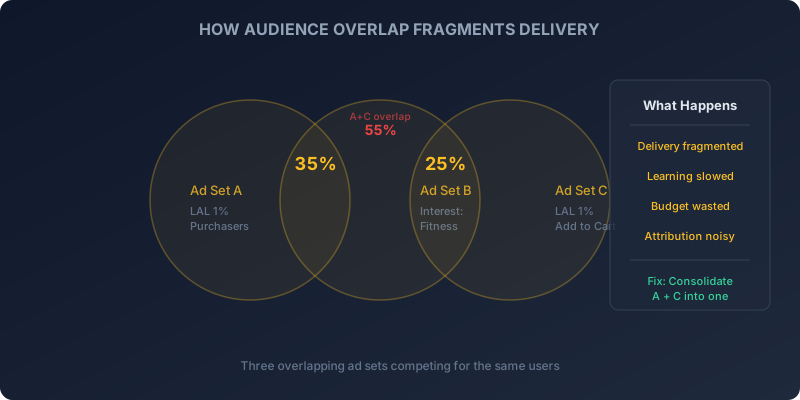
Audience overlap in Meta Ads occurs when two or more ad sets in the same account target the same people. This means you are competing against yourself in the auction, and Meta must decide which ad set gets to show its ad to that shared user. The result is inefficiency at best and inflated costs at worst.
Overlap is nearly unavoidable when you run multiple campaigns with different targeting criteria. A lookalike audience based on purchasers will share people with an interest-based audience targeting fitness enthusiasts if your customers happen to like fitness. The question is not whether overlap exists, but how much overlap is tolerable.
Most advertisers discover overlap only after noticing that scaling spend does not produce proportional results. Adding a third or fourth ad set delivers diminishing returns because each new ad set eats into the delivery of existing ones.
How Audience Overlap Actually Hurts Performance
There is a common myth that audience overlap causes your ad sets to "bid against each other" in the auction, driving up CPMs. The reality is slightly different. Meta uses an auction deduplication mechanism that prevents two ads from the same advertiser from entering the same auction for the same user.
What actually happens is that Meta picks the ad set with the highest expected value for that user and suppresses the other. This means the suppressed ad set loses delivery opportunities without you realizing it. Its budget goes unspent or is redirected to lower-quality impressions.
Overlap does not inflate CPM through self-bidding. It damages performance by fragmenting delivery, slowing the Learning Phase, and causing uneven budget utilization across ad sets.
The real damage of overlap manifests in three ways. First, ad sets exit the Learning Phase more slowly because conversion events are split across multiple overlapping ad sets instead of consolidating in one. Second, budget allocation becomes unpredictable as Meta shifts delivery between overlapping ad sets. Third, reporting becomes misleading because the same user may see ads from different ad sets, making attribution noisy.
How to Check Audience Overlap in Ads Manager
Meta provides a built-in tool to check audience overlap, but it is buried in the Audiences section rather than in the campaign view where most advertisers spend their time.
- Navigate to Meta Ads Manager and click Audiences in the left menu
- Select two saved audiences by clicking their checkboxes
- Click the three-dot Actions menu above the audience list
- Select Show Audience Overlap from the dropdown
- Review the overlap percentage and the number of shared users
- Repeat for other audience pairs to build a complete overlap map
The overlap tool only works with Saved Audiences. If you use Advantage+ or detailed targeting directly in ad sets without saving as audiences first, you cannot check overlap this way. Save your targeting as audiences before launching to enable overlap analysis.
When reviewing overlap data, focus on the percentage rather than the absolute number. An overlap of 200,000 people sounds large, but if both audiences are 5 million people, that is only 4% overlap, which is perfectly acceptable. An overlap of 50,000 between two audiences of 100,000 each is 50%, which is a serious problem.
Audience Consolidation Strategy to Eliminate Overlap
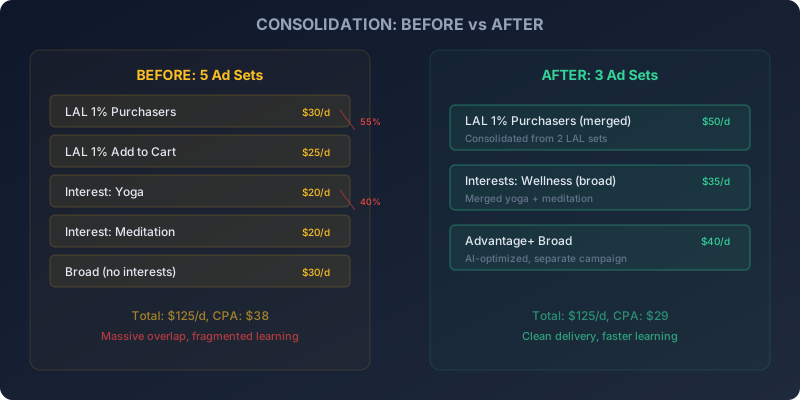
Consolidation is the primary solution for audience overlap. Instead of running five ad sets with overlapping targeting, merge them into two or three with distinct, non-overlapping audiences.
The consolidation process starts with mapping your current ad sets and their targeting criteria. Identify which audiences share the most overlap. Then decide which to merge and which to differentiate through exclusions.
Stop wasting ad budget
NovaStorm AI cuts Meta Ads CPA by 40% on average. Start free.
| Before Consolidation | Overlap Issue | After Consolidation |
|---|---|---|
| Ad Set 1: Interest - Yoga | 45% overlap with Set 2 | Merged into single broad interest ad set |
| Ad Set 2: Interest - Meditation | 45% overlap with Set 1 | Merged into single broad interest ad set |
| Ad Set 3: LAL 1% Purchasers | 30% overlap with Set 4 | Keep, exclude Set 4 custom audience |
| Ad Set 4: Website visitors 30d | 30% overlap with Set 3 | Keep, exclude Set 3 LAL seed |
| Ad Set 5: LAL 3% Purchasers | 60% overlap with Set 3 | Removed (redundant) |
The general rule is: if two ad sets have more than 30% overlap, consolidate them. If they have 15-30% overlap, add exclusions to separate them. Below 15%, leave them as is.
When Audience Overlap Is Actually Acceptable
Not all overlap is bad. Some degree of overlap is inevitable and even acceptable in certain situations. The key is understanding when overlap hurts performance and when it is a tolerable side effect of a sound strategy.
Overlap between prospecting and retargeting campaigns is normal and expected. Your retargeting audience is a subset of people who were first reached by prospecting. This is not harmful overlap; it is your funnel working as designed. Meta's auction deduplication handles this gracefully.
- Prospecting vs retargeting overlap: acceptable and expected
- Two interest-based ad sets under 15% overlap: acceptable
- Lookalike 1% vs Lookalike 3%: high overlap, consolidate to the broader one
- Same audience with different creative: better to use one ad set with multiple ads
- Two ad sets at 40%+ overlap: always consolidate or add exclusions
Practical Examples of Overlap Diagnosis and Resolution
Consider an e-commerce brand running five prospecting ad sets: LAL 1% purchasers, LAL 1% add-to-carts, interest in fashion, interest in online shopping, and broad targeting with no interests. This is a common setup that creates massive overlap problems.
The two lookalike audiences will overlap by 40-60% because add-to-cart users are a superset that includes most purchasers. The interest-based audiences overlap each other by 25-35%. And the broad targeting overlaps everything by definition.
The fix: merge the two lookalikes into one ad set using LAL 1% purchasers only. Merge the two interest audiences into one broader interest ad set. Keep the broad targeting as a separate Advantage+ campaign. You go from five overlapping ad sets to three distinct ones.
After consolidating, monitor your consolidated ad sets for 7-14 days before making further changes. Consolidation often creates a temporary dip while the algorithm re-learns, followed by improved and more stable performance.
Key Takeaways for Managing Audience Overlap
Audience overlap is a structural problem that compounds as you scale. Addressing it proactively is more effective than reacting to performance declines after the fact.
- Check audience overlap monthly using the Saved Audiences overlap tool.
- Overlap above 30% between prospecting ad sets requires consolidation.
- Overlap does not cause self-bidding, but it fragments delivery and slows learning.
- Use exclusions to differentiate audiences that naturally overlap.
- Fewer, larger ad sets outperform many small, overlapping ones.
- Prospecting-retargeting overlap is expected and acceptable.
Think of audience overlap management as structural maintenance for your ad account. It is not glamorous, but it prevents the slow degradation that erodes performance over time. Build an overlap check into your monthly account review routine and consolidate proactively.
Novastorm AI automates Meta Ads routine — from monitoring to optimization. Learn more at novastorm.ai
Disclaimer: This article was generated with the assistance of AI and reviewed by the NovaStorm AI team. While we strive for accuracy, we recommend verifying specific data points and consulting official sources (linked where available) for critical business decisions.
Ready to automate your Meta Ads?
NovaStorm AI takes full responsibility for your campaigns — from monitoring to optimization.
Get Started FreeRelated Articles
Dayparting in Meta Ads: Does Time-of-Day Targeting Still Work
Explore whether dayparting in Meta Ads still works in the age of algorithmic optimization. Learn when time-of-day targeting helps, when to avoid it, and how to analyze time performance.
Meta Ads for Startups: Budget-Friendly Scaling Strategies
Learn proven Meta Ads for startups strategies that maximize growth on limited budgets. Scale from $500 to $5K/mo with data-driven ad campaigns.
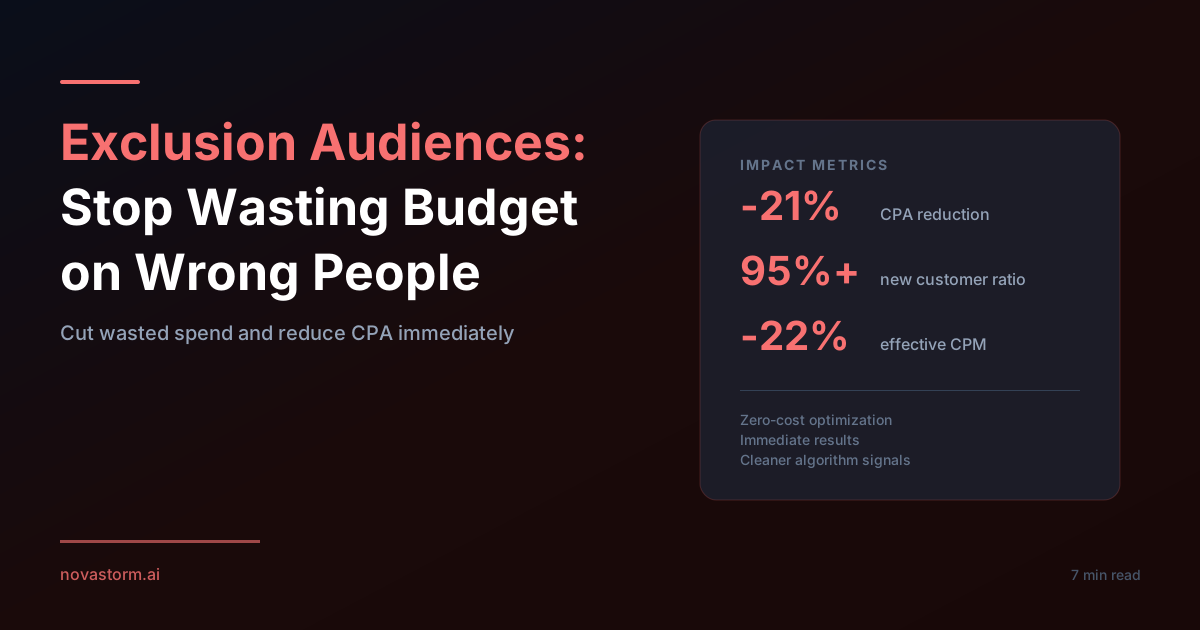
Exclusion Audiences: Stop Wasting Budget on Wrong People
Learn how exclusion audiences in Meta Ads reduce CPA and stop budget waste. Setup checklist for customer, converter, and frequency-based exclusions included.