AI and Machine Learning Product Ads on Meta: Tech Marketing
Learn how to advertise AI and machine learning products on Meta. Targeting data scientists, positioning AI tools, and building campaigns that convert tech buyers.
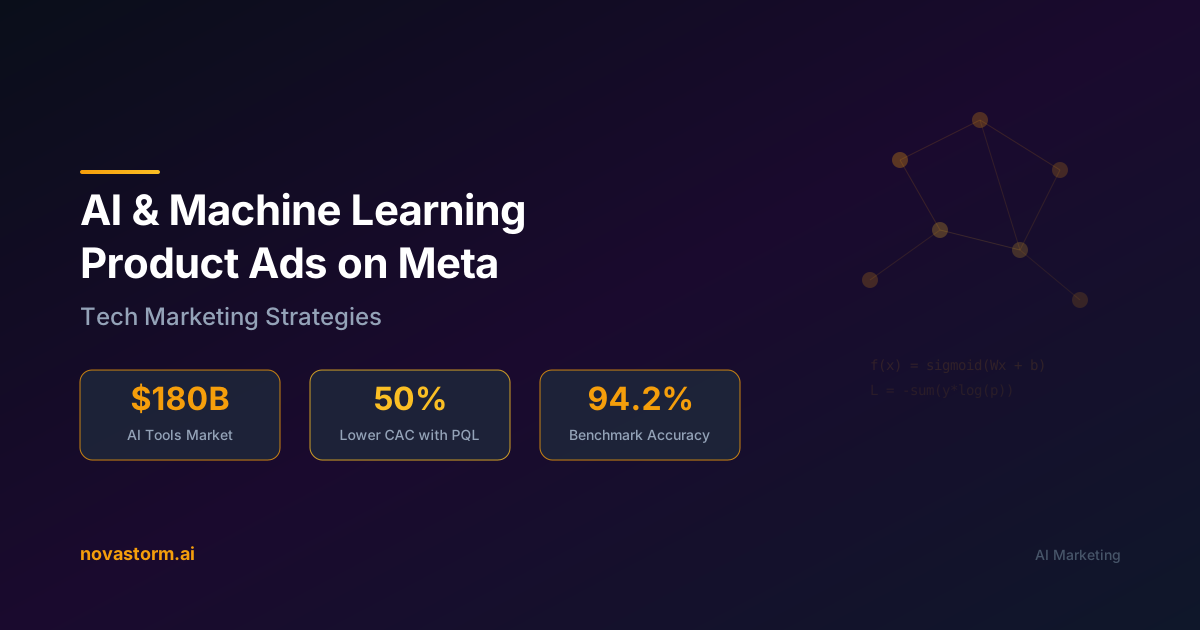
The AI and machine learning tools market has exploded to over $180 billion, with thousands of startups and established companies competing for attention. Yet cutting through the noise is harder than ever — every company claims to be "AI-powered." Running AI and machine learning product ads on Meta requires a fundamentally different approach: one that combines technical credibility with clear differentiation.
Meta's advertising platform offers unique advantages for AI product marketing. Its own machine learning infrastructure means the ad delivery system deeply understands how to optimize for technical audiences. This guide shows how to leverage that capability to reach data scientists, ML engineers, and AI-curious business leaders.
The AI Marketing Paradox on Meta
Here is the paradox: you are using AI (Meta's ad delivery system) to advertise AI products to people who build AI. Your audience understands machine learning at a deep level. They know what is technically feasible and what is marketing exaggeration. AI and machine learning product ads on Meta must respect this technical sophistication.
The companies that win are those that lead with specific capabilities rather than general AI promises. "Reduce model training time by 40% on distributed GPU clusters" resonates far more than "AI-powered efficiency."
| AI Product Category | Target Audience | Best Ad Format | Avg. CPC |
|---|---|---|---|
| MLOps Platforms | ML Engineers, Data Scientists | Video Demo | $2.50–$5.00 |
| AI APIs/SDKs | Developers, AI Engineers | Carousel + Code | $1.80–$4.00 |
| AutoML Tools | Data Analysts, Citizen Developers | Lead Gen Forms | $3.00–$6.00 |
| GPU Cloud/Compute | ML Researchers, DevOps | Comparison Ads | $2.00–$4.50 |
| AI Analytics | Business Analysts, Product Managers | Case Study Ads | $2.20–$5.50 |
Targeting AI and ML Practitioners on Meta
The AI audience on Meta is more accessible than most marketers assume. Data scientists and ML engineers are active on Instagram and Facebook, following AI researchers, engaging with ML content creators, and participating in AI community groups.
Effective targeting for AI and machine learning product ads on Meta combines role-based signals with technology-specific interests and academic connections.
- Job titles: Data Scientist, ML Engineer, AI Researcher, Head of AI, VP Data Science
- Interests: TensorFlow, PyTorch, Hugging Face, OpenAI, LangChain, MLflow
- Academic connections: Stanford AI Lab, MIT CSAIL, NeurIPS, ICML, CVPR
- Behavioral signals: Python developers, Jupyter notebook users, GPU computing interest
- Custom Audiences: arXiv paper downloaders, Kaggle competitors, ML newsletter subscribers
Creative That Resonates With Technical AI Buyers
AI product advertising requires a delicate balance between accessibility and technical depth. Go too shallow and you lose credibility with practitioners. Go too deep and you exclude the business decision-makers who approve budgets.
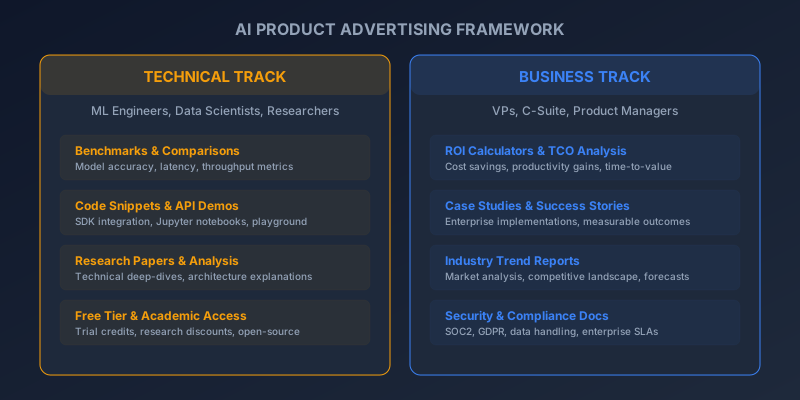
The solution is audience-specific creative. Run technical ads (model benchmarks, inference latency comparisons, integration code snippets) to ML engineer audiences. Run outcome-focused ads (cost savings, time-to-production metrics, ROI case studies) to manager and executive audiences.
Include real benchmark numbers in your ads. ML practitioners immediately dismiss vague performance claims. Show specific metrics: "GPT-4 level quality at 10x lower latency and 5x lower cost" with citation links. Specificity builds trust with technical audiences.
Campaign Structure for AI Products
Stop wasting ad budget
NovaStorm AI cuts Meta Ads CPA by 40% on average. Start free.
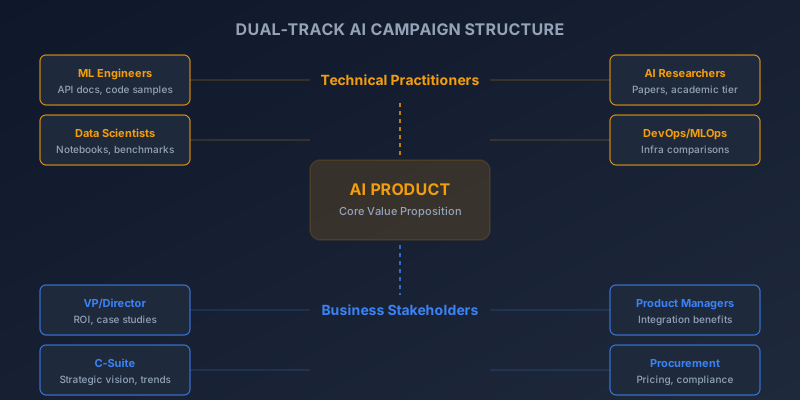
AI and machine learning product ads on Meta should follow a dual-track campaign structure. Track one targets technical practitioners who will evaluate and champion the product. Track two targets business stakeholders who control budgets and strategic decisions.
| Track | Audience | Funnel Stage | Content Strategy |
|---|---|---|---|
| Technical | ML Engineers | Awareness | Research papers, benchmark analyses |
| Technical | Data Scientists | Evaluation | Jupyter notebooks, API docs, playground |
| Technical | AI Researchers | Adoption | Free tier, academic pricing, integrations |
| Business | VPs/Directors | Awareness | Industry trend reports, market analysis |
| Business | C-Suite | Evaluation | ROI calculators, case studies |
| Business | Procurement | Decision | Pricing comparisons, security compliance |
Navigating AI Advertising Regulations on Meta
Meta has increasingly strict policies around AI-related advertising. Claims about AI capabilities must be substantiated. Ads suggesting AI can replace human judgment in sensitive areas face additional scrutiny. Deepfake-related products and AI tools for surveillance are prohibited.
Focus your ad copy on verifiable capabilities. Instead of "our AI understands everything," write "our NLP model achieves 94.2% accuracy on the SuperGLUE benchmark." Precision and honesty are both policy-compliant and more effective with technical audiences.
- Substantiate all AI performance claims with benchmark data or case studies
- Avoid implying sentience or human-equivalent intelligence
- Disclose when AI generates or modifies content in ads
- Do not promise outcomes that depend on user data quality
- Include links to technical documentation that support ad claims
Attribution and Measurement for AI Product Campaigns
AI products typically have complex evaluation cycles. A data scientist might see your ad, visit the documentation, experiment with the API over several weeks, then recommend it to their team lead. Standard 7-day click attribution misses most of this journey.
Extend your attribution window to 28 days click-through and 7 days view-through. Feed product usage events — API calls, model deployments, notebook runs — back to Meta via the Conversions API. This teaches the algorithm to find users who will actually adopt your product, not just sign up.
AI companies using product-qualified-lead (PQL) signals for Meta optimization see 50% lower cost per activated user compared to those optimizing for sign-ups alone. The key is feeding meaningful usage events back to the algorithm.
Scaling AI and Machine Learning Product Ads on Meta
The AI market evolves faster than any other tech segment. New models, capabilities, and competitors emerge weekly. Your Meta campaigns must be equally dynamic. Refresh creative every 5–7 days with updated benchmarks, new feature announcements, and competitive positioning.
Geographic expansion offers significant growth potential. AI talent is concentrated in specific hubs — Bay Area, London, Berlin, Tel Aviv, Bangalore, Beijing — but Meta lets you target these clusters precisely. Create location-specific campaigns that reference local AI ecosystem context.
Managing the velocity of AI product marketing at scale demands automation. Campaign monitoring, budget optimization, and creative rotation need to happen faster than human marketers can manage manually. AI-powered advertising tools — yes, using AI to sell AI — provide the real-time optimization needed to maintain competitive advantage in the fastest-moving tech category on Meta.
Novastorm AI automates Meta Ads routine — from monitoring to optimization. Learn more at novastorm.ai
Disclaimer: This article was generated with the assistance of AI and reviewed by the NovaStorm AI team. While we strive for accuracy, we recommend verifying specific data points and consulting official sources (linked where available) for critical business decisions.
Ready to automate your Meta Ads?
NovaStorm AI takes full responsibility for your campaigns — from monitoring to optimization.
Get Started FreeRelated Articles

Cloud Service Advertising on Meta: AWS and Azure Alternative Marketing
Discover how to advertise cloud services on Meta platforms. Strategies for marketing AWS and Azure alternatives, targeting cloud buyers, and scaling campaigns.
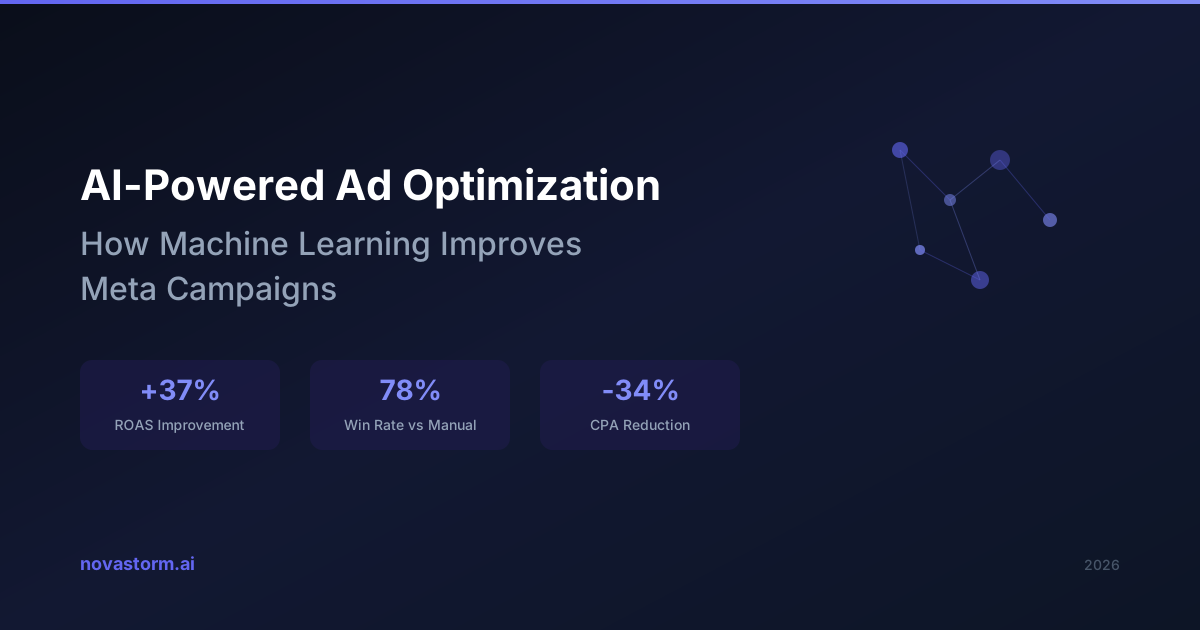
AI-Powered Ad Optimization: How Machine Learning Improves Meta Campaigns
Discover how AI-powered ad optimization uses machine learning to improve Meta campaign ROAS by 30-50%. Real strategies for automated bid, creative, and audience tuning.
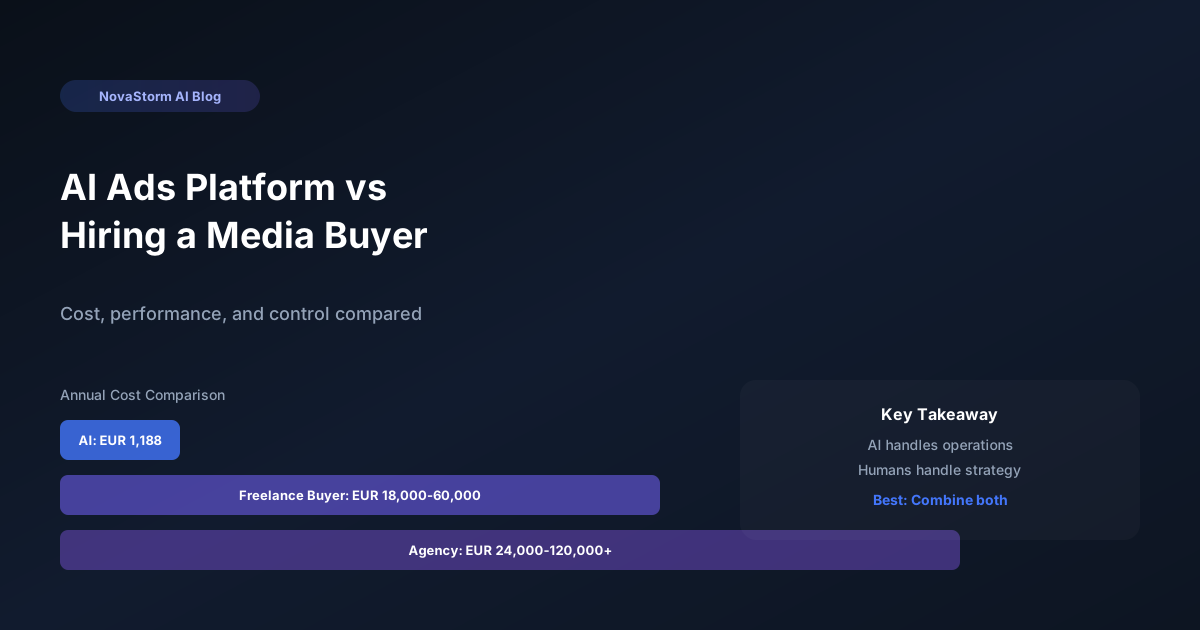
AI Ads Platform vs Hiring a Media Buyer: Cost, Performance, and Control Compared
Should you hire a media buyer or use an AI platform for Meta Ads? Comparing costs, performance, control, and scalability to help you decide.